
Mission Automotive Silicone Paste: 4 Greases Compared

Mission Automotive Silicone Paste, 8 oz is the closest match for automotive silicone paste if you want an 8-ounce dielectric grease jar with a brush in the lid. Choose another option if you need a temperature range, or a paste described for O-rings and brake components.
We earn a commission if you buy through links on this page. As an Amazon Associate I earn from qualifying purchases. Products are compared on manufacturer specifications, not hands-on testing.
- Best overall: Mission Automotive Silicone Paste, 8 oz – An 8-ounce dielectric grease paste with a lid-mounted applicator brush.
- Best for temperature range: Silicone Dielectric Grease, 8 oz – Its silicone paste is specified for -55°F to 570°F.
- Best for lower-temperature stability: Tribology Tech-Lube Silicone Paste, 8 oz – Its paste is specified to withstand temperatures up to 392°F.
| Product | Best for | Temperature range | Applicator | Shop |
|---|---|---|---|---|
| Mission Automotive Silicone Paste, 8 oz | Brush application | Wide range, unspecified | Brush in lid | Check Price on Amazon |
| Berkland Silicone Paste, 8 oz | Rubber components | Extreme, unspecified | — | Check Price on Amazon |
| Silicone Dielectric Grease, 8 oz | Wide temperature range | -55°F to 570°F | — | Check Price on Amazon |
| Tribology Tech-Lube Silicone Paste, 8 oz | Brush-equipped paste | Below freezing to 392°F | Brush included | Check Price on Amazon |
Automotive silicone paste options
Compare the size, temperature information, and applicator to match a silicone paste to the job.
Mission Automotive Silicone Paste, 8 oz
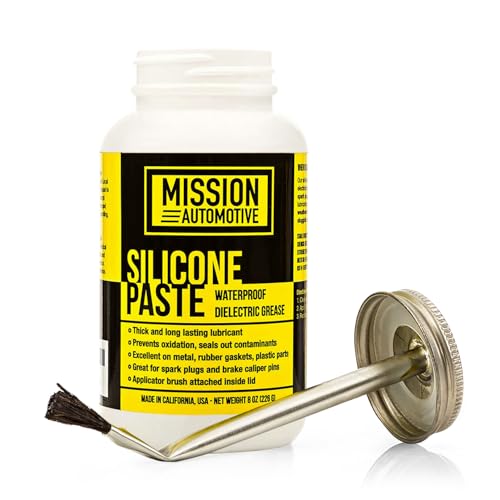
Mission Automotive Silicone Paste, 8 oz stands out for its brush integrated into the lid, which can help control application on connectors and spark plug boots. The 8-ounce container holds clear to slightly milky-white silicone dielectric grease. The maker says the paste provides waterproof sealing and helps protect against oxidation and corrosion in automotive and marine settings. This option suits buyers who want a brush and a general-purpose electrical sealant paste. Its temperature range is not quantified here, so buyers who need a specific operating limit should compare a product with a numeric range.
Bottom line: Choose this if a lid-mounted brush and an 8-ounce container are your priorities.
Berkland Silicone Paste, 8 oz

Berkland Silicone Paste, 8 oz is distinguished by its range of uses beyond electrical connectors: the maker describes it for O-rings, rubber gaskets, caliper slide pins, and plumbing components. The 8-ounce paste is described as pure silicone and waterproof; the maker says it will not swell rubber or degrade plastic components as petroleum greases can. That makes it a fit for buyers seeking one paste for seals as well as electrical moisture protection.
Bottom line: Pick this for listed O-ring, rubber gasket, and connector applications.
Silicone Dielectric Grease, 8 oz

Silicone Dielectric Grease, 8 oz separates itself with a specific operating range: -55°F to 570°F. Its non-curing silicone paste is presented for electrical connectors, battery terminals, spark plug boots, and RV or marine wiring. The maker says it helps seal out moisture, salt, and dirt and resist oxidation, corrosion, and electrical leakage. The 8-ounce container suits buyers who need a temperature span for a range of automotive or exposed wiring tasks. No applicator is identified, so those who want built-in brush control may prefer a brush-equipped option.
Bottom line: Choose this when the stated -55°F to 570°F range is decisive.
Tribology Tech-Lube Silicone Paste, 8 oz

Tribology Tech-Lube Silicone Paste, 8 oz combines a brush applicator with a upper temperature limit of 392°F. The clear silicone paste is described for connectors, battery terminals, brake calipers, sliding surfaces, gaskets, and O-rings. The maker says it resists water and remains stable without dripping or carbonizing under heat and friction. This is a useful match for buyers who want a brush and a defined high-temperature figure. The lower limit is described only as below freezing, rather than as an exact temperature, so it is less precise than a product with a full numeric span.
Bottom line: Pick this for brush application and a 392°F upper limit.
How to choose automotive silicone paste
Choose silicone paste by the surface and job first: dielectric grease is an electrical insulator, while a lubricant for moving hardware must also suit that mechanism. For connector work, use a small amount around the seal or boot to help keep moisture out; do not rely on grease to make a poor metal-to-metal electrical contact work. For rubber seals, check that the formula is explicitly suitable for rubber and plastic. A numeric temperature range matters when a part will see sustained heat or cold; compare both endpoints rather than treating an unspecified “high temperature” claim as a precise limit. A brush can help place a thin film, while a jar without one may require a separate applicator.
| Need | What to compare |
|---|---|
| Connector moisture protection | Dielectric paste and seal-compatible application |
| Rubber or plastic parts | Explicit material compatibility |
| Known hot or cold conditions | Numeric temperature endpoints |
| Controlled placement | Brush or other applicator |
Where dielectric silicone paste belongs
Dielectric grease is nonconductive, so its role is to protect and seal rather than carry current. Apply it sparingly to boots, connector seals, or the surrounding moisture barrier, and ensure the actual conductive terminals seat correctly. Spark plug grease belongs on the boot-to-insulator interface, not on the electrode or firing tip. Brake use is a separate application: a paste intended for electrical connectors is not automatically suitable for caliper pins or other moving brake hardware. Use only a formula expressly suited to the component, and keep any lubricant away from pads, rotors, and drums, where friction surfaces must remain clean.
How to apply silicone paste cleanly
Clean and dry the part before applying paste; trapped grit can abrade seals and interfere with connector fit. A thin, even film is generally preferable to filling a connector cavity, since excess can make assembly messy and prevent a seal from seating properly. Brush lids can help control the amount, but keep the brush and container free of dirt and other lubricants. On automotive electrical connections, disconnect power before service when the vehicle procedure requires it, and reconnect only after the parts are seated. For brake components, use the vehicle service procedure and keep grease strictly off friction material.
Frequently Asked Questions
Does dielectric silicone grease conduct electricity?
No, dielectric grease is an electrical insulator. Use it to seal around boots or connectors, not as a substitute for clean, correctly seated conductive contacts.
Where should spark plug dielectric grease go?
Apply a thin film at the boot-to-insulator interface rather than on the plug electrode. Keeping the firing tip and contact surfaces clean preserves the intended electrical path.
Can silicone paste be used on rubber O-rings?
Only use a formula identified as suitable for rubber and the specific application. Some silicone pastes are described for O-rings and rubber seals, but verify compatibility with the component material and service conditions.
How much dielectric grease should I apply?
Use a thin coating on the seal or boot area rather than packing the entire connector. The amount depends on connector geometry; the contacts still need to seat fully.
Can dielectric grease go on brake pads or rotors?
No, keep grease off pads, rotors, and drums because they are friction surfaces. Brake lubricant belongs only on hardware locations identified by the vehicle service procedure.