
Best Biocide for Diesel Fuel: 4 Options Compared

Power Service Bio Kleen, 16 oz is the best fit for most diesel users because its dual-phase formula works in both diesel fuel and water, where microbial contamination can collect. Choose Duda Energy Hammonds Biobor JF, 1 gal instead if you need a gallon-size container with a 1:80 treatment level, or Biobor JF, 16 oz for its lubricity and corrosion claims.
Diesel biocides target microbes in the fuel and water phases; match the product’s treatment rate to the tank volume and follow its label for safe handling.
We earn a commission if you buy through links on this page. As an Amazon Associate I earn from qualifying purchases. Products are compared on manufacturer specifications, not hands-on testing.
- Best overall: Power Service Bio Kleen, 16 oz – Its dual-phase formula is identified for both diesel fuel and water.
- Best for bulk treatment: Duda Energy Hammonds Biobor JF, 1 gal – The one-gallon format is rated for up to 10,240 gallons at 1:80.
- Best for a 16-ounce size: Biobor JF, 16 oz – The maker describes dual-phase chemistry and claims added lubricity.
| Product | Best for | Container size | Stated treatment rate | Listed fuel use | Shop |
|---|---|---|---|---|---|
| Power Service Bio Kleen, 16 oz | Two-phase treatment | 16 oz | — | Diesel fuel and water | Check Price on Amazon |
| Duda Energy Hammonds Biobor JF, 1 gal | Bulk tank treatment | 1 gal | 1:80; up to 10,240 gal | Diesel, kerosene, biodiesel, heating oil | Check Price on Amazon |
| Biobor JF, 16 oz | Lubricity claims | 16 oz | — | Aviation fuels; diesel in product name | Check Price on Amazon |
| FPPF Killem, 16 oz | Microbe control claims | 16 oz | 1,280 gal per bottle | Diesel fuel | Check Price on Amazon |
Diesel Fuel Biocides Compared
Compare the container sizes, stated treatment rates and fuel uses before selecting a diesel biocide.
Power Service Bio Kleen, 16 oz

Power Service Bio Kleen, 16 oz stands out for its dual-phase formulation, which the maker says is effective in both diesel fuel and water. The 16-ounce bottle is a manageable choice for owners treating a smaller tank or keeping a container on hand. The specifications also do not identify other fuel types, so choose it for diesel rather than assuming compatibility with gasoline or heating oil.
Bottom line: Choose this if treatment across both diesel and water phases is your priority.
Duda Energy Hammonds Biobor JF, 1 gal

Duda Energy Hammonds Biobor JF, 1 gal is the bulk-size option, with a one-gallon container and a 1:80 treatment level for up to 10,240 gallons. The maker lists diesel, kerosene, biodiesel and home heating oil among compatible fuels, giving it broader stated use than the diesel-specific options. Its claims also include preventing sludge formation and tank corrosion. A gallon container is a poor match for a small occasional treatment if you do not need that volume; check that the precise dose on the package matches the amount of fuel being treated.
Bottom line: Choose this for a large fuel volume or one of its additional listed fuel types.
Biobor JF, 16 oz

Biobor JF, 16 oz differentiates itself with explicit claims about lubricating injectors and fuel pumps, alongside its dual-phase chemistry. The maker claims it prevents microbial growth and fuel-system corrosion and can extend filter life; these are performance claims, not a substitute for checking suitability for a particular engine. Its treatment ratio is not included here, so verify the label dose against your tank volume before selecting it for a planned treatment.
Bottom line: Choose this if its injector-lubricity claims and 16-ounce size fit your needs.
FPPF Killem, 16 oz
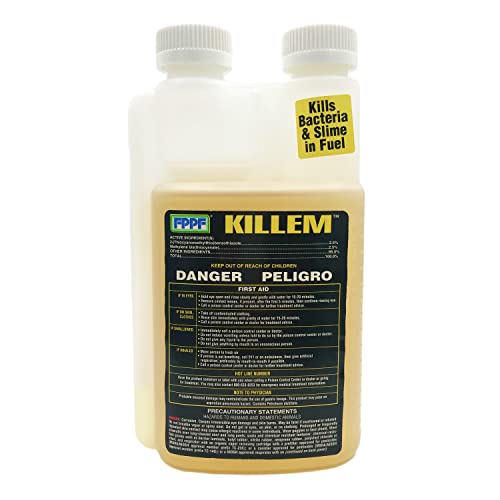
The maker also says it controls bacteria and fungi and reduces corrosion and slime. That makes the treatment volume useful for planning a larger tank dose, but note that the product name gives a different figure of 1,920 gallons per bottle. Resolve that mismatch on the container label before dosing, especially when treating a tank near either stated limit.
Bottom line: Choose this if a per-bottle treatment volume is useful, after verifying the conflicting figures.
How to choose a diesel fuel biocide
Choose a diesel biocide by matching its treatment dose to the fuel volume and deciding whether it needs to cover both fuel and water phases. Microbes tend to grow at the fuel-water interface, so draining accumulated water and cleaning contamination are important parts of tank care; biocide alone does not remove sludge or water. For a tank holding 1,000 gallons, for example, a 1:1,000 dose calls for 1 gallon of additive, while a 1:80 dose calls for 12.5 gallons. Read the container label for exact directions and protective equipment. The features here give a 1:80 rate for one option and a per-bottle figure for another, while others require label verification.
Fuel-water contamination and tank maintenance
Diesel fuel contamination is most likely where water settles at the tank bottom or meets the fuel, creating a place for bacteria and fungi to grow. Water can enter through condensation, leaking caps or contaminated deliveries; removing free water helps reduce the conditions that support growth. A biocide kills susceptible microbes but does not reliably clear existing biomass from filters, lines or tank surfaces. If a tank already has sludge or repeated filter plugging, inspect and clean the system rather than simply adding more treatment. For stored fuel, check for water and sediment periodically, and use a water-separating filter where the engine system is designed for one.
Compare common diesel biocide treatment formats
Container size and treatment concentration determine how practical a biocide is for a particular tank. The table separates the treatment figures from products whose dosing needs label confirmation.
| Format | What to match | Decision rule |
|---|---|---|
| 16-ounce bottle with gallon rate | Gallons treated per bottle | Use only after confirming the label rate matches your tank volume |
| 1-gallon concentrate, 1:80 | Bulk fuel volume and dose | Best suited to volumes where a gallon container is practical |
| Dual-phase product without a rate here | Fuel and water compatibility plus label dose | Confirm the dose before purchase if exact treatment quantity matters |
Safe handling and treatment mistakes
Diesel biocides are concentrated chemical treatments, so avoid skin and eye contact and use the protective equipment specified on the product label. Never exceed the labeled dose: more biocide does not fix water, sludge or clogged filters, and over-treatment can create compatibility problems. Add treatment in the order and conditions specified by the manufacturer, since some products require circulation through the tank to distribute evenly. Keep additives in their original, closed containers away from children, heat and ignition sources. Do not mix different biocides unless their labels explicitly allow it, and dispose of contaminated fuel or filters under local hazardous-waste rules.
Frequently Asked Questions
How often should diesel fuel biocide be used?
Use biocide according to the product label and the storage conditions, rather than on an arbitrary calendar schedule. Stored diesel that repeatedly accumulates water needs more frequent inspection and water removal; treatment cannot replace those steps.
Does diesel biocide remove water from a fuel tank?
No, a biocide does not remove free water from a tank. Water settles at the bottom, so drain it through the tank’s water drain or use the specified water-separating equipment before treating microbial contamination.
Can diesel biocide be used in biodiesel?
Some products are identified for biodiesel, but fuel compatibility is not universal. Confirm that the label names your blend, especially for blends above B20, before adding treatment.
Can diesel biocide clear clogged fuel filters?
Biocide does not physically clear a clogged filter or remove settled sludge. If filter restriction is already present, replace the filter and address tank sediment or microbial biomass before returning the engine to service.
How much biocide should I add to diesel fuel?
The amount depends on the product’s labeled concentration and fuel volume. For a 1:80 ratio, 1 gallon treats 80 gallons of fuel; measure accurately and do not apply a conflicting or unverified rate.