
Petbank Automatic Fish Feeder: Models Compared by Fit

For measured portions, choose Petbank 230/510 mL Precision Feeder, which sets servings from 0.1 to 2 g; the right Petbank automatic fish feeder depends on whether you need precise weighing, interval schedules or separate meal compartments.
Choose another model if you want a compartment-based feeder or a simpler timer rather than adjustable gram-based portions.
We earn a commission if you buy through links on this page. As an Amazon Associate I earn from qualifying purchases. Products are compared on manufacturer specifications, not hands-on testing.
- Best overall: Petbank 230/510 mL Precision Feeder – Its built-in weighing component adjusts portions from 0.1 to 2 g.
- Best for separate meals: Petbank 16-Compartment Feeder – Its 16 compartments hold up to 15 individual meals, with up to 2 g per compartment.
- Best for daily scheduling: Petbank 200 mL Feeder, Four Timers – It supports up to four feeding times per day and offers 8-, 12-, 24- or 48-hour intervals.
- Best for simple intervals: Petbank 200 mL Interval Feeder – It offers automatic feeding every 12, 24 or 48 hours, plus manual feeding.
| Product | Best for | Portion or capacity | Schedule options | Charging | Shop |
|---|---|---|---|---|---|
| Petbank 230/510 mL Precision Feeder | Measured portions | 0.1–2 g per portion | Up to 5 timers | Rechargeable | Check Price on Amazon |
| Petbank 16-Compartment Feeder | Separate meal portions | Up to 2 g per compartment | 15 individual meals | Rechargeable USB-C | Check Price on Amazon |
| Petbank 200 mL Feeder, Four Timers | Flexible daily schedules | 200 mL capacity | 8/12/24/48-hour intervals | USB rechargeable | Check Price on Amazon |
| Petbank 200 mL Interval Feeder | Simple interval feeding | 200 mL capacity | 12/24/48-hour intervals | USB-C rechargeable | Check Price on Amazon |
Petbank Automatic Fish Feeder Options
Compare each model’s portion method and feeding schedule before choosing a feeder for your aquarium.
Petbank 230/510 mL Precision Feeder
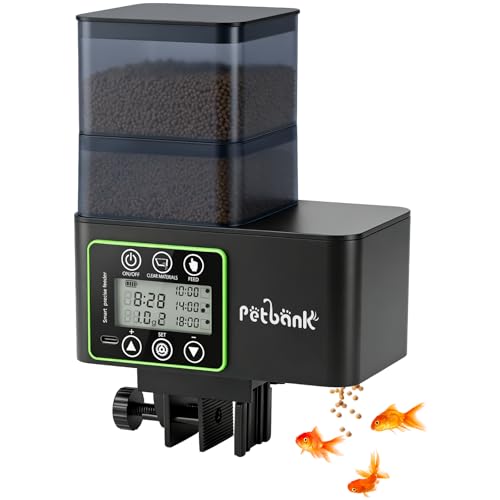
Measured serving control separates this model from Petbank’s compartment and interval feeders: its built-in weighing component sets each portion from 0.1 to 2 g, with accuracy of about ±0.1–0.2 g. The feeder is available in 230 mL and 510 mL capacities and supports up to five timers. Its self-cleaning and low-feed alert features may also suit owners who want reminders as part of the routine. Install the feeder before adding dry food; adding food first can affect portion accuracy. The measured range is a useful fit for portion-focused routines, but it is more adjustment than an interval-only setup requires.
Bottom line: Choose this model when measured portions and up to five daily timers matter most.
Petbank 16-Compartment Feeder

Separate meal compartments make this model distinct: its 16-grid design provides 15 individual meals, with up to 2 g in each compartment. That arrangement suits planned feedings with different foods or portions rather than a single bulk reservoir. The feeder can attach with an adjustable clamp base or a suction cup on the tank cover, giving two mounting approaches. Choose it when separating upcoming meals is more useful than setting a precise weight for each serving.
Bottom line: Choose this feeder when storing individual meal portions is the priority.
Petbank 200 mL Feeder, Four Timers

Daily scheduling is the key distinction here: this 200 mL feeder can be programmed for up to four feeding times per day, with one to three spins per feeding session. Its interval mode offers 8-, 12-, 24- or 48-hour cycles, and a manual button starts an immediate feed. The model is rechargeable by USB and has an LCD display. The maker says a single charge can last more than 3–6 months of continuous use. This range of timing options suits owners wanting more schedule control, though the spin setting does not provide a gram-based serving measurement.
Bottom line: Choose it for multiple daily feeding times and several interval choices.
Petbank 200 mL Interval Feeder

A simpler interval set distinguishes this 200 mL model from the four-timer version: automatic feeding can be set for every 12, 24 or 48 hours. A manual button also allows an immediate feeding. The reservoir holds 200 mL, and the feeder charges by USB; the maker says one charge lasts 3–6 months. These controls fit a routine built around repeating intervals rather than several individually programmed daily feedings. The interval choices are fewer than the other 200 mL model’s, so choose that alternative if an 8-hour cycle or up to four daily feed times is important.
Bottom line: Choose it for a 12-, 24- or 48-hour cycle with manual feeding available.
How to choose a Petbank automatic fish feeder
Choose by the feeding control you need: measured grams, separate meal compartments or a repeating timer. A weighed portion range of 0.1–2 g is useful when portion size itself must be adjusted; compartment capacity instead tells you how much each stored meal can hold. Timer count and interval length are different controls: a model with multiple daily feeding times is not interchangeable with one that only repeats a selected interval. Also check how the feeder mounts against your aquarium’s lid or rim before deciding. For dry fish food, use food that can pass through the dispensing opening; flakes and pellets are commonly used with automatic feeders, but particle size and shape affect dispensing consistency.
| Need | Control to compare | Choice direction |
|---|---|---|
| Measured serving weight | Grams per portion | Look for adjustable weighing |
| Separate stored meals | Compartment count | Look for divided food storage |
| Repeating routine | Hours between feeds | Match the interval to the routine |
Portion size and aquarium feeding
Small portions are generally safer than large dumps because uneaten food can decay and degrade aquarium water quality. A common starting point is to offer only what fish consume in about 2–3 minutes, then adjust for species, food type and tank conditions; this is a general feeding guide, not a universal ration. Pellet sizes, flakes and fish mouth size change how much food fits in a feeder’s dispensing cycle. Do not equate grams with meal count: a feeder’s portion weight or per-compartment maximum does not establish how much a particular fish should eat. Observe whether food remains uneaten, and avoid loading wet or damp food into a dry-food dispenser.
Feeder fit, food and moisture
Feeder mounting and food dryness are practical fit checks before programming a schedule. A clamp-style base needs a rim or edge it can grip, while a suction-mounted feeder needs a clean, smooth surface; confirm the mount suits your tank cover and opening. Keep the food hopper dry because humidity can make flakes or pellets clump and block a dispensing mechanism. Aquarium lids also vary in opening size, so align the feeder outlet with the feeding area rather than letting food land on the lid. Start with a short supervised cycle and check that food reaches the water; a successful timer setting alone does not confirm the food is dispensing freely.
Setting a safe feeding routine
Automatic feeding does not remove the need to monitor fish and water quality. Begin with a conservative amount, observe whether fish eat it promptly, and adjust the schedule instead of adding extra cycles to compensate for leftovers. Uneaten food should be removed because decomposing food can contribute to ammonia and other water-quality problems. Before leaving the feeder unattended, verify that the timer is correct, the outlet is unobstructed and the food is dry; test at least one full feeding cycle. A feeder’s rechargeable battery claim is not a substitute for checking its charge before an absence, and vacation feeding should not be used to justify excess portions.
Frequently Asked Questions
How much food should an automatic fish feeder dispense?
Start with only the amount fish finish in roughly 2–3 minutes, then adjust for species, food and tank conditions. Remove leftovers because decaying food can harm aquarium water quality.
Can an automatic fish feeder dispense flakes?
Many automatic feeders can dispense dry flakes or pellets, but food size and shape affect flow. Keep food dry and check a cycle to make sure flakes do not bridge or clog the outlet.
How often should aquarium fish be fed?
Many adult aquarium fish are fed once or twice daily, but species and life stage change the routine. Use a conservative schedule and watch for uneaten food rather than adding cycles automatically.
Should I test a fish feeder before vacation?
Yes; test at least one full feed cycle before leaving and confirm food reaches the tank. Also check the timer, charge and dry-food flow, since a programmed schedule cannot reveal a blocked outlet.
Can humidity clog an automatic fish feeder?
Yes; moisture can make dry flakes or pellets clump and obstruct dispensing. Keep the hopper dry, and check the outlet during a supervised cycle before relying on the feeder.