
Best Soft Start for Home AC: 3 Kits Compared

MICRO-AIR EasyStart Flex 398 is the best soft start for most home AC systems because it includes an installation kit and supports units under 6 tons. Choose SoftStart Home if you want a 70% startup-power reduction; AIRGO-G3 Soft Start is a general motor-protection module rather than a clearly specified home AC kit.
A soft starter gradually ramps compressor startup to reduce the brief current surge; confirm your AC’s tonnage and electrical compatibility before choosing.
We earn a commission if you buy through links on this page. As an Amazon Associate I earn from qualifying purchases. Products are compared on manufacturer specifications, not hands-on testing.
- Best overall: MICRO-AIR EasyStart Flex 398 – Includes an installation kit and is rated for AC units under 6 tons.
- Best for heat pumps: SoftStart Home – The maker says it works with air conditioners and heat pumps up to 6 tons.
- Best for motor protection: AIRGO-G3 Soft Start – Its feature set includes reverse-motor protection and adaptive ramp-up control.
| Product | Best for | Maximum AC size | Claimed inrush reduction | Shop |
|---|---|---|---|---|
| MICRO-AIR EasyStart Flex 398 | Most home systems | Under 6 tons | Up to 75% | Check Price on Amazon |
| SoftStart Home | AC and heat pumps | Up to 6 tons | Up to 70% | Check Price on Amazon |
| AIRGO-G3 Soft Start | Motor protection | — | Up to 70% | Check Price on Amazon |
Soft starts for home AC
Match the rated system size and installation approach to your air conditioner before comparing claimed current reduction.
MICRO-AIR EasyStart Flex 398

For a home AC system under 6 tons, MICRO-AIR EasyStart Flex 398 pairs a maximum 75% locked-rotor inrush reduction with an included installation kit. The maker says its color-coded four-wire hookup and step-by-step video support are intended to simplify installation, and it also describes generator use for central cooling systems. This is the strongest fit for buyers who want a home-and-RV kit with installation support. Its capacity is a limit, not a guarantee of compatibility with every system; verify the unit’s tonnage and wiring before choosing it.
Bottom line: Choose this if your home AC is under 6 tons and the included install kit suits your setup.
SoftStart Home
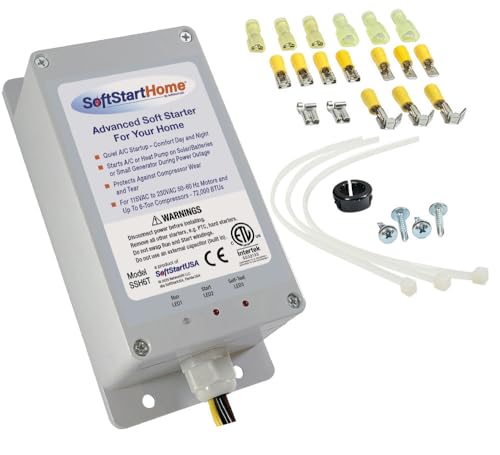
Unlike MICRO-AIR EasyStart Flex 398, SoftStart Home explicitly names both air conditioners and heat pumps, with compatibility up to 6 tons (72,000 BTUs). The maker claims up to 70% lower startup power and says the unit is designed for generator, RV, and solar power use. That combination suits a homeowner comparing AC and heat-pump applications, especially where backup power is part of the plan. The specifications do not establish an included installation kit, so buyers who need one should confirm that before ordering.
Bottom line: Choose this for an AC or heat pump within its 6-ton ceiling.
AIRGO-G3 Soft Start
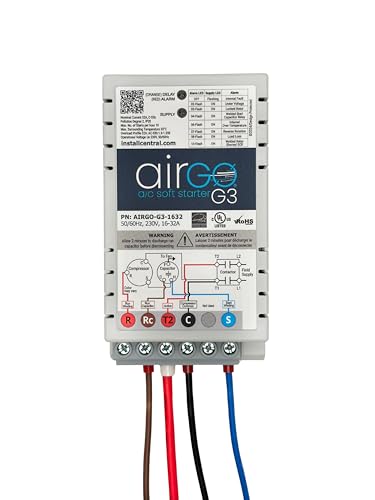
AIRGO-G3 Soft Start stands apart from the dedicated home AC kits with its advertised adaptive ramp-up and reverse-motor protection. The maker says the module can reduce inrush current by up to 70% and is designed for generators, solar, and off-grid power. Its compact dimensions are 5.5 by 3.5 by 2.5 inches, which may matter when planning enclosure space.
Bottom line: Consider this if motor protection features matter and an HVAC professional confirms AC compatibility.
How to choose a soft start for home AC
Choose by system capacity first: a kit rated up to 6 tons should not be assumed to fit a larger unit. Central air conditioner capacity is commonly expressed in tons, with 1 ton equal to 12,000 BTU per hour; check the equipment nameplate or manual for the unit’s rating. Next, compare the manufacturer’s claimed inrush-current reduction and whether the package includes installation support. Inrush current is the brief electrical surge when a compressor starts, not the unit’s steady running draw. A soft starter lowers that starting surge but does not reduce the AC’s normal cooling load. If your unit is near a capacity limit or its wiring setup is unclear, confirm compatibility with an HVAC technician before purchase.
Soft starter installation and electrical safety
Air conditioner soft starters connect to compressor electrical components, so installation involves more than attaching an external plug. AC capacitors can retain a dangerous charge after power is disconnected, and compressor terminals can expose lethal voltage; do not open the equipment cabinet unless qualified to work on HVAC electrical systems. Product claims about DIY wiring do not replace safe isolation and verification. A qualified installer can also check that the compressor and control wiring match the kit. Before selecting a kit, compare the unit’s tonnage and wiring diagram with the kit’s supported configuration. For a home AC system that uses a setup the maker does not identify, stop and verify fit rather than guessing from the enclosure size.
What soft starts change about generator use
A soft start reduces the compressor’s initial current surge, which can make startup less demanding on a generator than an unmodified start. It does not make a generator capable of supplying an undersized system: the generator still needs enough continuous output for the AC and other loads, plus suitable startup headroom. A generator’s rated running watts and starting watts are different figures, so compare both against the equipment requirements. The product claims here mention generator or off-grid use, but none supplies a generator wattage match for a particular home AC. Treat compatibility as a system-level calculation, especially if a furnace blower, refrigerator, or other large load may start at the same time.
Soft start versus hard start kits
A soft start kit controls compressor startup over a ramp, while a hard-start kit adds starting assistance to help a compressor begin turning; they are not interchangeable descriptions. Soft starts are generally chosen to lower the startup surge, including where generator or inverter limits matter. Hard-start components are often used when a compressor has trouble starting, but they do not serve the same purpose as a gradual ramp. Neither device fixes a failing compressor, poor wiring, or inadequate power supply. Match the repair to the diagnosed issue, and do not treat a current-reduction claim as proof that any AC can run from any generator.
Frequently Asked Questions
What does a soft start do to an AC compressor?
A soft start ramps compressor startup rather than allowing the full inrush surge at once. The reduction is model- and system-dependent, so use the specific kit’s capacity and claimed reduction as comparison points, not a guarantee for every unit.
Can a soft start let a generator run home AC?
A soft start can reduce the startup surge, but the generator still needs enough running watts for the AC and other active loads. Compare the generator’s starting and continuous ratings with the AC’s electrical requirements before relying on backup power.
How do I know what tonnage my AC is?
Check the outdoor unit’s nameplate or equipment documentation for capacity in BTU per hour or tons. One ton equals 12,000 BTU per hour, so 60,000 BTU per hour corresponds to 5 tons.
Can I install an AC soft starter myself?
Only attempt installation if you are qualified to work safely on HVAC electrical components and the kit matches the unit’s wiring. Capacitors can retain dangerous charge after disconnection, so homeowners without that training should use an HVAC professional.
Does an AC soft start lower running electricity use?
A soft start targets the brief compressor startup surge, not the AC’s ongoing cooling load. It should not be chosen as a way to reduce the system’s normal running electricity consumption.