
Facial Sponges for Face Washing: 5 Options Compared

For a compressed cellulose sponge for facial face washing, choose Derloyo 100-Count Cellulose Sponges if you want the largest pack, with 100 sponges; choose another option if you prefer reusable polymer or a smaller pack.
These water-activated pads expand into soft facial cleansing sponges. Use light pressure, especially on sensitive or irritated skin, rather than treating a sponge as a scrub brush.
We earn a commission if you buy through links on this page. As an Amazon Associate I earn from qualifying purchases. Products are compared on manufacturer specifications, not hands-on testing.
- Best overall: Derloyo 100-Count Cellulose Sponges – Its 100-count pack is the largest count among the cellulose options.
- Best for reusable use: Luxiv 120-Count Polymer Sponges – The maker describes this polymer sponge as reusable after washing with water.
- Best for stated dimensions: Kickleen 50-Count Pink Cellulose Sponges – Its compressed and expanded diameters are both provided.
| Product | Best for | Count | Material | Expanded size | Shop |
|---|---|---|---|---|---|
| Derloyo 100-Count Cellulose Sponges | Large cellulose pack | 100 | Cellulose | — | Check Price on Amazon |
| GAINWELL 50-Count Cellulose Sponges | Expansion detail | 50 | Cellulose | — | Check Price on Amazon |
| Kickleen 50-Count Pink Cellulose Sponges | Known pad dimensions | 50 | Cellulose | 2.9 in diameter | Check Price on Amazon |
| Luxiv 120-Count Polymer Sponges | Reusable polymer pads | 120 | Fiber polymer | 3.1 in diameter | Check Price on Amazon |
| 50-Count Pink Cellulose Face Sponges | Travel-sized pack | 50 | Cellulose | 2.9 in diameter | Check Price on Amazon |
Facial Sponges for Face Washing
Compare these compressed facial sponges by material, pack count and the product-specific use or size information provided.
Derloyo 100-Count Cellulose Sponges

Derloyo 100-Count Cellulose Sponges has a 100-count pack, making it the highest-count cellulose option here. The pads are made from wood-pulp cellulose and are intended for face washing, makeup removal and light exfoliation. The maker says the material is biodegradable and suitable for sensitive skin. This option suits someone who wants many compressed pads on hand for regular cleansing or travel.
Bottom line: Choose it if a large cellulose pack matters more than knowing the expanded pad size.
GAINWELL 50-Count Cellulose Sponges

GAINWELL 50-Count Cellulose Sponges stands out for its expansion ratio: each compressed sheet grows to 20 times its original thickness after absorbing water. Its 50-count pack is made from wood-pulp cellulose and is intended for facial cleansing, mask removal and light exfoliation. The maker says the pads are biodegradable and non-irritating. This is a good fit for buyers who value a specific expansion description over a larger pack.
Bottom line: Pick it if an expansion ratio is more useful to you than a larger pack.
Kickleen 50-Count Pink Cellulose Sponges
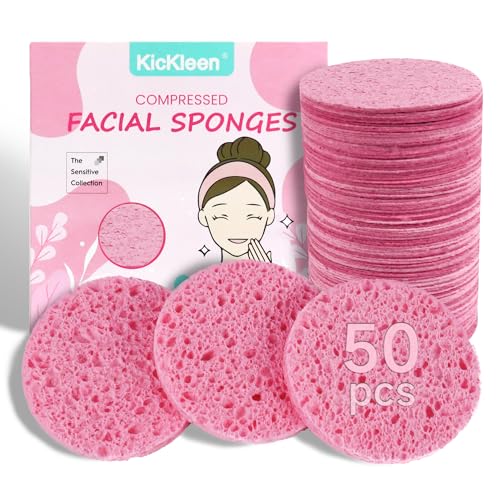
Kickleen 50-Count Pink Cellulose Sponges is the clearest choice when pad dimensions matter: the compressed round is 2.5 inches across, and it expands to 2.9 inches across by 0.3 inch thick. The 50-count pack uses cellulose made from wood pulp and is intended for daily cleansing, makeup removal and mask removal. The maker says one sponge per week can make a pack last about a year. That usage estimate depends on your routine; the tradeoff is a smaller pack than Derloyo 100-Count Cellulose Sponges for buyers who want more pads on hand.
Bottom line: Choose it if you want stated expanded dimensions for judging the pad’s size.
Luxiv 120-Count Polymer Sponges

Luxiv 120-Count Polymer Sponges differs from the cellulose options because it is made from fiber polymer and is described as reusable after rinsing with water. Its 120-count pack is the largest in this comparison, and the expanded diameter is 3.1 inches. The maker says it absorbs water in about 8 seconds when warm water is used. This suits someone who wants a reusable pad and an expanded size. The material is not cellulose, so choose another option if wood-pulp cellulose is a requirement.
Bottom line: Pick it if reusable polymer and a 3.1-inch expanded diameter fit your routine.
50-Count Pink Cellulose Face Sponges

50-Count Pink Cellulose Face Sponges pairs a 50-count pack with a diameter of about 2.9 inches and thickness of 0.32 inch. The compressed pads are made from wood-pulp cellulose and are promoted for face cleansing, makeup removal and light exfoliation, including travel use. The maker says one sponge per week can make the pack last a year.
Bottom line: Choose it if a 50-count cellulose pack with thickness suits your needs.
How to Choose a Facial Sponge for Face Washing
Start with material and how you plan to use the sponge: the options here include cellulose made from wood pulp and a fiber-polymer alternative. Compressed pads need water before use, so consider whether you want a disposable-style cellulose pad or a product explicitly described as reusable. Pack count ranges from 50 to 120 in this group, but count alone does not tell you how long a pack will last; frequency of use and replacement determine that. For a known expanded footprint, choose a sponge with a diameter, such as 2.9 or 3.1 inches. If you need to cover a specific area or fit a storage container, confirm expanded dimensions before choosing a pad whose size is not given.
Compressed Sponge Sizes and Face Fit
Expanded diameters of about 2.9 to 3.1 inches appear among the sponges with dimensions here, while compressed sizes are smaller. A round pad near 3 inches across fits in the palm and gives a manageable surface for washing cheeks and forehead; smaller areas such as around the nose still call for controlled pressure. Wet a compressed sponge fully and let it soften before using it, rather than rubbing a dry compressed pad across skin. Use gentle, short strokes and avoid scrubbing over broken, irritated or sunburned skin. If you want a specific thickness, compare the expanded measurement rather than relying on pack count: one listed pad expands to 0.3 inch thick and another is 0.32 inch thick.
Cellulose and Polymer Facial Sponges Compared
Cellulose is the fit for buyers specifically seeking plant-derived wood-pulp material; the polymer option is the one explicitly described as reusable. Use this table to match the material and size to your preference, not as a measure of cleansing performance.
| Need | Choice |
|---|---|
| Wood-pulp cellulose | Any of the four cellulose options |
| Explicitly reusable polymer | Luxiv 120-Count Polymer Sponges |
| Stated expanded diameter of 2.9 in | Kickleen 50-Count Pink Cellulose Sponges or 50-Count Pink Cellulose Face Sponges |
| Stated expanded diameter of 3.1 in | Luxiv 120-Count Polymer Sponges |
Material preference should not replace skin comfort: no cleansing pad should be used with force, and a rough or uncomfortable feel is a reason to stop using it.
How to Use and Care for a Facial Sponge
Soak a compressed facial sponge until it is fully expanded and soft, then apply cleanser or use it with water using gentle pressure. Rinse the pad thoroughly after washing so cleanser and makeup residue do not remain in its pores, then leave it to air-dry completely between uses. A damp sponge stored in a closed container can stay wet, so let it dry before packing it for travel. Replace a sponge if it develops an odor, visible residue that does not rinse away, or a damaged texture. For products described as reusable, rinse after each use and allow full drying; do not assume that a reusable claim means the pad can be sanitized by boiling or put in a washing machine.
Frequently Asked Questions
Should I use a facial sponge every day?
A facial sponge can be used during daily washing if the skin tolerates the contact, but gentle pressure matters more than frequency. Stop using it if skin becomes irritated, and avoid exfoliating over broken or inflamed skin.
How do I expand a compressed face sponge?
Soak the compressed pad in water until it softens and opens to its full shape. The GAINWELL option claims a 20-times increase in thickness, while other options provide different size details.
How often should I replace a face-washing sponge?
Replace a sponge when it develops odor, persistent residue or a damaged texture. A weekly-use estimate appears for some 50-count cellulose packs, but actual pack life changes with how often you wash and replace each pad.
Can I use a facial sponge to remove makeup?
Several of these sponges are intended for makeup removal as well as face washing. Rinse thoroughly after removing makeup, since residue can remain in a damp pad.
Are cellulose facial sponges reusable?
Cellulose material alone does not establish that a pad is meant for repeated use. Luxiv 120-Count Polymer Sponges is explicitly described as reusable; for any sponge, rinse it well and let it dry completely between uses.