
Best Rechargeable 9 Volt Batteries Compared by Capacity

HW 3600mWh Lithium 9V, 4-Pack is the best rechargeable 9 volt battery pick for most people because it combines a 3600mWh capacity with a four-slot charger and automatic shutoff. Choose another option if you need Ni-MH chemistry, USB-C charging, or batteries without a bundled charger.
Rechargeable 9V batteries use different chemistries and charging systems, so confirm that your device supports the battery type before using it.
We earn a commission if you buy through links on this page. As an Amazon Associate I earn from qualifying purchases. Products are compared on manufacturer specifications, not hands-on testing.
- Best overall: HW 3600mWh Lithium 9V, 4-Pack – Its 3600mWh capacity comes with a four-slot charger, automatic shutoff and charging safeguards.
- Best for Ni-MH capacity: EBL 1350mWh Ni-MH 9V, 4-Pack – The EBL pack states 1350mWh per battery and retains 80% capacity after three years of non-use.
- Best for USB-C charging: Quzmo 1300mAh Lithium 9V, 4-Pack – Each Quzmo battery has a built-in USB-C port and the pack includes a two-in-one cable.
| Product | Best for | Chemistry and capacity | Charging setup | Shop |
|---|---|---|---|---|
| HW 3600mWh Lithium 9V, 4-Pack | Charger included | Lithium, 3600mWh | 4-slot Micro USB charger | Check Price on Amazon |
| EBL 1350mWh Ni-MH 9V, 4-Pack | Ni-MH capacity | Ni-MH, 1350mWh | Compatible smart or universal charger | Check Price on Amazon |
| Quzmo 1300mAh Lithium 9V, 4-Pack | USB-C charging | Lithium-ion, 1300mAh | Built-in USB-C; cable included | Check Price on Amazon |
| HW 1400mAh USB-C 9V, 4-Pack | USB-C pack | Rechargeable, 1400mAh | Built-in USB-C; 4-in-1 cable | Check Price on Amazon |
| Amazon Basics 200mAh Ni-MH 9V, 4-Pack | Pre-charged Ni-MH | Ni-MH, 200mAh | Charger not included | Check Price on Amazon |
Rechargeable 9 volt batteries
Compare chemistry, capacity and charging method before choosing batteries for a particular device.
HW 3600mWh Lithium 9V, 4-Pack
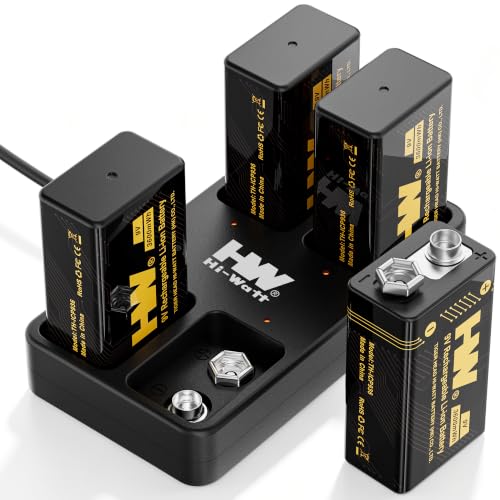
The included four-slot charger sets this apart from packs that require you to supply a charger. HW says the lithium batteries have 3600mWh capacity, can be charged in about 2.5 hours, and support more than 1000 cycles; the charger has LED status indicators and shuts off automatically when charging is complete. Built-in safeguards cover short circuit, overcharge, over-discharge and discharge overcurrent. This pack suits someone who wants to charge several batteries together. Its charger uses Micro USB, so it may not suit a setup built around USB-C charging.
Bottom line: Choose this pack if you want a bundled charger for up to four batteries.
EBL 1350mWh Ni-MH 9V, 4-Pack

The EBL pack gives a specific energy capacity for its Ni-MH batteries, unlike the other Ni-MH option here, which gives capacity in mAh. EBL says the batteries retain 80% of capacity after three years of non-use and support up to 1200 cycles. The four batteries suit devices whose manufacturer permits rechargeable Ni-MH 9V cells, including toys and game controllers. Charging requires a smart or universal charger that supports 9V Ni-MH batteries, so this is less convenient if you do not already have a compatible charger.
Bottom line: Choose this pack if you want Ni-MH batteries and have a compatible charger.
Quzmo 1300mAh Lithium 9V, 4-Pack
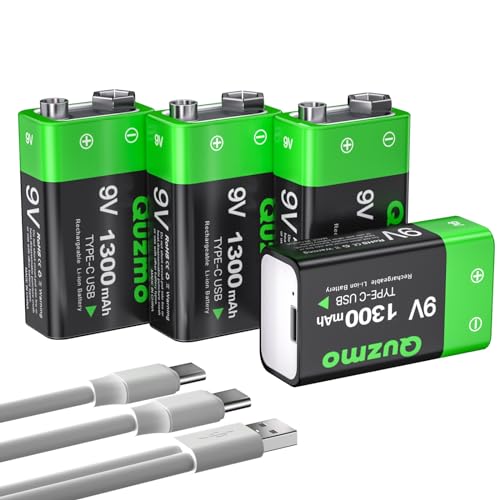
Built-in USB-C ports make the Quzmo pack distinctive: the included two-in-one cable charges the batteries without a separate battery charger. Quzmo says the cells have 1300mAh capacity and can be recharged more than 1200 times; built-in LEDs indicate charging status. That setup suits people who prefer charging through a USB-C cable rather than a multi-slot charger. The capacity is expressed in mAh, not mWh, so it cannot be compared directly with the energy figures given for some other packs without voltage information.
Bottom line: Choose this pack if built-in USB-C charging is your priority.
HW 1400mAh USB-C 9V, 4-Pack
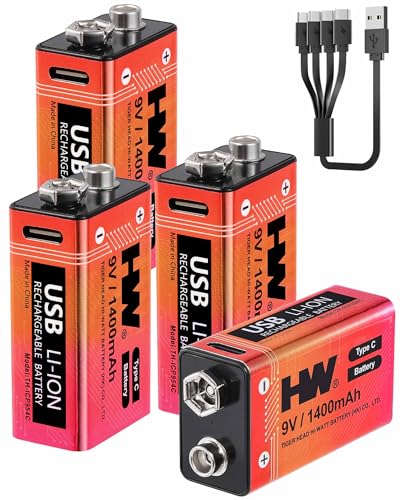
The HW pack pairs built-in USB-C charging with a four-in-one cable, rather than requiring a separate charger. HW says the batteries have 1400mAh capacity and support up to 1000 cycles; an LED indicates charging status, and the safeguards cover overcharge, over-temperature, overload and short circuit. The four-battery pack may suit someone seeking a cable-based charging arrangement. Its capacity is stated in mAh, so it should not be ranked numerically against mWh figures without comparable voltage data.
Bottom line: Choose this pack if you want USB-C charging and a four-battery set.
Amazon Basics 200mAh Ni-MH 9V, 4-Pack

The Amazon Basics pack is the only option here explicitly described as pre-charged and ready to use. It contains four 200mAh Ni-MH batteries; Amazon Basics says they can be recharged up to 1000 times and retain 80% capacity for 24 months. The pack may suit buyers who want rechargeable Ni-MH cells for compatible remotes or toys and already own a suitable charger. A charger is not included, so it is not a complete charging setup on its own.
Bottom line: Choose this pack if you want pre-charged Ni-MH batteries and already have a charger.
How to choose rechargeable 9 volt batteries
Start with the device manual: a 9V-shaped battery is not automatically compatible just because its terminals fit. Rechargeable 9V batteries use chemistries such as Ni-MH and lithium-ion, and their voltage behavior and charging requirements differ. Match both chemistry and charger to the device and battery specifications. Capacity may be given in mAh or mWh; mWh expresses energy, while mAh alone does not allow a fair energy comparison unless voltage is also known. Choose a pack with an included charger if you lack one, or confirm your charger explicitly supports the chemistry and 9V format. For devices with a fixed or safety-critical power requirement, use rechargeables only when the device maker permits them.
Rechargeable 9V battery capacity and runtime
Capacity is a guide, not a guaranteed runtime: actual operating time depends on the device’s current draw, cutoff voltage and battery design. A 9V battery powering a high-drain device can run down much faster than one in a low-drain remote. Compare mWh when available; mAh figures need voltage context, so do not treat 1300mAh as directly larger or smaller than 1350mWh. The product figures here use both units. A practical decision rule is to favor a pack with an energy figure when comparing runtime potential, then check whether its chemistry and voltage suit the device. Rechargeable cells also need recharging rather than replacement when depleted, so a spare set can reduce downtime.
Rechargeable batteries in smoke alarms
Use rechargeable 9V batteries in a smoke alarm only if that alarm’s manufacturer allows the specific chemistry and battery type. Many alarms call for a particular battery, and a physically fitting cell may still have a voltage or charging profile the alarm is not designed for. Smoke alarms are life-safety devices: the U.S. Fire Administration recommends testing alarms monthly and replacing batteries at least once a year unless the alarm has a 10-year sealed battery. Test the alarm after any battery change. If the alarm manual requires a non-rechargeable battery or a specific model, follow that requirement rather than substituting a rechargeable cell.
Ni-MH and lithium rechargeable 9V batteries compared
Ni-MH and lithium models differ in chemistry, capacity labeling and charging arrangement; select based on device compatibility and how you plan to recharge them. A charger designed for one chemistry should not be assumed to work with another. This table summarizes the distinctions relevant to these choices.
| Type | What to compare | Buying check |
|---|---|---|
| Ni-MH | Capacity may be given in mAh or mWh | Use a charger made for 9V Ni-MH cells |
| Lithium | Capacity and charging method vary by pack | Check device compatibility and the included or built-in charging system |
For either type, match the battery to the device rather than relying on the 9V label alone. If you are replacing an alarm battery, the alarm manual takes priority over convenience features such as USB charging.
Frequently Asked Questions
Can rechargeable 9V batteries go in smoke alarms?
Only when the alarm manufacturer approves that battery chemistry and type. Smoke alarms are safety devices, so use the specified battery and test the alarm monthly.
Can I charge Ni-MH 9V batteries in any charger?
No; use a charger specifically compatible with 9V Ni-MH batteries. A charger designed for another chemistry or format may not charge them correctly.
Is mAh comparable with mWh for 9V batteries?
Not directly: mAh measures charge capacity, while mWh measures energy. A fair conversion requires voltage, so compare mWh values when both batteries provide them.
How often should rechargeable 9V batteries be replaced?
Replace a rechargeable cell when it no longer holds enough charge for its device or shows damage. Smoke alarm batteries need special attention: test the alarm monthly and follow its specified battery and replacement schedule.
Do rechargeable 9V batteries fit every 9V device?
No; terminal fit does not guarantee electrical compatibility. Check the device manual for supported chemistry and voltage requirements before installing a rechargeable cell.