
Extra Long Downspout Extensions: 3 Flexible Options

Prestantious 16.5-Foot Flexible Extension suits most people who need an extra long downspout extension because it stretches to 16.5 feet and includes adapters for 2×3-inch and 3×4-inch downspouts. Choose plusgutter 16.5-Foot Flexible Extension instead if you need adapters for more downspout sizes; choose plusgutter 11.5-Foot Flexible Extension if 11.5 feet of reach is enough.
A flexible extension carries roof runoff away from a downspout outlet, but the yard’s slope and the outlet’s fit determine whether it drains where you need it.
We earn a commission if you buy through links on this page. As an Amazon Associate I earn from qualifying purchases. Products are compared on manufacturer specifications, not hands-on testing.
- Best overall: Prestantious 16.5-Foot Flexible Extension – Reaches 16.5 feet and includes adapters for 2×3-inch and 3×4-inch downspouts.
- Best for more downspout sizes: plusgutter 16.5-Foot Flexible Extension – Includes adapters for four sizes, from 2×3-inch to 3.5×4-inch.
- Best for shorter runs: plusgutter 11.5-Foot Flexible Extension – Extends from 2.6 to 11.5 feet for a shorter drainage route.
| Product | Best for | Maximum extension | Minimum length | Downspout fit | Shop |
|---|---|---|---|---|---|
| Prestantious 16.5-Foot Flexible Extension | Common downspout sizes | 16.5 ft | 3.6 ft | 2×3 in; 3×4 in | Check Price on Amazon |
| plusgutter 16.5-Foot Flexible Extension | Multiple outlet sizes | 16.5 ft | 3.4 ft | 2×3, 3×3, 3×4, 3.5×4 in | Check Price on Amazon |
| plusgutter 11.5-Foot Flexible Extension | Shorter drainage runs | 11.5 ft | 2.6 ft | 2×3, 3×3, 3×4, 3.5×4 in | Check Price on Amazon |
Extra Long Downspout Extensions Compared
Compare the maximum reach, compact length, and compatible downspout sizes before choosing an extension.
Prestantious 16.5-Foot Flexible Extension
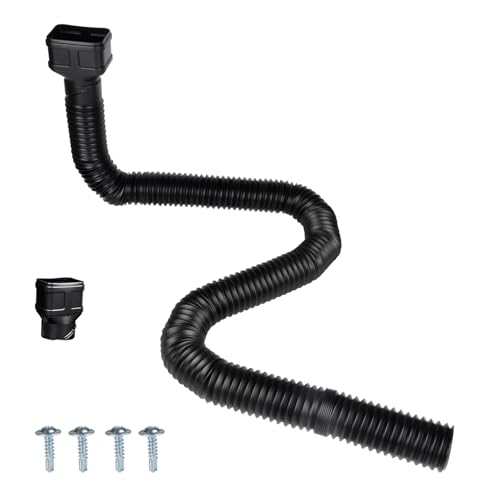
Prestantious 16.5-Foot Flexible Extension pairs a 16.5-foot maximum reach with adapters for two common rectangular downspout sizes. The flexible pipe measures 2.6 inches inside and 3.1 inches outside in diameter, so check that the included adapter and outlet fit your setup. Its stretch range starts at 3.6 feet, which is longer than the minimum length of the other 16.5-foot option. That may matter where the extension needs to tuck close to the wall when shortened. The main limitation is the narrower adapter range; buyers with 3×3-inch or 3.5×4-inch downspouts should consider another option.
Bottom line: Pick this if your downspout is 2×3 inches or 3×4 inches and you need reach up to 16.5 feet.
plusgutter 16.5-Foot Flexible Extension

plusgutter 16.5-Foot Flexible Extension covers four rectangular downspout sizes with its two adapters, including 3×3-inch and 3.5×4-inch outlets. The extension adjusts from 3.4 to 16.5 feet and is made of PE. The maker says its thickened material withstands at least 10 pounds without deformation and can be buried; treat those as product claims, not a substitute for checking the site’s drainage conditions. Its 4-inch diameter is another dimension to compare against the available space. The adapter range is its distinguishing feature, but buyers needing a pipe with an inside and outside diameter may prefer a more dimension-specific option.
Bottom line: Choose this when your downspout is one of the four stated sizes, especially 3×3 or 3.5×4 inches.
plusgutter 11.5-Foot Flexible Extension

plusgutter 11.5-Foot Flexible Extension is the shorter-reach option, extending to 11.5 feet while starting at 2.6 feet when retracted. Like plusgutter 16.5-Foot Flexible Extension, it is made of PE and includes adapters for 2×3-, 3×3-, 3×4-, and 3.5×4-inch downspouts. The maker says its thickened material withstands at least 10 pounds without deformation and can be buried. A shorter maximum can suit a compact yard or a discharge point near a walkway, but it will not reach as far as the two 16.5-foot models. Measure the route before choosing it if water must pass around landscaping or other obstacles.
Bottom line: Pick this for a shorter route when 11.5 feet of maximum reach is sufficient.
How to Choose an Extra Long Downspout Extension
Choose by the route’s measured length, outlet fit, and the ground where the water will discharge. Measure from the downspout outlet to the intended discharge point, then allow for bends; a straight-line distance can underestimate the pipe length needed. Flexible extensions can be shaped around obstacles, but sharp bends and low spots can impede flow or collect debris. A common drainage rule of thumb is to carry roof runoff at least 5 to 10 feet from the foundation, where the lot allows, and direct it toward a safe downhill outlet. If the route needs more than 11.5 feet, select a model with 16.5 feet of reach; if it is shorter, compare the retracted lengths and adapter fit instead.
Downspout Fit and Extension Sizing
Match the adapter opening to the downspout’s outside dimensions, not just its nominal size. Rectangular downspouts commonly measure 2×3 or 3×4 inches, while the options here also cover 3×3 and 3.5×4 inches on selected models. Measure across both outside faces and check that the adapter seats securely; a loose transition can spill water beside the outlet. Also measure the extension’s path at full length and when shortened, since these products have different minimum lengths. For a narrow side yard, leave room for the pipe to curve without kinking. The 16.5-foot models suit longer routes; the 11.5-foot model is the fit when that reach is enough.
| Route need | Choice | Reason |
|---|---|---|
| Up to 11.5 feet | plusgutter 11.5-Foot Flexible Extension | Shorter maximum reach and 2.6-foot minimum length |
| Up to 16.5 feet, 2×3- or 3×4-inch outlet | Prestantious 16.5-Foot Flexible Extension | Includes adapters for those two sizes |
| Up to 16.5 feet, 3×3- or 3.5×4-inch outlet | plusgutter 16.5-Foot Flexible Extension | Its adapters cover those additional sizes |
Where to Direct Roof Runoff
Direct runoff to a spot where it can disperse without flowing back toward the house or onto a neighbor’s property. Roofs shed a surprising volume of water: 1 inch of rain on 1,000 square feet of roof produces about 623 gallons of runoff. That volume can overwhelm a small low spot, so consider the soil, slope, and nearby drains before settling on an outlet location. Keep discharge away from walkways where water could pool or freeze, and avoid directing it toward a septic system or a retaining wall. If the extension is buried, maintain a route that drains rather than leaving a sagging section full of water; standing water can attract debris and interfere with flow.
Common Downspout Extension Mistakes
The most common mistake is choosing by maximum reach alone without checking the adapter or the actual path. Measure the downspout, the route, and the extension’s minimum length before installation. A pipe that reaches the target only when stretched tight may be difficult to route around a corner; a pipe that is too long may buckle or leave a trip hazard. Another mistake is discharging beside the foundation because the extension ends short of the intended outlet. Aim for a downhill location and watch where water flows during rain. Clear leaves and sediment from the outlet and extension periodically, especially after storms; a blocked route can send water back toward the building.
Frequently Asked Questions
How far should a downspout extension reach?
A common rule of thumb is to discharge roof runoff at least 5 to 10 feet from the foundation where the lot permits. Measure the route around obstacles, because bends add length beyond the straight-line distance.
How do I measure a rectangular downspout?
Measure the outside width and depth of the downspout opening in inches. Compare both dimensions with the adapter sizes, since 2×3-inch and 3×4-inch outlets are not interchangeable.
Can a flexible downspout extension be buried?
Some flexible extensions are designed for burial, but the route still needs to drain toward its outlet. Avoid low spots where water and sediment can collect, and verify the pipe is suitable for the soil and load conditions at the site.
How much water comes off a roof in rain?
About 623 gallons run off a 1,000-square-foot roof during 1 inch of rain. Roof area and rainfall depth determine the volume, so a small outlet area may not disperse runoff quickly.
How often should downspout extensions be cleared?
Check extensions at least twice a year and after heavy storms, removing leaves and sediment that can obstruct flow. Homes near trees may need more frequent checks during leaf fall.