
The Best Celtic Salt: 5 Types Compared for Cooking

For everyday cooking and baking, Celtic Sea Salt Fine Ground, 1 lb is the practical pick because its fine grains are made to dissolve evenly. Choose a coarse salt instead if you want crystals for a grinder, brining, or finishing; select a larger bag if you use salt in bulk.
We earn a commission if you buy through links on this page. As an Amazon Associate I earn from qualifying purchases. Products are compared on manufacturer specifications, not hands-on testing.
- Best overall: Celtic Sea Salt Fine Ground, 1 lb – Fine grains suit everyday seasoning and baking.
- Best for bulk use: L’Essence De Cuisine Coarse Sel Gris, 5 lb – The 80-ounce coarse crystals are sized for grinders and brining.
- Best for fine French salt: Le Marinier Organic Fine Celtic Salt, 18 oz – This hand-harvested French salt comes in an 18-ounce fine-ground package.
| Product | Best for | Grind | Package size | Origin | Shop |
|---|---|---|---|---|---|
| Celtic Sea Salt Fine Ground, 1 lb | Daily cooking | Fine | 16 oz | — | Check Price on Amazon |
| Le Marinier Organic Fine Celtic Salt, 18 oz | French fine salt | Fine | 18 oz | France | Check Price on Amazon |
| L’Essence De Cuisine Coarse Sel Gris, 5 lb | Bulk grinding | Coarse | 80 oz | France | Check Price on Amazon |
| Celtic Sea Salt Light Grey Coarse, 1 lb | Coarse finishing | Coarse | 16 oz | — | Check Price on Amazon |
| Sante Naturelle Organic Fine Celtic Salt, 18 oz | Moist fine grains | Fine | 18 oz | France | Check Price on Amazon |
Celtic Salt Compared
Choose by grain size first, then match the package size to how often you cook with it.
Celtic Sea Salt Fine Ground, 1 lb
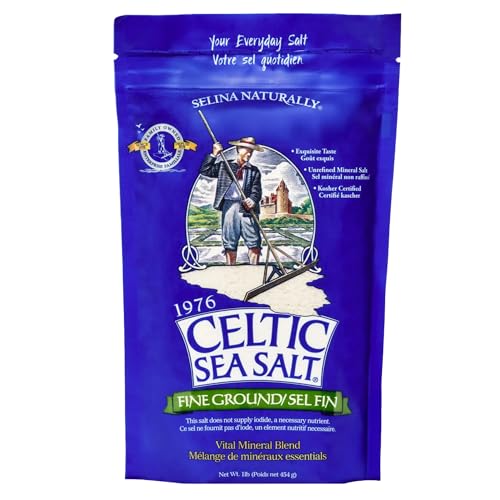
Fine grains make this option the most straightforward choice for everyday seasoning and baking. The 16-ounce package is a familiar kitchen-sized amount, and the product features describe a soft texture intended to dissolve evenly in recipes. It is hand-harvested and unrefined, with no additives, and the maker says it is third-party lab tested for purity. Fine salt can be easier to measure by volume than coarse crystals, but crystal size and moisture still affect how much salt a spoonful contains. Choose another option if you specifically want grinder-ready crystals or a bulk bag.
Bottom line: Pick this for a fine-grain salt suited to routine cooking and baking.
Le Marinier Organic Fine Celtic Salt, 18 oz
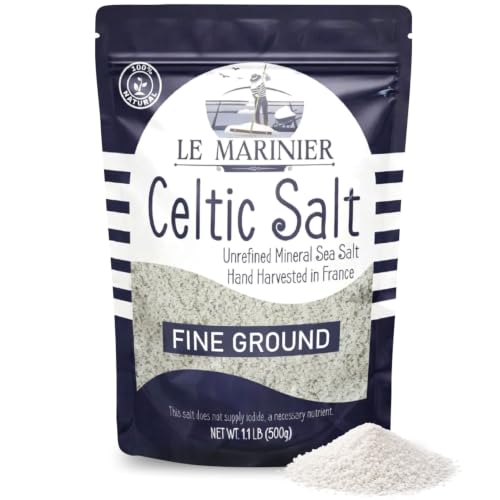
French marsh sourcing and a fine grind distinguish this 18-ounce option. Le Marinier says the salt is hand-harvested using a traditional method and contains no additives; the maker also describes it as unrefined. Its fine texture makes it appropriate for cooking and baking when you want grains that disperse readily. At 18 ounces, the package is slightly larger than a 16-ounce option, but it is still a single package rather than a bulk supply. The maker’s mineral and hydration statements are not a reason to use salt as a health supplement; choose it for its culinary form and stated sourcing.
Bottom line: Choose this if French sourcing and fine grains are your priorities.
L’Essence De Cuisine Coarse Sel Gris, 5 lb

The 80-ounce resealable bag sets this coarse sel gris apart for kitchens that go through salt quickly. The maker says it is hand-harvested in France and contains no additives or anti-caking agents. Coarse crystals are sized for mills and grinders, and the product features also name brining, pickling, broths, salt crusts, and roasting as uses. This package is substantially larger than the single-pound and 18-ounce choices, so it takes more storage space and may be excessive for occasional seasoning. Coarse crystals do not dissolve as quickly as fine grains, so account for that when adding salt late in cooking.
Bottom line: Pick this for frequent grinding, brining, or other high-volume kitchen use.
Celtic Sea Salt Light Grey Coarse, 1 lb

This 16-ounce package offers coarse light-grey crystals without the bulk of the 5-pound option. The product features identify the salt as coarse-ground, and its size makes it a modest amount for a grinder or salt cellar. Its compact package dimensions are about 2.3 inches on each side. The name describes it as hand-harvested and unrefined, while the features mention vegetarian suitability and quality certification. Those points do not make coarse crystals a direct substitute for fine salt in baking: larger grains dissolve differently and can distribute unevenly. Choose a fine-ground option for recipes that call for uniform mixing.
Bottom line: Choose this when you want coarse crystals in a one-pound package.
Sante Naturelle Organic Fine Celtic Salt, 18 oz

The naturally moist texture described by the maker distinguishes this French fine-ground salt from a dry, free-flowing fine salt. Sante Naturelle says it is hand-harvested from French ocean marshes and unrefined, with no processing beyond its traditional harvesting. Its 18-ounce package suits cooking and baking if you prefer a fine grain and do not need a grinder-ready crystal. A slightly moist salt may clump more readily than dry fine salt, so keep the container sealed and use a dry spoon. The maker’s mineral and wellness claims should not be treated as a reason to increase salt intake.
Bottom line: Pick this if you want a fine French salt with a naturally moist texture.
How to Choose Celtic Salt for Cooking
Match the grind to the way you use salt: fine grains suit baking and quick dissolving, while coarse crystals suit mills, salt crusts, and brining. Salt is about 39% sodium by weight, so weighing it gives a more consistent amount than measuring by spoon when grain sizes differ. A teaspoon of fine table salt is roughly 2,300 mg of sodium, near the FDA’s 2,300 mg daily limit for most adults; coarse crystals can pack differently in a teaspoon. Choose fine salt for recipes with volume measures, and weigh salt when precision matters. Specialty sea salt is not necessarily iodized, so people relying on salt for iodine should verify iodization on the package rather than assume it.
This quick guide matches common kitchen needs to the product forms.
| Kitchen need | Useful form | Reason |
|---|---|---|
| Baking or quick mixing | Fine | Smaller grains disperse readily |
| Mill or grinder | Coarse | Crystals are sized for grinding |
| Brining or frequent use | Coarse bulk | Large package supports higher-volume use |
Fine Versus Coarse Celtic Salt
Fine and coarse salts differ chiefly in how quickly their crystals dissolve and how they measure by volume. Fine grains distribute more evenly through dough and sauces; coarse crystals remain noticeable longer and work well in grinders or on finished food. A teaspoon is not a dependable equal measure across different crystal sizes, because a spoon holds different amounts of salt depending on grain shape and packing. For baking, use the recipe’s specified salt type or measure by weight when possible. For a grinder, check that the crystals fit its mechanism; very damp salt can also be unsuitable for some mills. Coarse salt is not automatically lower in sodium by weight.
How Much Celtic Salt Should You Use
Use salt as a seasoning, not as an electrolyte supplement: adults are generally advised to keep sodium below 2,300 mg per day, and a teaspoon of fine table salt can contain roughly that amount. Sodium needs vary by person, so a salt’s trace minerals do not make unrestricted use appropriate. The FDA identifies iodized salt as an important iodine source, while specialty salts may not be iodized; check the package if iodine intake is a concern. For recipe accuracy, weigh salt rather than substituting teaspoon amounts between fine and coarse crystals. Reduce added salt when a dish already includes salty ingredients such as cured meats, cheese, or soy sauce.
How to Store Celtic Sea Salt
Keep salt in a tightly closed container in a cool, dry cupboard; moisture can make fine or naturally damp salt clump. Use a dry spoon, since water introduced into the container encourages caking, and avoid storing salt beside a steaming pot. A resealable bag helps limit exposure between uses, but a small cellar or jar can make daily access easier. Coarse salt stored for a grinder should remain dry enough to flow through the mill; if it clumps, use it from a cellar rather than forcing it into a mechanism. Salt itself does not require refrigeration, and a dry storage spot helps preserve a workable texture.
Frequently Asked Questions
Is Celtic salt different from regular table salt?
Celtic salt is a sea salt, while table salt is commonly refined and may be iodized. Grain size and moisture vary, so a spoonful of one type may not contain the same amount as a spoonful of another. For recipe consistency, measure by weight when possible.
Can I use coarse Celtic salt for baking?
You can, but coarse crystals dissolve and distribute more slowly than fine salt. If a recipe calls for fine salt, grind the coarse crystals or weigh the salt rather than swapping teaspoon measures directly.
Does Celtic sea salt provide iodine?
Only salt that is iodized reliably serves as an iodine source; sea salt is not automatically iodized. Check the package for iodization, especially if you depend on salt as a dietary iodine source.
How much sodium is in a teaspoon of salt?
A teaspoon of fine table salt contains roughly 2,300 mg of sodium, approximately the FDA’s daily limit for most adults. Coarse salt can differ by volume because crystal size changes how tightly a teaspoon packs.
Why is some Celtic salt slightly damp?
Some sea salts retain moisture from their harvesting and processing, giving them a damp or clumping texture. Keep the container sealed and use a dry spoon to reduce additional moisture.