
High Flow Kitchen Faucets: 3 Models Compared by Spray

For a high-pressure spray mode, choose GIMILI Commercial Pull-Down Faucet; for a faucet with a 1.8 GPM flow rate and three modes, choose WEWE High-Arc Pull-Down Faucet. High-pressure spray changes the spray pattern, not necessarily the faucet’s maximum gallons per minute.
Buyers focused on measurable flow should compare GPM rather than spray labels. Choose a different model if sink-hole fit, installation dimensions or a certified specification matters more to you.
We earn a commission if you buy through links on this page. As an Amazon Associate I earn from qualifying purchases. Products are compared on manufacturer specifications, not hands-on testing.
- Best overall: GIMILI Commercial Pull-Down Faucet – Its dual nozzles include a high-pressure spray mode for rinsing and a separate stream mode.
- Best for stated flow rate: WEWE High-Arc Pull-Down Faucet – The maker specifies 1.8 GPM and three spray settings, including pause.
- Best for spring reach: OWOFAN Spring Pull-Down Faucet – Its flexible commercial-style spring design is intended to extend motion around the sink.
| Product | Best for | Spray modes | Shop |
|---|---|---|---|
| GIMILI Commercial Pull-Down Faucet | Pressure spray | Spray and stream | Check Price on Amazon |
| WEWE High-Arc Pull-Down Faucet | Measured flow | Stream, spray, pause | Check Price on Amazon |
| OWOFAN Spring Pull-Down Faucet | Spring-style reach | Stream and spray | Check Price on Amazon |
High flow kitchen faucets compared
Compare spray functions, stated flow and reach to match the faucet to your sink tasks.
GIMILI Commercial Pull-Down Faucet

GIMILI Commercial Pull-Down Faucet is the clearest match for shoppers prioritizing a high-pressure spray mode: its two independent nozzles separate spray from stream. The maker says the spray is for rinsing food debris, while stream provides gentler output for filling. The faucet uses SUS 304 stainless steel, a ceramic valve core and a single handle, and includes a deck plate. Its 21.2-inch overall height makes clearance worth measuring before choosing it.
Bottom line: Pick this if a dedicated high-pressure spray mode matters more than a published GPM figure.
WEWE High-Arc Pull-Down Faucet
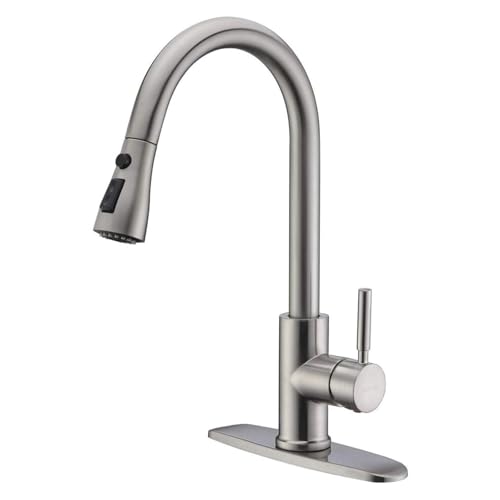
WEWE High-Arc Pull-Down Faucet stands out with a 1.8 GPM rate and three settings: stream, spray and pause. The 20-inch pull-down reach and 360-degree swivel give it a clear range-of-motion specification, while its ceramic cartridge and SUS 304 construction address the faucet’s control and body materials. It is described for 1- or 3-hole fit, so check the included deck plate arrangement against the sink. The trade-off for flow-focused buyers is that 1.8 GPM is below the 2.2 GPM federal maximum commonly allowed for kitchen faucets; it is not a higher-capacity choice by that measure.
Bottom line: Pick this if you want an explicit 1.8 GPM figure and a pause setting.
OWOFAN Spring Pull-Down Faucet
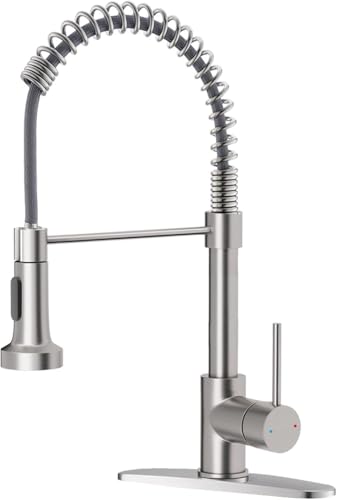
OWOFAN Spring Pull-Down Faucet uses a commercial-style spring design, distinguishing it from the conventional high-arc shapes among these choices. Its two modes are stream for filling and high-pressure spray for rinsing, and the maker describes a flexible range of motion for reaching around the sink. The product also identifies stainless steel and NSF certification. The spring form is a visual and practical fit consideration for kitchens where a more exposed commercial look suits the space.
Bottom line: Choose this for a spring-style faucet with stream and high-pressure spray modes.
How to compare high flow kitchen faucet spray
Start with gallons per minute (GPM) when the goal is higher water volume: a high-pressure spray description alone does not establish a higher GPM. Most US kitchen faucets are limited to a maximum 2.2 GPM under federal standards, while several models here specify 1.8 GPM. Spray modes alter the outlet pattern; a concentrated spray can feel stronger without increasing total flow. Use the maker’s GPM figure for a direct comparison, and treat “power” language as a spray claim unless a flow rate is also given. If filling speed is your main concern, prioritize a GPM rather than a pressure-mode label.
| What is specified | What it tells you | Decision use |
|---|---|---|
| GPM | Water volume per minute | Compare filling flow |
| Spray mode | Outlet pattern or control | Compare rinsing options |
| Hose reach | Pull-down working distance | Check sink coverage |
Choose spray modes for kitchen tasks
Stream is generally suited to filling, while spray spreads water for rinsing; a pause control temporarily stops output at the head. The included faucets vary from two settings to three, so choose by the tasks you actually do rather than assuming more modes mean more water. A concentrated spray may rinse debris more effectively than a broad stream, but it does not prove a higher flow rate. If switching modes with wet hands matters, look for controls positioned at the spray head and check whether the faucet offers a pause function.
Check sink holes and faucet clearance
Measure the sink’s hole count and deck thickness before ordering: faucets can be configured for one hole, multiple holes, or use a deck plate to cover extra openings. Spout height and reach also affect whether a tall pot fits beneath the outlet and whether the spray head can reach the basin corners. One model here specifies a 1.30–1.38-inch mounting hole and a 1.5-inch maximum deck thickness; use those numbers as a fit check, not as universal dimensions. For a 21-inch-tall faucet, verify overhead clearance, especially beneath cabinets.
Understand faucet flow and household limits
Kitchen faucet flow is measured in gallons per minute at a specified test pressure; pressure at home can differ from the test setup. Federal standards generally cap kitchen faucet flow at 2.2 GPM, so a spray-power claim should not be read as permission to exceed that rate. Aerators can shape the stream and introduce air, while mineral buildup in an aerator may reduce flow over time. If a faucet suddenly produces a weak stream, check for a clogged aerator before assuming the faucet itself has failed. Do not remove flow-control components to chase a higher rate.
Frequently Asked Questions
Does a high-pressure spray mean higher GPM?
No; spray pressure language describes the spray effect and does not establish total gallons per minute. Compare a published GPM rate when water volume is the deciding factor.
What is the usual maximum kitchen faucet flow?
Most US kitchen faucets are subject to a 2.2 GPM federal maximum. A faucet specified at 1.8 GPM is below that cap.
Will a 1.8 GPM faucet fill pots more slowly?
At the same pressure and conditions, a lower GPM supplies less water per minute than a higher rate. A 1.8 GPM rating is about 18% below 2.2 GPM, though actual home flow can vary with plumbing pressure.
How do I know whether the faucet fits my sink?
Count the mounting holes and measure the deck thickness and available height. A deck plate can cover extra holes, but it does not solve an oversized mounting hole or insufficient overhead clearance.
Can I increase faucet flow by removing the aerator?
Removing or altering a flow-control part is not a safe way to raise a faucet’s rated flow. If output has dropped, clean the aerator and check for debris or a plumbing restriction first.