
Best Kenwood 6×9 Speakers Compared by Power and Design

The Kenwood KFC-693 is the strongest pick for most buyers because it combines a 650-watt peak rating with a 150-watt RMS rating and a five-way design. Choose a different model if your priorities are a simpler driver layout, a shallow mounting depth or a polypropylene cone.
A 6×9 speaker is an oval car speaker; matching the nominal size alone does not guarantee that it will fit your vehicle.
We earn a commission if you buy through links on this page. As an Amazon Associate I earn from qualifying purchases. Products are compared on manufacturer specifications, not hands-on testing.
- Best overall: Kenwood KFC-693 – It is the only model here with both peak and RMS power ratings, plus a five-way design.
- Best for shallow mounting: Kenwood eXcelon KFC-X695 – Its mounting depth is 2-3/4 inches, and it uses a two-way design.
- Best for 3-way design: Kenwood KFC-6966S – It pairs a three-way layout with a 400-watt peak rating and polypropylene cone.
| Product | Best for | Design | Peak power | Cone | Shop |
|---|---|---|---|---|---|
| Kenwood KFC-693 | Rated power clarity | 5-way | 650 W | Polypropylene | Check Price on Amazon |
| Kenwood KFC-6966S | Three-way simplicity | 3-way | 400 W | Polypropylene | Check Price on Amazon |
| Kenwood KFC-6996PS | Sound field focus | 5-way | — | — | Check Price on Amazon |
| Kenwood eXcelon KFC-X695 | Shallow mounting | 2-way | 300 W | Injection-molded polypropylene | Check Price on Amazon |
Kenwood 6×9 Speakers
Compare these Kenwood oval car speakers by driver layout, power rating and cone material before checking vehicle fit.
Kenwood KFC-693

The KFC-693 stands apart by giving both peak and RMS ratings: 650 watts peak and 150 watts RMS. Its five-way layout combines a woofer, balanced dome tweeter and additional super tweeters, while the maker says its Acoustic Sound Harmonizer improves response from 3,000 to 4,000 Hz. The polypropylene woofer cone has a diamond array pattern and rubber surround. Consider it if you want several high-frequency drivers and a continuous-power figure to compare with an amplifier. Its more elaborate driver layout may be unnecessary if you prefer a simpler two- or three-way speaker.
Bottom line: Choose it if you want an RMS figure and a five-way layout to compare with your system.
Kenwood KFC-6966S

The KFC-6966S is the three-way choice, with a 400-watt peak rating and a polypropylene cone. The maker says the cone supports lasting performance and strong bass; those are performance claims, not a substitute for an RMS rating when matching an amplifier. The speaker is sold as a pair and is described as flush mount with easy installation. It suits buyers who want a less complex driver layout than the five-way options. The power figure is peak only, so a buyer matching speakers to an amplifier should compare continuous RMS ratings rather than treating 400 watts as an RMS target.
Bottom line: Pick it for a three-way Kenwood pair with a polypropylene cone.
Kenwood KFC-6996PS
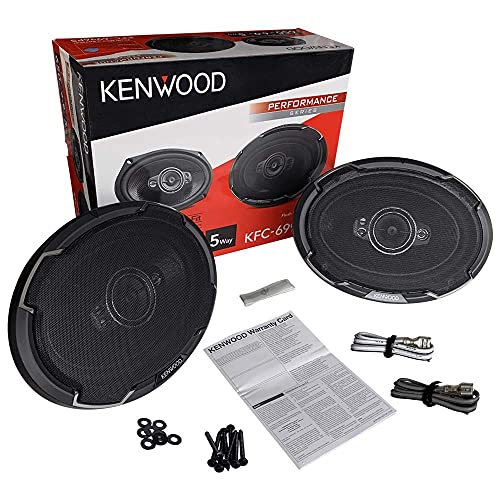
The KFC-6996PS emphasizes sound-field features rather than a power rating: its Sound Field Enhancer is intended to widen the sound field and aid high-frequency performance. The woofer cone has a diamond array pattern, which the maker says reduces distortion. Its five-way layout makes it another option for buyers who want multiple driver types, but the maker does not give a power figure or cone material. That makes amplifier matching harder to assess than with the KFC-693, which provides both peak and RMS ratings. Prioritize this model only if the sound-field feature is the deciding factor.
Bottom line: Choose it when a sound-field enhancer matters more than a power rating.
Kenwood eXcelon KFC-X695
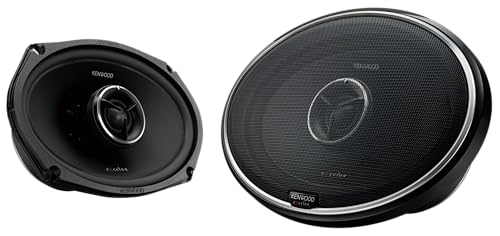
The KFC-X695 is the two-way option and the only model here with a mounting depth: 2-3/4 inches. Its injection-molded polypropylene cone woofer and oversized 1-3/16-inch soft dome tweeter distinguish it from the multi-way models. This is a fit-oriented choice for a door or rear-deck location where depth is a constraint. The rating is 300 watts peak, not RMS, so do not use it alone to establish continuous amplifier compatibility.
Bottom line: Pick it when the 2-3/4-inch mounting depth and two-way layout suit your installation.
How to choose Kenwood 6×9 speakers
Start with fit and RMS power, then decide how many driver types you want. A 6×9 label describes a nominal oval speaker size, not the exact cutout, basket shape or depth; vehicle openings and mounting hardware vary. Measure the opening and available depth, including room for the window mechanism and door panel, before choosing a model. For amplifier matching, compare the speaker’s RMS rating with the amplifier’s RMS output at the same impedance, not peak watts. A peak figure is a brief maximum, whereas RMS is the more useful continuous-power comparison. As a simple rule, if the available cavity is under 3 inches deep, prioritize a model with a depth and confirm that the vehicle opening clears it.
What 2-way, 3-way and 5-way mean
Driver count describes how a speaker divides sound, but more ways do not automatically mean better sound. A two-way design typically splits low and high frequencies between a woofer and tweeter; three-way adds a driver for another band. Five-way designs add still more drivers, though actual crossover behavior and component quality determine how smoothly they blend. A coaxial speaker packages drivers together in one assembly, saving space compared with separate component speakers. Use the simplest layout that fits your listening goals and installation. A five-way layout is not a reason by itself to buy a model, and a compact factory system may not benefit from extra tweeters without suitable tuning.
Check 6×9 fit before installation
Confirm the cutout, mounting depth, screw pattern and clearance behind the speaker before ordering. Nominal 6×9 dimensions do not guarantee that a replacement basket will match a vehicle’s factory opening. Doors may need a vehicle-specific adapter bracket or wiring harness, while rear decks can have obstructions below the panel. Check that the cone and tweeter clear the grille and trim, and verify connector polarity so both speakers move in phase. If the opening is tight or shallower than 3 inches, use a depth measurement rather than relying on the speaker’s nominal size. Installation work near a door should account for window travel and wiring so nothing is pinched.
Match power ratings and protect hearing
Use RMS ratings to compare continuous power handling, and match amplifier output to the speaker’s impedance and RMS capability. Turning up an underpowered or mismatched system until it distorts can damage speakers; clipping is not a safe way to get more volume. Peak ratings alone do not establish an appropriate amplifier match. Keep listening levels moderate: prolonged exposure at or above 85 dBA can risk hearing damage, and louder sound shortens safe exposure time. Set gains with a clean signal, then lower volume if vocals sound harsh or bass breaks up. A properly fitted speaker also needs a secure mounting seal, since air leaks around the frame can weaken bass response.
Frequently Asked Questions
Does peak wattage show continuous speaker power?
No; peak power is a short-duration maximum, while RMS is the useful continuous-power rating for amplifier matching. Compare amplifier RMS output and speaker RMS handling at the same impedance.
Will any 6×9 speaker fit my car?
No; the 6×9 designation is nominal, and cutout dimensions, basket shape and mounting depth vary by vehicle. Measure the opening and clearance, including space for window movement and trim.
Is a five-way speaker always better than a two-way?
No; a five-way layout adds drivers, but crossover design and system tuning determine whether they blend well. A two-way speaker can be the better fit when space, simplicity or the intended setup matters more.
How deep should a 6×9 speaker opening be?
There is no universal depth because vehicle cavities differ. Measure from the mounting surface to the nearest obstruction; if clearance is under 3 inches, confirm a model’s mounting depth and account for the grille and wiring.
Can loud car speakers damage hearing?
Yes; prolonged sound exposure at or above 85 dBA can risk hearing damage, and safe exposure time decreases as volume rises. Lower the volume if the sound becomes distorted or harsh.