
Sougayilang Fishing Reels: 3 Models Compared by Use

For most anglers choosing among these Sougayilang fishing reels, Sougayilang XY1000 Spinning Reel stands out for its 13+1 bearings, metal shaft and carbon drag washers. Choose Sougayilang GT1000 Spinning Reel instead if its 22-pound maximum drag rating matters more; Sougayilang DK1000 Spinning Reel is an option for anglers who want a 5.2:1 gear ratio and a collapsible handle.
A spinning reel holds and retrieves line on a fixed spool, making it a common choice for casting lures or bait. Match the reel size to your rod, line and target fish before choosing by bearing count alone.
We earn a commission if you buy through links on this page. As an Amazon Associate I earn from qualifying purchases. Products are compared on manufacturer specifications, not hands-on testing.
- Best overall: Sougayilang XY1000 Spinning Reel – Its 13+1-bearing setup pairs with a metal main shaft and triple-disc carbon drag washers.
- Best for higher stated drag: Sougayilang GT1000 Spinning Reel – It has a maximum drag of 22 pounds and a 5.2:1 gear ratio.
- Best for a collapsible handle: Sougayilang DK1000 Spinning Reel – Its CNC-machined ABS handle folds and can be set up for left- or right-hand retrieve.
| Product | Best for | Bearings | Gear ratio | Shop |
|---|---|---|---|---|
| Sougayilang XY1000 Spinning Reel | Metal-shaft construction | 13+1 | — | Check Price on Amazon |
| Sougayilang GT1000 Spinning Reel | Stated drag capacity | 11+1 | 5.2:1 | Check Price on Amazon |
| Sougayilang DK1000 Spinning Reel | Collapsible handle | 11 | 5.2:1 | Check Price on Amazon |
Sougayilang fishing reels compared
Compare the models by their mechanics, then match reel size and line capacity to your rod and target fish.
Sougayilang XY1000 Spinning Reel

The XY1000 is the only model here with a 13+1-bearing count, a hardened metal main shaft and triple-disc carbon drag washers. Its hollow frame and interchangeable CNC-machined aluminum handle are aimed at anglers who want those construction features in a light spinning reel design. The maker describes it as suitable for ocean boat, rock and beach fishing. A bearing count does not establish retrieve smoothness or durability by itself, and the specifications give no gear ratio or drag rating to compare; anglers who need either number should confirm it before choosing.
Bottom line: Choose this if its metal shaft and carbon drag construction are your priorities.
Sougayilang GT1000 Spinning Reel

The GT1000 is the only model here with a maximum drag rating: 22 pounds. Its 11 ball bearings plus one instant anti-reverse bearing, 5.2:1 gear ratio and brass pinion gears give anglers specific mechanical details to compare. The maker says the reel is intended for saltwater or freshwater use. The drag figure is not a safe line-strength recommendation; set drag below the breaking strength of the weakest line or leader component. Choose another model if a collapsible handle or the XY1000’s carbon drag washers better fit your priorities.
Bottom line: Pick this if you want a maximum drag rating alongside a 5.2:1 ratio.
Sougayilang DK1000 Spinning Reel
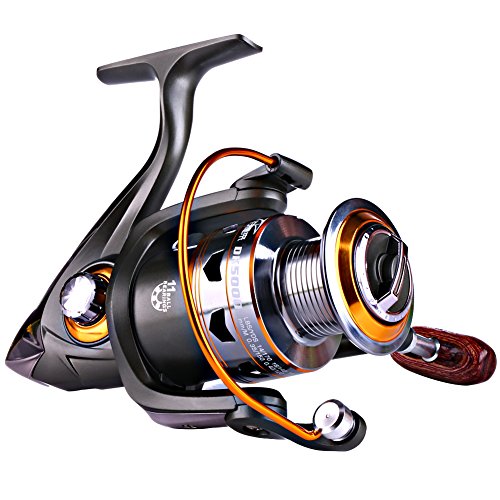
The DK1000 stands apart with a collapsible CNC-machined ABS handle that can be switched between left- and right-hand retrieve. It has an 11-bearing setup, 5.2:1 gear ratio, aluminum spool and S-curve oscillation system. The maker names ocean boat, rock and beach fishing as well as lakes, rivers, reservoirs, ponds and streams as intended settings. This model does not have a maximum drag figure in the specifications, so anglers matching drag closely to a target fish should verify that number before choosing it.
Bottom line: Choose this for its collapsible, reversible handle and 5.2:1 retrieve ratio.
How to choose a Sougayilang spinning reel
Start with reel size, line capacity and drag needs; bearing count should come later. A 1000-size reel is generally used for light line and smaller freshwater or inshore setups, but size numbers are not standardized across every manufacturer, so confirm the spool’s line capacity and pair it with the rod’s recommended line range. A gear ratio of 5.2:1 means the rotor turns 5.2 times per handle turn; spool diameter also affects how much line each turn retrieves. If choosing for a fish that may run, compare the reel’s maximum drag with the line and leader strength, rather than treating a higher drag number as a target setting. For the models here, only one supplies a maximum drag number.
What bearing count and gear ratio tell you
Bearing count describes components that support rotating parts, but it is not a stand-alone measure of smoothness or reel quality. Bearing placement, gear alignment, materials and maintenance also affect operation. The “+1” in an 11+1 or 13+1 count commonly distinguishes an anti-reverse bearing from the other bearings; compare the manufacturer’s configuration rather than assuming every bearing has the same role. A 5.2:1 ratio is a moderate retrieve ratio: the rotor completes 5.2 turns per handle turn, while actual line pickup varies with spool size and how full it is. Use the table to identify which stated specifications are useful for your priority.
| Priority | Specification to compare | Decision |
|---|---|---|
| Retrieve speed | Gear ratio and spool size | Compare both, not ratio alone |
| Drag planning | Maximum drag and line strength | Set drag below the weakest line or leader |
| Construction | Shaft, gears and drag washers | Choose the materials that suit your use and care routine |
Match a 1000-size reel to rod and line
A 1000-size spinning reel usually fits light rods and line, but the size label alone cannot establish line capacity or a proper rod match. Check the rod’s line rating and the spool capacity in the line type and diameter you plan to use; braided line of a given breaking strength is thinner than many monofilaments, so capacity differs. Leave a small gap below the spool lip rather than filling line flush to the edge, which can encourage loops and tangles. For saltwater use, rinse the reel exterior with fresh water after exposure and dry it before storage; avoid directing high-pressure water into the body, where it can force salt and grit inside.
Set drag and maintain a spinning reel
Drag should release line before a fish’s pull reaches the breaking strength of the weakest line, knot or leader in the setup. A common starting point is roughly one-quarter to one-third of that weakest component’s rated strength, then adjust cautiously for knots and actual conditions. Keep the rod angled rather than pointing it directly at a fish under load, since a high, abrupt bend can overload the blank. After fishing, loosen the drag for storage so the washers are not left compressed, wipe the reel dry and inspect the line roller and bail for grit or damage. Saltwater use calls for fresh-water rinsing and regular inspection of moving parts.
Frequently Asked Questions
What does a 5.2:1 reel gear ratio mean?
A 5.2:1 ratio means the rotor turns 5.2 times for each full handle turn. Actual line retrieval per turn also depends on spool diameter and how much line remains on the spool.
How much line should a 1000-size reel hold?
A 1000-size label does not establish a universal line capacity because spool dimensions and rating conventions vary. Compare the reel’s capacity for your chosen line diameter with the rod’s recommended line range before setting up.
How should I set spinning reel drag safely?
A common starting point is about one-quarter to one-third of the weakest line or leader’s rated breaking strength. Reduce that setting if knots or abrasion weaken the setup, and adjust based on conditions rather than using maximum drag by default.
Can a spinning reel be used in saltwater?
Some spinning reels are intended for saltwater, but salt residue can corrode metal parts if left on the reel. Rinse the exterior gently with fresh water after use, dry it, and inspect moving parts regularly.
Does a higher bearing count make a reel smoother?
Not necessarily; bearing placement, gear alignment and construction also affect how smoothly a reel turns. Compare the bearing configuration alongside the gear and drag materials, and keep grit out of moving parts.