
Klipsch R-610F: Specs and System Options Compared

The Klipsch Reference R-610F pair suits most buyers who want two floorstanding speakers, with 94 dB sensitivity and a 45 Hz–21 kHz frequency response. Choose Klipsch R-610F 5.0 Pack or Klipsch R-610F 5.1 Pack instead for a multichannel home theater package, or Klipsch R-610F Pair with R-100SW if you want a powered subwoofer alongside the towers.
The R-610F is a tower speaker designed to stand on the floor; bundle contents and whether a package includes one or two towers are the main distinctions here.
We earn a commission if you buy through links on this page. As an Amazon Associate I earn from qualifying purchases. Products are compared on manufacturer specifications, not hands-on testing.
- Best overall: Klipsch R-610F Pair – A standalone pair of R-610F towers with 94 dB sensitivity and 45 Hz–21 kHz response.
- Best for one speaker: Klipsch R-610F Single Speaker – A single R-610F, with a 6.5-inch woofer and 340-watt power handling.
- Best for 5.1 surround: Klipsch R-610F 5.1 Pack – The package includes R-610F towers, bookshelf and center speakers, and a 12-inch subwoofer.
| Product | Best for | System configuration | Subwoofer | R-610F quantity | Shop |
|---|---|---|---|---|---|
| Klipsch R-610F Pair | Stereo listening | Pair of towers | None included | 2 | Check Price on Amazon |
| Klipsch R-610F 5.0 Pack | 5.0 home theater | 5.0 channel package | None included | 2 | Check Price on Amazon |
| Klipsch R-610F Pair with R-100SW | 2.1 with subwoofer | 2.1 channel bundle | 10-inch powered | 2 | Check Price on Amazon |
| Klipsch R-610F Single Speaker | Single speaker replacement | Single tower | None included | 1 | Check Price on Amazon |
| Klipsch R-610F 5.1 Pack | 5.1 surround | 5.1 channel package | 12-inch included | 2 | Check Price on Amazon |
Klipsch R-610F speaker options
Compare standalone R-610F speakers with packages that add other channels or a subwoofer.
Klipsch R-610F Pair
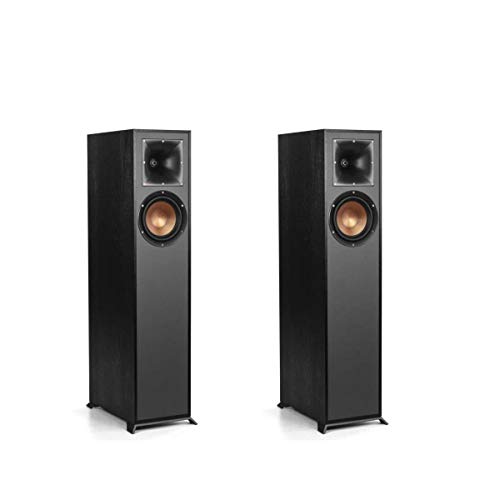
This standalone pair is the direct choice for a two-speaker setup: each tower has a 1-inch aluminum tweeter and a 6.5-inch spun-copper woofer. The pair has a 45 Hz–21 kHz frequency response, 94 dB sensitivity, 8-ohm impedance, and 85 watts continuous power handling per the specifications. It suits buyers who want floorstanding speakers without adding a center channel or subwoofer in the same package. A limitation is that the pair does not include a subwoofer, so buyers seeking deeper bass extension for movie effects may prefer a bundle that adds one.
Bottom line: Choose this pair for a straightforward R-610F stereo setup without bundled surround speakers.
Klipsch R-610F 5.0 Pack

This package expands beyond a stereo pair with two R-41M bookshelf speakers and an R-52C center channel alongside the two R-610F towers. Its 5.0 configuration provides front left, center, front right, and two surround channels, but no dedicated subwoofer is included. The package also includes magnetic grilles, injection-molded feet and screws, and a five-year Klipsch warranty. It suits buyers assembling a surround setup from one package while keeping bass management to their receiver or a separately selected sub. Compared with a 5.1 bundle, the missing subwoofer is the key limitation for buyers who want a dedicated low-frequency channel.
Bottom line: Pick this package for five speaker channels when a bundled subwoofer is not required.
Klipsch R-610F Pair with R-100SW

This bundle keeps the setup to two R-610F towers and adds an R-100SW powered subwoofer rather than center and surround speakers. The subwoofer has a 10-inch front-firing woofer and up to 300 watts peak power handling; the package is described as a 2.1 home theater system. The towers use Tractrix horn-loaded tweeters and dual 6.5-inch copper-spun IMG woofers, according to the package features. It suits music, gaming, or film setups centered on two-channel playback plus bass. Buyers who want dialogue anchored to a center speaker or rear surround channels will need a different package.
Bottom line: Choose this bundle when adding a powered sub matters more than extra surround channels.
Klipsch R-610F Single Speaker

Unlike the paired option, this is one R-610F tower, making it the relevant choice when replacing or adding a single speaker rather than buying a stereo pair. Its maker includes one 6.5-inch spun-copper woofer, a 1-inch aluminum tweeter with a 90-by-90-degree Tractrix horn, 45 Hz–21 kHz response, and 94 dB sensitivity at 2.83 V/1 m. Power handling is 340 watts. This suits a buyer with a specific single speaker need and an existing compatible setup. The limitation is quantity: a buyer starting a stereo system would need two speakers, not just this one.
Bottom line: Select this if you need one tower to match or complete an existing setup.
Klipsch R-610F 5.1 Pack

This package adds a 12-inch R-12SW subwoofer to the two R-610F towers, R-52C center channel, and R-41M bookshelf speakers, creating a 5.1 configuration. The R-12SW has a 400-watt all-digital amplifier according to the package features. Compared with the 5.0 package, the added subwoofer provides a dedicated bass channel, which suits buyers who want a complete surround speaker arrangement with bundled low-frequency support. It is a larger multi-speaker setup than a standalone pair, so confirm that the room and receiver can accommodate the additional channels before choosing it.
Bottom line: Choose this package for five speaker channels plus a dedicated 12-inch subwoofer.
How to choose an R-610F setup
Choose by channel count first: a pair serves stereo, while a 5.0 or 5.1 package adds center and surround speakers. A 2.1 bundle adds a powered subwoofer but does not add a center or rear channels. Speaker sensitivity is measured in decibels at a specified input and distance; the pair’s 94 dB rating is given alongside a 2.83 V/1 m rating on the single speaker specifications, so compare ratings only when measurement conditions match. Impedance also matters: an 8-ohm speaker is a common home-audio load, but an AV receiver’s supported speaker impedance should be checked before connecting. Choose the system whose channels match the receiver outputs and the listening setup you actually plan to use.
Where to place floorstanding speakers
Start with the towers on a firm, level floor, with the tweeters near seated ear height and the left and right speakers forming an approximately equal-sided triangle with the main seat. Rear-firing ports need room to breathe, so avoid pushing a rear-ported tower tightly against a wall; moving a speaker farther from a wall often reduces excessive bass reinforcement. Toe the towers inward gradually and listen for a stable center image rather than assuming one angle suits every room. Keep left and right placement symmetrical where possible, and avoid blocking the speaker fronts with furniture. In a 5.1 setup, place the center channel near the display and aim surround speakers to cover the seating area.
What each R-610F configuration adds
Channel labels show what a package contains: “.0” means no subwoofer channel is included, while “.1” identifies a subwoofer channel. The two multi-channel packs here add center and bookshelf speakers; the 2.1 bundle instead pairs the towers with a powered subwoofer. Use this table to narrow the configuration before considering room layout and receiver connections.
| Configuration | Included speakers | Subwoofer | Fits |
|---|---|---|---|
| Stereo pair | Two towers | No | Two-channel listening |
| 2.1 bundle | Two towers | 10-inch powered | Stereo plus bass channel |
| 5.0 package | Towers, center, bookshelf pair | No | Five speaker channels |
| 5.1 package | Towers, center, bookshelf pair | 12-inch included | Surround plus bass channel |
Receiver matching and safe setup
Match the speaker load and wiring to the AV receiver’s manual before connecting; the R-610F pair specifications give an 8-ohm impedance, but receiver compatibility depends on the receiver’s permitted load and how many speakers are driven at once. Turn the receiver off before changing speaker wires, and keep bare conductors from touching each other or the chassis, which can cause a short. Use speaker wire with polarity consistent at both ends so the positive and negative connections do not get reversed. Begin at a moderate volume after setup, then raise it while listening for distortion. A subwoofer’s level and crossover are receiver settings, so calibrate them for the room rather than treating the subwoofer as a substitute for correctly placed main speakers.
Frequently Asked Questions
Does the R-610F package include a subwoofer?
The standalone pair and single tower do not include a subwoofer. The 2.1 bundle includes a 10-inch powered subwoofer, while the 5.1 pack includes a 12-inch subwoofer.
Can an R-610F pair work with an 8-ohm receiver?
The pair’s specifications give an 8-ohm impedance. Check the receiver’s permitted speaker load, especially if several channels will play at high volume at the same time.
How far from a wall should tower speakers sit?
Start with at least several inches of space behind a rear-ported tower, then adjust by listening for even bass. A small room or strong bass buildup can call for more distance from the wall.
What does 94 dB speaker sensitivity mean?
Sensitivity describes sound output for a defined input and distance; the single speaker’s rating is 94 dB at 2.83 V/1 m. Compare speakers using the same measurement conditions, since different test methods can make figures misleading.
Do I need a subwoofer with floorstanding speakers?
A subwoofer is optional for stereo listening, but it adds a dedicated low-frequency channel in a 2.1 or 5.1 setup. Choose one when deeper bass for film effects or a separate bass channel matters to your system.