
Aipas E-Bikes: 3 Models Compared by Power and Fit

Aipas A4 Folding E-Bike suits most everyday riders who need a folding, low-step e-bike, with a 63-pound weight and 20-inch tires that make storage more manageable. Choose Aipas M1 Pro Step-Thru instead for wider tires and dual suspension on gravel or trails; Aipas M1 Pro and M2 Pro is a combined M1 Pro and M2 Pro option rather than a single model.
We earn a commission if you buy through links on this page. As an Amazon Associate I earn from qualifying purchases. Products are compared on manufacturer specifications, not hands-on testing.
- Best overall: Aipas A4 Folding E-Bike – Its 20-inch folding design and 63-pound weight suit commuting and compact storage.
- Best for trails: Aipas M1 Pro Step-Thru – The 26 x 4-inch tires, dual suspension and 110Nm torque suit uneven routes.
- Best for two-model choice: Aipas M1 Pro and M2 Pro – The combined M1 Pro and M2 Pro package pairs 1800W peak power with 26 x 4-inch tires.
| Product | Best for | Motor output | Tire size | Weight | Shop |
|---|---|---|---|---|---|
| Aipas A4 Folding E-Bike | Commuting, storage | 1000W peak | 20 in | 63 lb | Check Price on Amazon |
| Aipas M1 Pro Step-Thru | Trail comfort | 1800W peak | 26 x 4 in | 88 lb | Check Price on Amazon |
| Aipas M1 Pro and M2 Pro | Two-model option | 1800W peak | 26 x 4 in | 90 lb | Check Price on Amazon |
Aipas E-Bikes Compared
Compare frame style, tire dimensions and motor output to match an Aipas model to your route and storage needs.
Aipas A4 Folding E-Bike

Aipas A4 Folding E-Bike is the compact-folding choice in this group, with a low-step frame, 20-inch fat tires and a 63-pound weight with battery. The 48V, 12.8Ah battery is removable, and the motor produces 78Nm of torque. Aipas says the bike reaches 28 mph in pedal-assist mode and can climb grades up to 20 degrees. The step-through frame can make getting on and off easier, while folding can help when storage space is tight. Its smaller tires and city-focused layout are less suited than the 26-inch models to rough trail terrain.
Bottom line: Pick it for commuting when folding storage and an easy step-through frame matter most.
Aipas M1 Pro Step-Thru

Aipas M1 Pro Step-Thru is the single-bike step-through option for riders who want wide tires and dual suspension on uneven routes. It has 26 x 4-inch tires, a 48V, 17.5Ah removable battery and 0–5 pedal-assist levels; the bike weighs 88 pounds. Aipas says the 1800W peak rear-hub motor delivers 110Nm torque, supports climbs up to 23 degrees and provides up to 85 miles of pedal-assist range. The larger tires offer a different fit from the A4’s 20-inch wheels, but the 88-pound weight can be a drawback if you need to lift or carry the bike often.
Bottom line: Choose it for a step-through fat-tire setup on mixed commuting and trail routes.
Aipas M1 Pro and M2 Pro
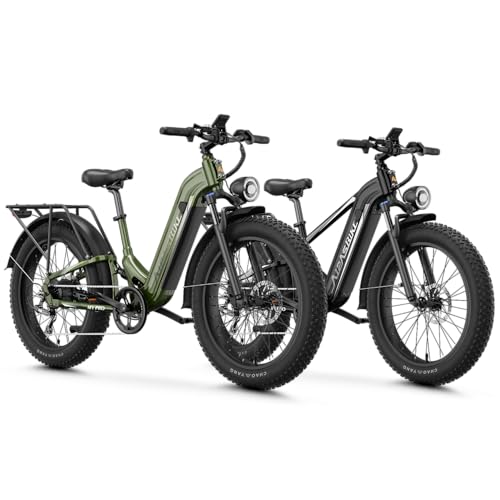
Aipas M1 Pro and M2 Pro differs from the single-bike choices by combining the M1 Pro and M2 Pro in one option. The shared listed setup includes a 1800W peak rear-hub motor, 110Nm torque, 26 x 4-inch tires, dual suspension and a removable 48V, 17.5Ah battery. Aipas says pedal-assist range reaches up to 85 miles and the bikes can climb grades up to 23 degrees. The combined option may suit a household comparing two models, but its 90-pound stated weight makes it the heaviest option here and may be inconvenient for frequent lifting.
Bottom line: Consider it when comparing the M1 Pro and M2 Pro together matters more than keeping one bike light.
How to choose an Aipas e-bike
Choose by route and handling first: the A4 is a 20-inch folding commuter, while the M1 Pro options use 26 x 4-inch tires and dual suspension. Fat tires can offer a wider contact patch on loose ground, but they add rolling resistance on pavement compared with narrower tires. A motor’s peak wattage is not a direct measure of legal classification or sustained output; U.S. e-bike rules vary by state, and many states distinguish classes using motor assistance and speed limits. Check local rules for where an e-bike may be ridden before taking a high-powered model onto public paths. Also account for bike weight: an 88- to 90-pound bike can be difficult to carry up stairs or load onto a vehicle.
Battery capacity helps comparison, but route, rider load, hills, assist level and temperature change actual range. Treat maximum range claims as best-case guidance rather than a guaranteed distance.
Frame and tire fit for commuting or trails
Frame style and wheel size shape everyday fit: the A4’s low-step frame and 20-inch wheels favor easier mounting and compact storage, while the M1 Pro’s step-through frame and 26-inch wheels give a larger trail-oriented layout. A 4-inch-wide tire is intended for a different surface feel than a typical city tire; it can feel more planted on loose dirt, while pavement handling may feel slower. Riders should check stand-over height, reach to the handlebar and saddle adjustment against their own measurements before choosing a frame. A step-through opening eases mounting, but it does not guarantee that the cockpit or saddle will fit every rider. For frequent carrying, consider 63 pounds a meaningful advantage over bikes weighing close to 90 pounds.
This quick guide matches the main form factor to the common use case.
| Form factor | Typical fit | Trade-off |
|---|---|---|
| 20-inch folding bike | City errands, compact storage | Smaller wheel feel on rough ground |
| 26 x 4-inch fat-tire bike | Gravel, dirt paths, mixed routes | More weight to handle or carry |
Battery range and charging expectations
Battery range depends on more than watt-hours: hills, rider and cargo weight, tire pressure, temperature, wind, and pedal-assist level all affect how far a charge lasts. Aipas states up to 85 miles of pedal-assist range for the M1 Pro models, but a route with steep climbs or high assist can use energy faster than a flat, moderate-pace ride. The A4 has a removable 48V, 12.8Ah battery, while the M1 Pro models use removable 48V, 17.5Ah batteries. Removability is useful when the bike must stay in a shared or outdoor storage area and charging needs to happen indoors. For a daily commute, plan around a return trip with reserve rather than relying on the maximum claim.
Charge lithium-ion e-bike batteries with the compatible charger, on a dry surface away from heat and combustible clutter; stop using a battery that is swollen, damaged or unusually hot.
Power, speed and safe riding
Motor power and claimed speed do not replace the need for braking distance, visibility and helmet use. Aipas gives the A4 a 28 mph pedal-assist maximum, and describes the M1 Pro motor as 1800W peak; those figures should prompt a check of local e-bike class limits before riding on shared paths. Many state definitions use 20 mph or 28 mph thresholds, but the class definitions and permitted locations differ by jurisdiction. Use a bicycle helmet that fits and is appropriate for the riding conditions, and give yourself more stopping distance on wet pavement, gravel or a heavily loaded bike. Wide tires do not eliminate the risk of slipping, and high torque can make low-speed starts abrupt for a new rider.
Before a first ride, check tire pressure, brake operation, wheel attachment and the battery’s secure fit; repeat the checks after transporting the bike or riding rough terrain.
Frequently Asked Questions
How far can an Aipas e-bike go on one charge?
Aipas says the M1 Pro battery supports up to 85 miles of pedal-assist range. Hills, rider and cargo weight, temperature and assist level can reduce real-world distance, so plan a reserve for the return leg.
Is a 26-inch fat tire good for pavement?
A 26 x 4-inch tire can handle pavement, but its wide footprint is designed to provide traction on loose or uneven surfaces too. Compared with narrower city tires, fat tires can feel slower and increase rolling resistance on smooth roads.
How heavy are these Aipas electric bikes?
The A4 weighs 63 pounds with its battery, while the M1 Pro is 88 pounds and the combined M1 Pro/M2 Pro option is listed at 90 pounds. If you must lift the bike into a car or carry it up stairs, the weight difference is important.
Can I ride a 28 mph e-bike on a bike path?
Path access depends on state and local rules, not just the bike’s advertised speed. Many U.S. e-bike laws use 20 mph and 28 mph thresholds in class definitions, so check the specific rules for the path and jurisdiction before riding.
What should I check before riding an electric bike?
Check tire pressure, brakes, wheel attachment and battery security before each ride, especially after transport or rough terrain. A helmet and extra stopping distance are important because the bike’s speed and added weight affect how quickly you can stop.