
Air Tanks for Diving: 5 Portable Models Compared

For a compact backup cylinder, the Spare Air Original stands out with its 3-cubic-foot capacity and included holster, leash and refill adapter. Spare Air Original 3 cu ft is a small auxiliary air source, not a replacement for a complete scuba system; choose a different setup if you need a primary supply for a longer or deeper dive.
These portable cylinders vary in capacity, breathing-time claims and included equipment. Match the tank to your planned depth and refill access, and use scuba equipment only with appropriate training and a dive plan.
We earn a commission if you buy through links on this page. As an Amazon Associate I earn from qualifying purchases. Products are compared on manufacturer specifications, not hands-on testing.
- Best overall: Spare Air Original 3 cu ft – The 3-cubic-foot cylinder includes a holster, leash and refill adapter.
- Best for larger capacity: OCEADIVEO 1.9L Tank Set – Its 1.9-liter tank is larger than the other liter-capacity options.
- Best for very shallow use: 0.5L Tank with Snorkel Mask – The set pairs a 0.5-liter tank with a snorkel mask and gives a 30-foot maximum depth.
| Product | Best for | Capacity | Tank material | Breathing time | Shop |
|---|---|---|---|---|---|
| Spare Air Original 3 cu ft | Compact backup | 85 L | — | — | Check Price on Amazon |
| OCEADIVEO 1.9L Tank Set | Larger cylinder | 1.9 L | 6061 aluminum | — | Check Price on Amazon |
| SMACO S300 0.5L | Depth range claim | 0.5 L | Aluminum | About 35 breaths | Check Price on Amazon |
| OCEADIVEO Mini 0.5L | Simple mini tank | 0.5 L | Aluminum | Up to 35 breaths | Check Price on Amazon |
| 0.5L Tank with Snorkel Mask | Shallow snorkeling | 0.5 L | 6061 aluminum | About 6 minutes | Check Price on Amazon |
Air Tanks for Diving
Compare capacity, included equipment and stated breathing claims against your intended dive and refill plan.
Spare Air Original 3 cu ft

The Spare Air Original is the only model here identified by a 3-cubic-foot capacity, and it comes with a holster, leash and refill adapter. The maker describes it as a compact, accessible backup that can be handed to another diver in an emergency. It suits divers seeking an auxiliary air source with carry hardware included. The specifications do not give a breathing-time figure, so this choice cannot be compared with models that provide one. Treat any mini cylinder as backup equipment, not as a substitute for a complete scuba setup or dive training.
Bottom line: Choose this when you want a compact backup cylinder with carry and refill accessories.
OCEADIVEO 1.9L Tank Set

The OCEADIVEO 1.9-liter set has the largest liter capacity among these options and includes a diving vest and refill adapter. Its 6061 aluminum construction has an anti-corrosion coating, and the maker describes three refill routes: a local dive shop, the included adapter, or a 3,000-psi compressor that is not included. This option suits buyers who want more cylinder volume and have a reliable fill plan. It arrives empty, so the buyer must arrange an appropriate fill; the 3,000-psi compressor is not part of the set.
Bottom line: Pick this set if a larger stated capacity and multiple refill routes matter most.
SMACO S300 0.5L
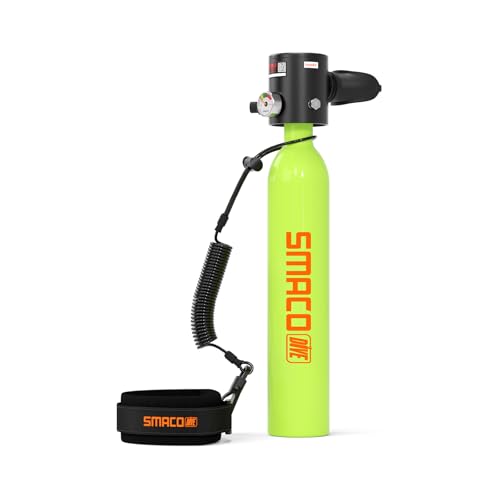
The SMACO S300 is the only 0.5-liter option here whose maker specifies both an approximate breath count and a 100-foot backup-use depth claim. The maker says it provides about 35 breaths at 200 bar and describes a built-in triple-layer filter. Its compact format may suit a diver looking for a small auxiliary cylinder, but the breath count is approximate and should not be treated as guaranteed dive duration. Depth, breathing rate and conditions affect air use; plan a conservative ascent and do not rely on a small tank as a primary supply.
Bottom line: Choose this if you want a 0.5-liter tank with a 100-foot backup-use claim.
OCEADIVEO Mini 0.5L

The OCEADIVEO Mini is a 0.5-liter portable cylinder with a corrosion-resistant aluminum build and a maker-claimed capacity of up to 35 breaths. It may suit a buyer who wants a small cylinder for shallow-water activity. Because the breath count is a maker claim without a pressure or depth in the fields, do not use it to calculate a safe dive duration.
Bottom line: Pick this for a small aluminum tank when a depth-specific claim is not your deciding feature.
0.5L Tank with Snorkel Mask

The 0.5-liter tank-and-mask combination is the only option that explicitly pairs a snorkel mask with the cylinder and gives a maximum depth of 30 feet. The maker estimates about six minutes of underwater breathing, while noting that depth, temperature and breathing rate affect that time. Its 6061 aluminum cylinder suits buyers focused on very shallow snorkeling rather than a deeper backup role. The hard 30-foot limit matters: choose another configuration for any planned dive deeper than 30 feet, and never treat an estimated duration as a reserve guarantee.
Bottom line: Choose this for snorkeling paired with very shallow underwater use within its 30-foot limit.
How to choose an air tank for diving
Start with the tank’s role: an auxiliary cylinder is not the same as a complete scuba system. Capacity, working pressure, regulator compatibility and fill method determine whether a cylinder fits a dive plan; a breath count alone does not establish safe duration. As a practical rule, if a product gives a maximum depth of 30 feet, do not plan to take it deeper. Compare actual capacity and included refill equipment, then account for breathing rate, depth and water conditions. For any dive requiring a dependable primary gas supply, choose appropriately rated scuba equipment and training rather than relying on a mini tank. Confirm the tank can be filled and serviced by a qualified dive shop before committing to a particular cylinder.
Mini scuba tank depth and breathing limits
A tank’s usable breathing time falls as depth and exertion increase, so a maker’s breath or minute estimate is not a fixed guarantee. At 33 feet of seawater, ambient pressure is about twice surface pressure, meaning a breath consumes roughly twice as much gas as it would at the surface. Cold water, current and stress can further raise air use. Use the maximum depth as a firm ceiling, and plan the ascent with a reserve rather than using the last available air. The 30-foot limit on a tank-mask set is materially different from a maker’s 100-foot backup-use claim; neither turns a mini cylinder into a complete independent dive system.
Refill and cylinder service basics
Refill access is a key ownership constraint: compressed-air cylinders require compatible fills, and not every home compressor is suitable for breathing air. Use a qualified dive shop or a compressor explicitly designed and maintained for breathing air, with the correct pressure and connection. In the United States, many common scuba cylinders undergo a visual inspection annually and a hydrostatic test at five-year intervals; cylinder specification and applicable rules can affect the schedule, so verify the stamped markings and service status with a qualified inspector. Never fill a damaged, overdue or unidentified cylinder. An empty-cylinder purchase also needs a fill plan before the first dive, not after arriving at the water.
Mini tank options by intended use
Choose by the need the cylinder is meant to meet, not by the biggest breath claim alone. A small tank can be useful only when its depth, capacity and refill arrangement fit the planned activity, and shallow snorkeling equipment is not interchangeable with a deeper-rated backup. The comparison below organizes these choices by their use and size.
| Need | What to prioritize | Product example |
|---|---|---|
| Auxiliary dive air | Capacity, compatible regulator and accessible carry | Spare Air Original 3 cu ft |
| Multiple refill routes | Adapter compatibility and a proper breathing-air source | OCEADIVEO 1.9L Tank Set |
| Snorkeling within 30 feet | Mask pairing and stated depth limit | 0.5L Tank with Snorkel Mask |
Regardless of format, remain within training limits and carry the primary equipment required by the dive plan. A compact cylinder should never be treated as permission to extend a dive or descend beyond its limit.
Frequently Asked Questions
How deep can a mini scuba tank go?
Use the specific model’s maximum depth as its limit; the tank-and-mask set here gives 30 feet, while another maker claims backup use to 100 feet. A depth claim does not replace training, a dive plan or the other equipment required for scuba diving.
How long does a 0.5-liter dive tank last?
The models claim up to about 35 breaths or about six minutes, depending on the model. Actual duration changes with depth, breathing rate, temperature and exertion, so do not use a headline estimate as guaranteed reserve time.
Can I refill a mini scuba tank at home?
Only use a compressor designed to deliver breathing air at the tank’s required pressure and with a compatible connection. A general-purpose air compressor is not automatically safe for breathing air; a local dive shop is an alternative fill route.
How often should scuba cylinders be inspected?
Many common scuba cylinders receive a visual inspection every year and a hydrostatic test every five years in the United States. The required schedule can depend on cylinder markings and applicable rules, so have a qualified inspector verify the individual tank’s status.
Is a mini scuba tank enough for a full dive?
A mini cylinder should not be treated as a replacement for a complete scuba system. Its capacity is small, and available breathing time changes with depth and exertion; use the equipment and training required for the full dive plan.