
Anti-Whining Dog Collar: 5 Options Compared

For a collar that specifically detects whining, Dogtra Smart NOBARK is the closest match because its detection includes whining and howling as well as barking. Choose a bark-only model only if barking is the behavior you want to address; a remote training collar is a different approach.
Whining can signal anxiety, discomfort, or a need, so identify the trigger before using a correction collar.
We earn a commission if you buy through links on this page. As an Amazon Associate I earn from qualifying purchases. Products are compared on manufacturer specifications, not hands-on testing.
- Best overall: Dogtra Smart NOBARK – Its detection includes whining and howling, with app controls and usage notifications.
- Best for bark differentiation: Garmin BarkLimiter Deluxe – Its bark-differentiating technology has automatic correction levels and vibration or manual modes.
- Best for adjustable sensitivity: FAFAFROG Smart Bark Collar – It offers five sensitivity levels and a 30-second pause after six consecutive activations.
| Product | Best for | Vocalizations detected | Controls or modes | Shop |
|---|---|---|---|---|
| Dogtra Smart NOBARK | Whining detection | Whining, barking, howling | Count, vibration, static 1–10, auto increase | Check Price on Amazon |
| Garmin BarkLimiter Deluxe | Bark differentiation | Barking | Automatic, vibration, manual 7 levels | Check Price on Amazon |
| FAFAFROG Smart Bark Collar | Sensitivity adjustment | Barking | 4 modes; 5 sensitivity levels | Check Price on Amazon |
| Koguzl Bark Collar 2-Pack | Two-collar set | Barking | 5 modes; 7 sensitivity levels | Check Price on Amazon |
| 4500FT Remote Dog Training Collar | Remote training | Barking among other behaviors | Beep 1–8; vibration 1–16; shock 0–99 | Check Price on Amazon |
Anti-Whining Dog Collars Compared
Start with whether a collar detects whining specifically or is designed for barking instead.
Dogtra Smart NOBARK

Unlike the bark-focused alternatives, this model is described as detecting whining and howling as well as barking. Its triple detection sequence is designed to verify vocal behavior and filter ambient noise and general motion; Dogtra says the app can control settings and send notifications within 33 feet, though the app is not required for operation. Modes include bark counting, pager vibration, static levels 1–10, and auto increase. The fit is for dogs as small as 10 lb. Its static option may not suit owners seeking vibration-only training.
Bottom line: Choose this if detecting whining, rather than barking alone, is the priority.
Garmin BarkLimiter Deluxe

For a bark-focused alternative, this collar distinguishes barking and offers automatic correction levels, plus vibration and manual modes with seven levels. Garmin says its Bark Odometer counts barks to help gauge effectiveness and that bark differentiation reduces false or excessive corrections. Stainless steel contact points are designed for different breeds and coat thicknesses. The compact unit measures 2.4 in high, 1.8 in long, and 1.5 in wide.
Bottom line: Pick this for bark-focused training with several correction modes.
FAFAFROG Smart Bark Collar

This bark collar stands out for adjustable sensitivity and a display that shows working status and power level. The maker describes two activation conditions: continued barking and vocal-cord vibration. It has four working modes and five sensitivity levels, and its protection mode pauses operation for 30 seconds after six continuous activations. The collar size is 27 in. The modes are presented for barking, not whining detection, so it is a less suitable choice when the vocal behavior to address is whining.
Bottom line: Choose it when bark sensitivity settings and a visible status display matter.
Koguzl Bark Collar 2-Pack
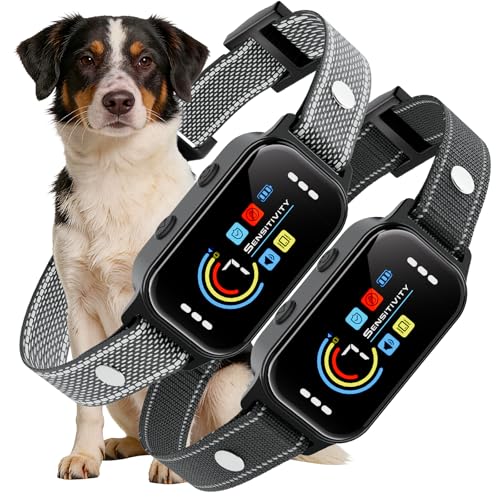
This is the only two-collar set among these options, and its dog range is 11–120 lb. Koguzl describes five training modes, seven sensitivity levels, an IP67 waterproof rating, and an auto-safety pause after three activations in 45 seconds. The maker also claims an anti-misfire chip reduces false triggers by 67%; treat that figure as a manufacturer claim, not an independent result. The product is bark-focused, so its modes do not make it a specific whining detector.
Bottom line: Consider it when you need two bark collars for dogs in its weight range.
4500FT Remote Dog Training Collar

Unlike the automatic bark collars, this remote training system is intended for several behaviors, including excessive barking, and gives the handler control over when to use a cue. It offers beep levels 1–8, vibration levels 1–16, shock levels 0–99, and a no-shock option; the product name gives a 4500 ft remote range. Its fit is 10–120 lb and a 7.8–24.4 in neck, with an IPX8 rating. It is not described as automatically identifying whining, so it requires a different training approach.
Bottom line: Choose it if you want remote-controlled cues for multiple behaviors, not automatic whining detection.
How to choose an anti-whining dog collar
Choose a collar that explicitly detects whining if that is the vocalization you want to address; bark detection alone does not establish whining detection. Compare the detection method, available cue types, and any fit limits before considering extra features. Vibration-only and static options are different training choices, and a setting count does not indicate how a dog will respond. Start by observing when whining occurs: separation, excitement, attention-seeking, and discomfort call for different responses. If vocalization is new, persistent, or paired with changes in behavior, consult a veterinarian before using a correction device. A collar should not replace identifying and addressing the cause.
Fit and safe use for dog collars
Measure the dog’s neck where the collar will sit and compare that measurement with the product’s size or range; weight alone does not guarantee a correct fit. Contact points should touch the coat and skin without being so tight that they restrict breathing or movement. Check the collar frequently for rubbing or irritation, and remove it if the skin becomes sore. Do not leave a training collar on continuously or use it on an unsupervised dog. A remote range or waterproof rating does not establish that a collar is suitable for every setting. If the fit cannot be confirmed from the range, verify it before ordering.
Automatic bark collars versus whining detection
Automatic bark collars respond to vocalization or related signals, while a remote collar lets the handler deliver a cue and the whining-focused option here is described as detecting whining and howling. The distinction matters: a barking-only detector may not respond to whining at all. Use this guide to match the mechanism to the behavior rather than treating all bark collars as interchangeable.
| Need | What to prioritize |
|---|---|
| Detect whining | Explicit whining detection |
| Address barking automatically | Bark recognition and trigger safeguards |
| Deliver cues remotely | Remote control and a no-shock option if wanted |
More modes do not necessarily mean a better fit; choose the simplest control method that matches the training plan.
What to do before correcting whining
First identify the trigger and meet basic needs; whining may accompany anxiety, discomfort, or a request to go outside. Reward quiet behavior and teach an alternative behavior, such as settling on a mat, rather than correcting every sound. Avoid triggering a collar when another dog or nearby noise causes the response, since an incorrect association can confuse training. Keep sessions short and consistent, and stop if the dog shows distress or the vocalization worsens. If whining begins suddenly or continues despite changes in routine, have a veterinarian check for a health or pain issue before relying on a collar.
Frequently Asked Questions
Can an anti-whining collar detect barking too?
Some can, but check for explicit whining detection rather than assuming a bark collar recognizes it. The whining-focused option here is described as detecting whining, barking, and howling.
How should I measure a dog for a collar?
Measure around the neck where the collar will sit, then compare that number with the collar size or range. A dog’s weight does not by itself confirm neck fit.
Should I use a correction collar for separation whining?
A correction collar does not address the cause of separation-related distress. Start with a veterinarian or qualified behavior professional, and avoid leaving a training collar on an unsupervised dog.
When should I stop using a dog training collar?
Stop if the collar causes skin irritation, distress, or a worsening behavior response. Remove it and reassess fit and approach; new or persistent whining merits veterinary advice.
Are vibration and static correction the same?
No. Vibration is a tactile cue, while static correction is a separate stimulation mode. Choose a device and settings consistent with your training plan, and avoid using a mode you are not prepared to manage safely.