
Archoil Diesel Fuel Additive: 3 Options Compared

For most diesel owners seeking an additive for ongoing use, Archoil AR6500 Diesel Treatment, 40 oz 2-Pack is the practical pick because its two 40-ounce bottles treat up to 800 gallons total. Choose Archoil Diesel Fuel System Kit, AR6400-D + AR6500 if you want a cleaner step before maintenance dosing, or Archoil AR6500 Diesel Treatment, 10 oz 4-Pack if smaller bottles are easier to store and measure.
Diesel fuel additives are concentrated products mixed into fuel for purposes such as cleaning or lubricity improvement; match the dose to the fuel volume and the product’s directions.
We earn a commission if you buy through links on this page. As an Amazon Associate I earn from qualifying purchases. Products are compared on manufacturer specifications, not hands-on testing.
- Best overall: Archoil AR6500 Diesel Treatment, 40 oz 2-Pack – Two 40-ounce bottles treat up to 800 gallons total.
- Best for a clean-and-maintain routine: Archoil Diesel Fuel System Kit, AR6400-D + AR6500 – Combines a 12-ounce AR6400-D cleaner with 40-ounce AR6500 treatment.
- Best for smaller bottles: Archoil AR6500 Diesel Treatment, 10 oz 4-Pack – Four 10-ounce bottles each treat up to 100 gallons.
| Product | Best for | Package | Treatment volume | Use | Shop |
|---|---|---|---|---|---|
| Archoil AR6500 Diesel Treatment, 40 oz 2-Pack | Regular fill-ups | Two 40-oz bottles | 800 gal total | Every fill-up | Check Price on Amazon |
| Archoil Diesel Fuel System Kit, AR6400-D + AR6500 | Two-step routine | 12-oz + 40-oz bottles | 30–40 gal cleaner; 400 gal treatment | Clean, then maintain | Check Price on Amazon |
| Archoil AR6500 Diesel Treatment, 10 oz 4-Pack | Smaller containers | Four 10-oz bottles | 400 gal total | Before fill-up | Check Price on Amazon |
Archoil diesel fuel additives
Compare the package sizes and intended dosing routines before choosing an Archoil fuel additive.
Archoil AR6500 Diesel Treatment, 40 oz 2-Pack
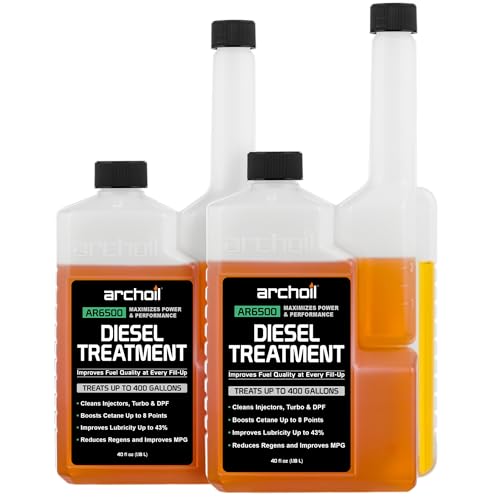
The two-bottle format distinguishes this AR6500 option, with up to 800 gallons of total treatment capacity. Each 40-ounce bottle treats up to 400 gallons, and the product is intended for use at each fill-up across diesel vehicles and equipment, including HPCR systems. The maker says it improves lubricity by 43% in ASTM D6079 testing and raises cetane by up to 8 points. This package suits owners who want a larger supply for routine dosing; its bottle size may be less convenient if you prefer smaller containers for storage or measuring.
Bottom line: Choose this if you want a larger AR6500 supply for recurring fill-ups.
Archoil Diesel Fuel System Kit, AR6400-D + AR6500

The cleaner treats 30–40 gallons, while the AR6500 bottle treats up to 400 gallons; both are intended for diesel vehicles and equipment, including modern HPCR systems. The maker says the cleaner removes injector deposits and restores spray patterns, and that AR6500 improves lubricity by 43% in ASTM D6079 testing. This pairing suits someone planning an initial cleaning step, but it is a less direct choice if you only want a single maintenance additive.
Bottom line: Choose this when you want a cleaner step followed by ongoing treatment.
Archoil AR6500 Diesel Treatment, 10 oz 4-Pack

Four smaller bottles make this AR6500 package easier to store or handle than the 40-ounce-bottle options. Each 10-ounce bottle treats up to 100 gallons, for 400 gallons total, and the product is added to the tank before filling. It is intended for diesel vehicles and equipment, including HPCR systems. The maker says it improves lubricity by 43% in ASTM D6079 testing and raises cetane by up to 8 points. The smaller package offers less total treatment capacity than the two-bottle option, so it may not suit owners who want to stock up for frequent use.
Bottom line: Choose this if compact bottles matter more than total treatment capacity.
How to choose an Archoil diesel additive
Choose by purpose first: routine treatment and a clean-then-maintain routine are different jobs. Never assume a capful or bottle covers a full tank without checking its labeled ratio. A useful decision rule is to choose the kit when you specifically want the cleaner step; choose a standalone AR6500 package when your priority is routine treatment.
Diesel additive dosing and tank volume
Measure the fuel going into the tank, not the vehicle’s advertised tank capacity, when calculating a dose. A partially filled tank needs less additive than a full tank if the product’s ratio is based on gallons treated. The AR6500 10-ounce bottle’s maximum is 100 gallons, and its 40-ounce bottle’s maximum is 400 gallons; the cleaner’s 12-ounce treatment range is 30–40 gallons. Do not exceed the product’s directions to try to intensify an effect. Additive concentration is also why accurate measurement matters when filling a small tank or treating equipment with a compact fuel reservoir. Keep containers closed and use a suitable measuring method that avoids spills.
What cetane and lubricity mean for diesel fuel
Cetane number describes diesel fuel’s ignition quality: a higher number indicates shorter ignition delay under standardized engine testing. ASTM D975 specifies a minimum cetane number of 40 for No. 2-D diesel fuel, although fuel quality and engine requirements can differ by grade and application. Lubricity is a separate property that matters because diesel fuel lubricates parts of the fuel system; the HFRR test in ASTM D6079 measures fuel lubricity, with ASTM D975 setting a maximum wear scar of 520 microns. These measures are not interchangeable: a cetane claim does not establish a lubricity result, and neither one alone predicts a particular vehicle’s performance. Treat product-specific claims as maker claims, not a guarantee for every engine.
Safe handling of diesel fuel additives
Diesel fuel and concentrated additives are combustible, so keep them away from flames, sparks, smoking materials, and hot surfaces while measuring or pouring. Work with the engine off, avoid breathing vapors, and prevent skin and eye contact; use protective gloves and eye protection when handling a spill risk. Store additive in its original, closed container away from children and pets, and clean up drips promptly rather than leaving a slick surface. Add the product to the fuel tank as directed, not to engine oil or another fluid system. If additive contacts eyes or skin, follow the container’s first-aid directions and seek medical advice when needed. Never transfer fuel chemicals to drink or food containers.
Frequently Asked Questions
How much AR6500 treats 100 gallons of diesel?
A 10-ounce AR6500 bottle treats up to 100 gallons, while a 40-ounce bottle treats up to 400 gallons. Match the amount to the fuel volume rather than automatically pouring a full bottle into a smaller tank.
When should I use the AR6400-D cleaner?
The 12-ounce cleaner dose treats 30–40 gallons, so check the fuel amount before dosing.
Does cetane number measure diesel lubricity?
No, cetane number relates to ignition quality, while lubricity concerns wear protection in fuel system components. ASTM D6079 uses an HFRR test to measure lubricity; ASTM D975 limits the wear scar for diesel fuel to 520 microns.
Can diesel additive be poured into a running vehicle?
Additive should be poured into the tank with the engine off, following the container’s directions. Keep the product away from ignition sources because diesel fuel and concentrated additives are combustible.
Can I use diesel additives in gasoline engines?
No, these Archoil products are identified for diesel engines and equipment, including HPCR systems. Use only a product intended for the fuel and engine type in your owner’s manual.