
Milwaukee Cordless Paint Sprayers: 5 Models Compared

For a Milwaukee 18V-compatible cordless paint sprayer, Cordless HVLP Sprayer, 1,200 mL stands out for its 1,200 mL container and stated 150 DIN/s maximum viscosity. These are third-party compatible sprayers, not Milwaukee-made tools; choose Vtuxcey Water-Based Sprayer, 4 Copper Nozzles instead if you use water-based paint and need to avoid latex.
Check that your exact battery model is compatible before ordering, and remember that these tools do not include a battery.
We earn a commission if you buy through links on this page. As an Amazon Associate I earn from qualifying purchases. Products are compared on manufacturer specifications, not hands-on testing.
- Best overall: Cordless HVLP Sprayer, 1,200 mL – Its 1,200 mL container and stated 150 DIN/s maximum viscosity distinguish it from the other options.
- Best for nozzle choice: DTEZTECH 200W Sprayer, 4 Copper Nozzles – It comes with four copper nozzles and has an airflow of 1,600 mL/min.
- Best for water-based paint: Vtuxcey Water-Based Sprayer, 4 Copper Nozzles – It is designed for water-based paint and expressly excludes latex paint.
| Product | Best for | Nozzles | Flow rate | Paint limit | Shop |
|---|---|---|---|---|---|
| Cordless HVLP Sprayer, 1,200 mL | Larger paint cup | — | 1,000 mL/min | 150 DIN/s max | Check Price on Amazon |
| Cordless HVLP Sprayer, 2 Nozzles | Simple cleanup | 2; 1 mm, 1.5 mm | — | — | Check Price on Amazon |
| DTEZTECH 200W Sprayer, 4 Copper Nozzles | Nozzle flexibility | 4 copper | 1,600 mL/min airflow | — | Check Price on Amazon |
| Vtuxcey Water-Based Sprayer, 4 Copper Nozzles | Water-based coatings | 4 copper; 1.0, 1.8, 2.5 mm, and — | — | Water-based only | Check Price on Amazon |
| Cordless Sprayer, 2 Nozzles | Thinner coatings | 2; 1.8 mm, 2.5 mm | — | Thin to 100 DIN/s | Check Price on Amazon |
Milwaukee-Compatible Cordless Paint Sprayers
Compare nozzle setups, flow figures and paint restrictions to find a sprayer that fits your project.
Cordless HVLP Sprayer, 1,200 mL

The 1,200 mL container is the distinguishing feature of this sprayer, which also has a brushless motor and a flow rate of 1,000 mL/min. It is compatible with a range of Milwaukee 18V lithium-ion battery models, including several 48-11 series packs, but the battery is not included. The maker says it handles coatings up to 150 DIN/s and names latex paint, stains and sealers among suitable materials. That viscosity ceiling is a limit, not a guarantee that every coating can be sprayed unthinned; follow the coating maker’s preparation guidance.
Bottom line: Choose this if a larger container and a 150 DIN/s ceiling suit your coating.
Cordless HVLP Sprayer, 2 Nozzles

A dust-blowing joint and a faucet-connected cleaning connector set this sprayer apart: one can blow dust from a surface before spraying, then connect the tool to help clear residual paint from its pipe. It has two nozzle sizes, 1 mm and 1.5 mm, and three spray patterns: horizontal, vertical and circular. The tool is intended for Milwaukee M18 18V batteries, which are not included. Its nozzle and pattern choices give buyers a defined setup for varied small projects, but the maker does not establish a viscosity ceiling; check that the coating is suitable for the sprayer before starting.
Bottom line: Pick this if the dust-blowing and faucet-cleaning connections are useful for your workflow.
DTEZTECH 200W Sprayer, 4 Copper Nozzles
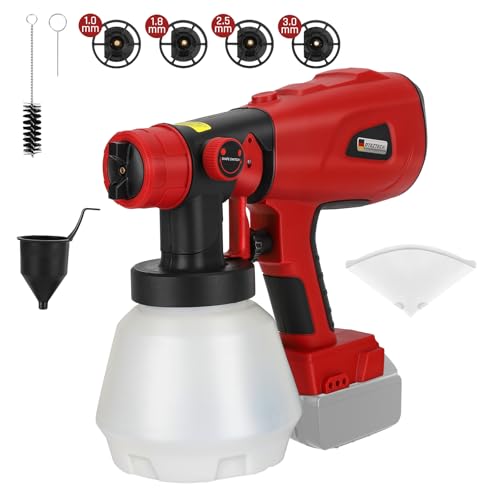
Four copper nozzles and an airflow of 1,600 mL/min distinguish this model from the two-nozzle options. Its 200 W brushless motor, spray-distance switch and pattern-adjustment knob are aimed at DIY projects such as furniture, fences and interior walls. The handheld sprayer is compatible with Milwaukee 18V batteries, sold separately. The maker identifies a broad range of home and yard uses, but airflow alone does not tell you the paint’s supported viscosity or the liquid delivery rate; confirm coating compatibility rather than treating the airflow figure as a paint-flow rating.
Bottom line: Choose this if having four copper nozzles matters more than a viscosity limit.
Vtuxcey Water-Based Sprayer, 4 Copper Nozzles

The key constraint is paint type: this sprayer is designed for water-based paint and is not suitable for latex paint. It includes four copper nozzles, with three sizes given as 1.0 mm, 1.8 mm and 2.5 mm, plus three spray patterns. Milwaukee 18V lithium-ion batteries are compatible, but the battery is not included. This is the clearest choice for someone specifically using a water-based coating who wants multiple nozzle options; it is the wrong fit if the planned coating is latex, regardless of nozzle selection.
Bottom line: Pick this for compatible water-based paint, not latex.
Cordless Sprayer, 2 Nozzles

This sprayer’s maker advises thinning paint to 100 DIN/s for finer atomization, a more restrictive preparation target than the 150 DIN/s ceiling given for Cordless HVLP Sprayer, 1,200 mL. It has two nozzles, 1.8 mm and 2.5 mm, and three spray patterns, and works with Milwaukee M18 18V batteries that are not included. That makes the paint-preparation instruction central to the choice: users who want to spray thicker coatings without thinning should consider another option and verify its limit. Clean the gun promptly after each session, as the maker advises.
Bottom line: Choose this if you can prepare the coating to the maker’s 100 DIN/s target.
How to Choose a Milwaukee-Compatible Paint Sprayer
Choose by coating compatibility first, then nozzle setup and container size. HVLP means high-volume, low-pressure: a turbine or motor moves air to atomize paint, while a fluid nozzle and needle meter the coating. Nozzle diameter affects which coatings can pass through, but a larger tip does not override a sprayer’s paint or viscosity limit. A DIN viscosity value is a flow-time measurement, not a percentage; compare readings only when the same cup and procedure are used. For a project with several coatings, check each coating maker’s thinning directions and the sprayer’s limit before filling the cup. A flow rate is not a coverage guarantee: material, spray distance and technique all affect how quickly a surface is coated.
Battery Fit and Cordless Run Time
Confirm the battery model number against the sprayer’s compatibility list before ordering; an M18 label by itself does not prove that every pack fits every aftermarket tool. Milwaukee 18V-compatible sprayers here do not include batteries. Cordless operation removes the extension cord, but battery capacity and motor load determine practical run time, so keep a charged spare ready for a large job. Do not rely on a battery estimate that is not tied to the exact pack and coating workload. For a small cabinet or chair, a handheld cup can be manageable; for a long fence, pauses to refill and clean may matter more than cordless convenience. Protect battery contacts from paint and rinse water during cleanup.
Spray Patterns, Distance and Overlap
Use a fan that matches the surface: a horizontal or vertical pass suits broad boards, while a smaller round pattern can help with narrow work. Hold the gun about 6 to 8 inches from the surface as a starting point, then adjust based on the tool and coating; too far can dry the spray before it lands, while too close can create runs. Move at a steady speed and overlap each pass by about half the fan width to avoid stripes and uneven coverage. Test the pattern on scrap first, keeping the gun moving before pulling the trigger and releasing it after the pass. Mask nearby surfaces because fine overspray travels beyond the workpiece.
Paint Preparation and Spray Safety
Prepare only the coating allowed by the sprayer, and strain paint if the coating maker recommends it or lumps could obstruct the nozzle. Thin by measurement rather than guesswork; changing viscosity changes atomization and coverage. Wear eye protection and a respirator selected for the coating and its safety data sheet, and provide strong ventilation. Keep spraying away from flames, pilot lights and sparks because many coatings release flammable vapors. Never spray toward people or animals, and do not use an indoor space without controlling overspray and ventilation. Clean the cup, nozzle and fluid path promptly after use with the cleaner appropriate for the coating; leaving paint to dry in a small passage can block the sprayer.
Frequently Asked Questions
What does DIN viscosity mean for paint spraying?
DIN viscosity is the time a liquid takes to flow through a specified cup opening, expressed in seconds. A 100 DIN/s instruction is a preparation target, not a universal paint-thinning ratio, so use the coating maker’s directions and the sprayer’s limit.
How far away should I hold a paint sprayer?
Start about 6 to 8 inches from the surface and keep the gun perpendicular while moving steadily. Adjust on scrap if the finish looks dry or begins to run, since coating viscosity and the sprayer affect the working distance.
How much should spray passes overlap?
Overlap each pass by about half the fan width for more even coverage. Keep your hand moving at a consistent speed, and test the pattern before coating the finished surface.
Can I spray latex paint with these tools?
Only use latex when the specific sprayer permits it and the coating can meet its preparation limits. The Vtuxcey model is expressly unsuitable for latex, while Cordless HVLP Sprayer, 1,200 mL names latex among its suitable materials and has a 150 DIN/s maximum.
How do I avoid clogging a cordless paint sprayer?
Strain coating when appropriate and clean the cup, nozzle and fluid path promptly after each session. Use a cleaner compatible with the coating, and never leave paint to dry in the nozzle or internal passages.
What safety gear should I use when spraying paint?
Use eye protection and a respirator suited to the coating’s safety data sheet, with strong ventilation. Keep spraying away from flames, pilot lights and sparks because many paints and coatings release flammable vapors.