
Ari Whitten Red Light Therapy: 5 Books Compared

Ari Whitten Red Light Therapy Guide is the direct match for Ari Whitten’s red light therapy guide; its full title signals a broad range of topics, while Summary of Ari Whitten’s Guide is a summary for readers seeking a shorter treatment of that book.
Choose another guide if you want a different stated focus, such as skincare or low-level laser therapy. These are books about red light therapy, not therapy devices.
We earn a commission if you buy through links on this page. As an Amazon Associate I earn from qualifying purchases. Products are compared on manufacturer specifications, not hands-on testing.
- Best overall: Ari Whitten Red Light Therapy Guide – The only full-length title here specifically attributed to Ari Whitten, with a broad topic range in its title.
- Best for a summary: Summary of Ari Whitten’s Guide – Its title identifies it as a summary of Ari Whitten’s guide.
- Best for laser focus: Rejuvenation: Red Light Therapy, Second Edition – Its title specifically centers on low-level laser therapy and a red laser pointer.
| Product | Best for | Title focus | Dimensions (H × W × D) | Weight | Shop |
|---|---|---|---|---|---|
| Ari Whitten Red Light Therapy Guide | Broad topic coverage | Broad topic range | 9.59 × 7.65 × 1.32 in | 1.25 lb | Check Price on Amazon |
| Red Light Therapy Book: Complete Guide | Broad guide alternative | Skin, hair, pain relief, recovery, sleep | 11 × 8.5 × 0.28 in | 0.67 lb | Check Price on Amazon |
| Rejuvenation: Red Light Therapy, Second Edition | Laser-focused reading | Low-level laser and red laser pointer | — | — | Check Price on Amazon |
| The Red-Light Therapy: Personal Health | Skincare emphasis | Skincare, acne, hair loss, weight loss | — | — | Check Price on Amazon |
| Summary of Ari Whitten’s Guide | Summary format | Summary of Ari Whitten’s guide | — | — | Check Price on Amazon |
Ari Whitten Red Light Therapy Books and Alternatives
Compare the directly named guide with related red light therapy books by their focus and available physical specifications.
Ari Whitten Red Light Therapy Guide
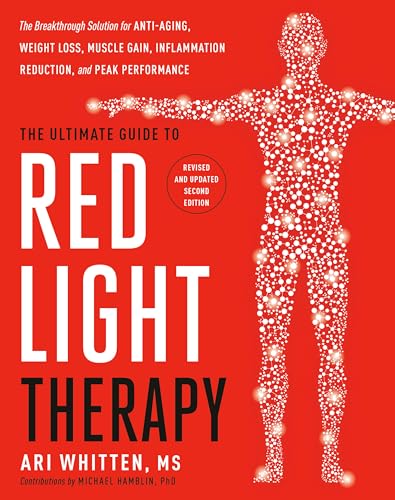
Ari Whitten Red Light Therapy Guide is the direct Ari Whitten match among these choices, and its title spans anti-aging, weight loss, muscle gain, inflammation reduction, and peak performance. The book measures 9.59 × 7.65 × 1.32 inches and weighs 1.25 pounds, useful figures if shelf or bag space matters. It suits readers looking for one broad guide rather than a narrowly focused title. The limitation is that the title alone does not establish the book’s specific protocols, evidence standards, or depth; readers who need those should inspect the contents before choosing.
Bottom line: Choose this if you want the directly named Ari Whitten guide and broad topical scope.
Red Light Therapy Book: Complete Guide

Red Light Therapy Book: Complete Guide is a broad alternative whose title explicitly names skin, hair, pain relief, recovery, sleep, cellular energy, protocols, and dosage. At 11 × 8.5 × 0.28 inches and 0.67 pounds, its dimensions differ from the Ari Whitten guide and may matter for storage. It suits readers who want a title that foregrounds protocols and dosage alongside several application areas. The title does not reveal how those protocols are supported or tailored, so readers seeking device-specific dosing should verify that the book addresses their equipment.
Bottom line: Pick this for a broad alternative whose title calls out protocols and dosage.
Rejuvenation: Red Light Therapy, Second Edition

Rejuvenation: Red Light Therapy, Second Edition stands apart by framing its subject as low-level laser therapy and specifically mentioning a red laser pointer. That makes it the most narrowly laser-oriented title in this group, rather than a general guide matching Ari Whitten’s broader subject list. It may suit readers who want to explore that particular approach. Its title also uses the word “treat,” but a title is not evidence that a method works for a given condition.
Bottom line: Choose this if the low-level laser and pointer focus matches your reading goal.
The Red-Light Therapy: Personal Health

The Red-Light Therapy: Personal Health is an alternative with a title focused on personal health and skincare, acne, hair loss, and weight loss. That emphasis differentiates it from the broader Ari Whitten title and from the laser-specific approach of Rejuvenation: Red Light Therapy, Second Edition. It may suit readers whose interest is centered on those topics. The title’s health-related wording should not be taken as proof of treatment outcomes, and the title gives no physical dimensions to compare. Readers who need a particular approach or evidence standard should confirm that the book covers it before selecting this guide.
Bottom line: Pick this for a title centered on skincare and personal health topics.
Summary of Ari Whitten’s Guide

Summary of Ari Whitten’s Guide is the only title here presented as a summary of Ari Whitten’s guide, making it a distinct option for readers who want a condensed treatment rather than another guide. It is related to the named book but is not the full-length guide itself. The title does not say how much content is condensed or whether it includes practical protocols, so it may not suit readers who need detailed guidance. No dimensions or weight are available for comparison; confirm the physical or digital format if that affects your choice.
Bottom line: Choose this when a summary, rather than the full guide, is what you want.
How to choose a red light therapy book
Choose by the questions you need the book to answer: device selection, dosing, wavelength, or a specific use. Red and near-infrared light are commonly discussed in different wavelength bands: roughly 630–660 nanometers for red and 810–850 nanometers for near-infrared. A useful guide should distinguish wavelength from irradiance, which is power per area, and from dose, which is energy per area. Prefer a book that explains how its recommendations apply to a particular device rather than treating all panels, masks, and lamps as interchangeable. If your main need is a summary, a summary title may fit better than a comprehensive guide; if you need specific protocols, verify that the book includes them and explains their limits.
Understanding wavelength, irradiance, and dose
Wavelength identifies the light band, while irradiance and exposure time determine the delivered energy per area. A common calculation is dose in joules per square centimeter = irradiance in milliwatts per square centimeter × seconds ÷ 1,000; for example, 50 mW/cm² for 200 seconds equals 10 J/cm². That calculation only works when irradiance at the treatment distance is known and measured appropriately. Device output, distance, beam spread, and treatment area can change exposure, so a number copied from one device may not transfer to another. Use a guide that makes those distinctions clear, and do not assume a book’s general example is a safe or suitable protocol for your equipment.
Red light devices and basic eye safety
Red light therapy devices include panels, wearable masks, and small lamps, and their size and output can differ substantially. Bright LEDs and lasers can pose eye hazards; never stare into a source, and follow the device’s eye-protection guidance, especially for high-output equipment or near-infrared light that is not readily visible. A book cannot replace the device’s safety instructions because the risk depends on output, distance, and exposure time. Buyers comparing books should look for plain explanations of eye precautions and the difference between red and near-infrared light. Treat a claim about a condition as a claim to evaluate, not as proof that a device or protocol will produce a particular result.
Using book dimensions to compare formats
Physical dimensions can help you decide whether a book suits a shelf, desk, or bag, but they do not show how much usable guidance it contains. A 0.28-inch-thick book will take less shelf depth than a 1.32-inch-thick one, while an 11-inch-tall book may need more vertical clearance than a 9.59-inch one. Check whether the format is print or digital when portability matters; a title alone does not establish that. For practical use, also consider whether you want a broad overview, a narrow topic focus, or a condensed summary. Choose the topic scope first, then use dimensions as a secondary fit check rather than as a proxy for quality.
Frequently Asked Questions
What is the difference between red and near-infrared light?
Red light is commonly discussed around 630–660 nanometers, while near-infrared is often around 810–850 nanometers. The bands differ in wavelength and visibility, so a guide should not treat them as interchangeable.
How do I calculate a red light therapy dose?
Multiply irradiance in mW/cm² by exposure seconds, then divide by 1,000 to get J/cm². For example, 40 mW/cm² for 250 seconds equals 10 J/cm², provided irradiance is measured at the treatment distance.
Can I look directly at a red light therapy device?
No; avoid staring into bright LEDs or laser sources, and use eye protection when the device guidance calls for it. Near-infrared light may be hard to see even though it can still reach the eyes.
Does a red light therapy book tell me which device to buy?
A book may explain device terms, but device output and treatment distance vary. Look for discussion of wavelength, irradiance, and measurement distance before applying any example protocol.
How long should a red light therapy session last?
There is no single session time that applies to every device, because dose depends on irradiance and exposure duration. Use the device-specific guidance rather than transferring a time from a different lamp or panel.