
Armstrong Once ‘N Done Floor Cleaner Concentrate Compared

Armstrong Once ‘N Done, 1 Gallon is the best fit for most buyers seeking Armstrong Once ‘N Done floor cleaner concentrate because it is a one-gallon concentrate for routine cleaning across several hard-floor materials.
Choose a smaller container if you need less concentrate; for instance, Armstrong Once ‘N Done, 64 oz is a 64-ounce bottle with a dilution of one capful per gallon of water.
We earn a commission if you buy through links on this page. As an Amazon Associate I earn from qualifying purchases. Products are compared on manufacturer specifications, not hands-on testing.
- Best overall: Armstrong Once ‘N Done, 1 Gallon – One gallon of concentrate is specified for routine cleaning across no-wax vinyl, ceramic, marble, granite, terrazzo, slate and stone.
- Best for dilution guidance: Armstrong Once ‘N Done, 64 oz – The 64-ounce bottle says one capful per gallon of water makes up to 32 gallons.
- Best for smaller storage: Armstrong Once ‘N Done, 32 oz – The 32-ounce size makes up to 16 gallons.
| Product | Best for | Bottle size | Surface guidance | Yield | Shop |
|---|---|---|---|---|---|
| Armstrong Once ‘N Done, 1 Gallon | Broad surface range | 128 fl oz | No-wax vinyl, ceramic, marble, granite | — | Check Price on Amazon |
| Armstrong Once ‘N Done, 64 oz | Known dilution ratio | 64 fl oz | Residential vinyl, Formica, fiberglass | Up to 32 gal | Check Price on Amazon |
| Armstrong Once and Done, 1 Gallon | Routine cleaning | 128 fl oz | No-wax vinyl, ceramic, marble | — | Check Price on Amazon |
| Armstrong Once ‘N Done, 32 oz | Smaller bottle size | 32 fl oz | No-wax vinyl, ceramic, marble, stone | Up to 16 gal | Check Price on Amazon |
Armstrong Once ‘N Done floor cleaner concentrates
Compare bottle size, surface guidance and stated dilution yield to choose a concentrate for your floors.
Armstrong Once ‘N Done, 1 Gallon
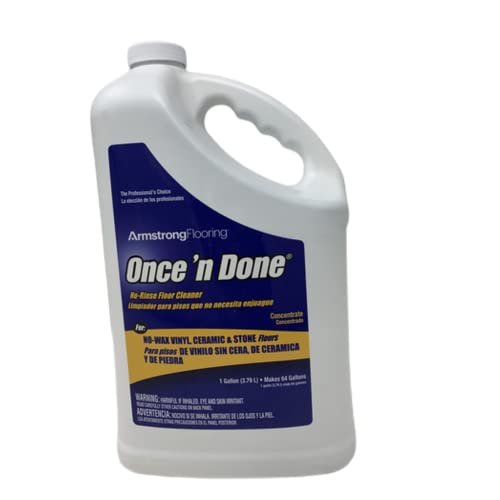
Armstrong Once ‘N Done, 1 Gallon names the broadest set of floor materials among these options: no-wax vinyl, ceramic, marble, granite, terrazzo, slate and stone. The one-gallon bottle is a concentrated formula intended for routine cleaning, and its features say it leaves no dulling or sticky film. Choose it when those surface types match the floors you need to clean and you want a larger container.
The maker does not give a dilution ratio, so confirm the mixing amount before use rather than guessing. It is not the smallest container here.
Bottom line: Choose this if you want a gallon and need its broad stated floor-surface range.
Armstrong Once ‘N Done, 64 oz

Armstrong Once ‘N Done, 64 oz is the only option with a mixing measure: one capful per gallon of water, with up to 32 gallons of diluted cleaner from the 64-ounce concentrate. Its surface guidance covers residential vinyl, Formica, fiberglass, rubber tile, asphalt tile, ceramic and terrazzo, and it says no rinsing is required. This makes it useful when you want a clear dilution direction and the surfaces fit your home.
The formula must be diluted; the product features explicitly say not to use it full strength.
Bottom line: Pick this if a capful-per-gallon dilution is your deciding factor.
Armstrong Once and Done, 1 Gallon
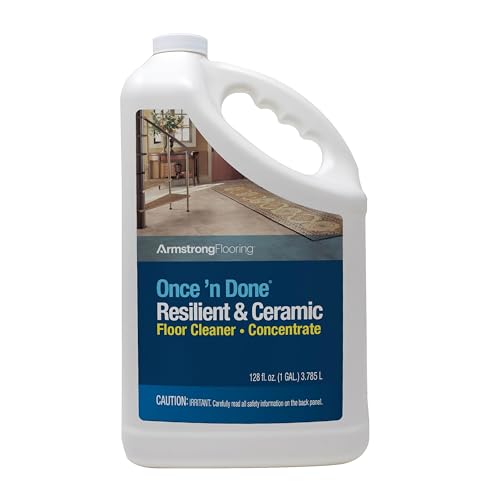
Armstrong Once and Done, 1 Gallon is a one-gallon concentrate with a succinct surface guide: no-wax vinyl, ceramic, marble and more. It is intended for routine cleaning, requires no rinsing and leaves no dulling film, according to its features. The size and routine-cleaning purpose make it a direct fit for buyers who want the gallon format without needing a longer named surface list.
The product features give no mixing ratio.
Bottom line: Choose this gallon when routine cleaning and no-rinse use match your needs.
Armstrong Once ‘N Done, 32 oz
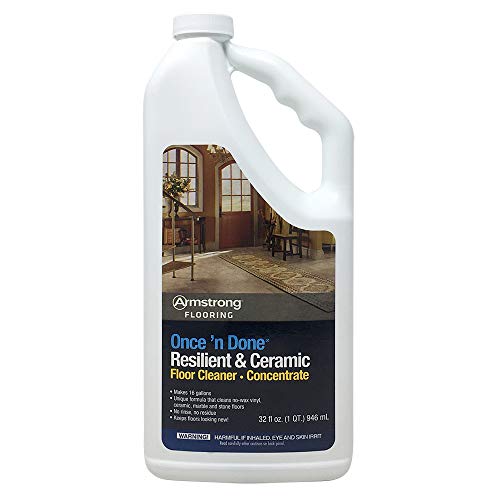
Armstrong Once ‘N Done, 32 oz is the smallest container here at 32 fluid ounces, and its features say the concentrate makes 16 gallons. It is intended for routine cleaning of no-wax vinyl, ceramic, marble and stone floors, with no rinsing and no dulling film. That combination suits a buyer who wants less concentrate on hand while still preferring a yield.
Check the intended dilution before mixing.
Bottom line: Pick this if you prefer a smaller bottle and its named surfaces fit.
How to choose an Armstrong Once ‘N Done concentrate
Start with the floor material and then compare container size and dilution guidance. No-wax vinyl, ceramic and marble appear across several of these options, while granite, slate and terrazzo are named in some surface lists but not all. For a floor not expressly named, verify compatibility before applying a cleaner.
Concentrates are mixed with water before use; the yield can help estimate how much ready-to-use solution a bottle provides. A capful-per-gallon direction is provided for the 64-ounce option, while the 32-ounce option gives a yield of 16 gallons without an exact ratio here. Do not infer a dilution measure from bottle size alone. Choose the package whose directions you can follow and whose surface guidance matches the floor.
Floor surface compatibility and finish
Use the surface list as a decision rule: if your floor is no-wax vinyl, ceramic or marble, each option names at least one of those materials; if it is granite or slate, the one-gallon option with the longer named list is the clearest match. The product features describe these formulas for routine cleaning, not specialized restoration or stripping.
“No dulling film” and “no rinsing” are product claims, not a substitute for a floor-material check. Sweep or vacuum grit before damp cleaning; abrasive particles can scratch many hard finishes when dragged under a mop. Avoid using a floor cleaner on an unlisted finish until compatibility is confirmed, especially on specialty coatings or delicate stone.
Concentrate dilution and routine cleaning
Measure concentrate rather than pouring by eye. The 64-ounce option specifies one capful per gallon of water and says it makes up to 32 gallons; the 32-ounce option says it makes 16 gallons. These yields make dilution important: full-strength use is expressly prohibited for the 64-ounce formula, and over-concentrating can leave cleaner residue.
For general floor care, remove loose debris first, use a damp rather than soaking-wet mop, and work in manageable sections. Excess water can seep into seams or edges, especially around resilient flooring. Let the cleaned surface dry before walking across it, and keep people and pets away from a wet floor to reduce slip risk.
Common mistakes with floor cleaner concentrate
The main avoidable mistake is assuming similarly named concentrates share identical directions. The 64-ounce option gives a capful-per-gallon measure, but that ratio should not be applied to another package unless its own directions confirm it. Use the package-specific measure and water amount.
Another mistake is treating “stone” as one uniform surface. Natural stone can vary in porosity and finish, and the surface guidance differs among the options. Match the named material, test a small inconspicuous area when the floor’s finish is uncertain, and avoid mixing the cleaner with other chemicals. Keep concentrate in its original container and out of children’s reach.
Frequently Asked Questions
How much Once ‘N Done goes in a gallon of water?
The 64-ounce formula says to use one capful per gallon of water. For other package sizes, use their own package directions rather than assuming the same cap measure.
Can Armstrong Once ‘N Done be used on marble floors?
Several of these concentrates name marble among their suitable surfaces, including the 32-ounce and one-gallon options. Confirm that your particular marble finish is compatible before cleaning.
Does floor cleaner concentrate need to be rinsed off?
The 64-ounce and 32-ounce product features say no rinsing is required. Use the intended dilution and avoid leaving excess solution pooled on the floor.
How long does a 32-ounce bottle of concentrate make?
The 32-ounce option says it makes 16 gallons of diluted cleaner. The precise water-to-concentrate measure is not included in that yield statement, so use its package directions.
Can concentrated floor cleaner be used full strength?
The 64-ounce formula specifically says not to use it full strength and gives a capful-per-gallon dilution. Dilute concentrates according to the directions for the exact package.