
Back to the Roots Potting Mix: 4 Blends Compared

For a general-purpose choice, Back to the Roots All-Purpose Potting Mix, 6 qt suits gardeners who want an organic, peat-free mix for herbs, vegetables, fruit and flowers in a 6-quart bag. Choose Back to the Roots Indoor Potting Soil, 12 qt for indoor plants, Back to the Roots 3-in-1 Seed Starting Mix, 6 qt for starting seeds, or Back to the Roots Succulent & Cacti Mix, 12 qt for succulents and cacti, where a faster-draining blend matters more than all-purpose use.
We earn a commission if you buy through links on this page. As an Amazon Associate I earn from qualifying purchases. Products are compared on manufacturer specifications, not hands-on testing.
- Best overall: Back to the Roots All-Purpose Potting Mix, 6 qt – The 6-quart all-purpose mix is intended for herbs, vegetables, fruits and flowers.
- Best for houseplants: Back to the Roots Indoor Potting Soil, 12 qt – The indoor mix includes mycorrhizae and yucca extract.
- Best for seed starting: Back to the Roots 3-in-1 Seed Starting Mix, 6 qt – The 3-in-1 blend is made for seeds, herbs, vegetables and flowers.
- Best for succulents: Back to the Roots Succulent & Cacti Mix, 12 qt – Perlite, horticultural sand and aged bark support faster drainage and aeration.
| Product | Best for | Package size | Intended use | Notable ingredients | Shop |
|---|---|---|---|---|---|
| Back to the Roots All-Purpose Potting Mix, 6 qt | Mixed plantings | 6 qt | Herbs, vegetables, fruit, flowers | Yucca extract, dolomitic limestone | Check Price on Amazon |
| Back to the Roots Indoor Potting Soil, 12 qt | Indoor houseplants | 12 qt | Indoor plants | Yucca extract, mycorrhizae | Check Price on Amazon |
| Back to the Roots 3-in-1 Seed Starting Mix, 6 qt | Starting seeds | 6 qt | Seeds, herbs, vegetables, flowers | Mycorrhizae, coconut coir, yucca extract | Check Price on Amazon |
| Back to the Roots Succulent & Cacti Mix, 12 qt | Cacti and succulents | 12 qt | Succulents and cacti | Aged bark, perlite, horticultural sand | Check Price on Amazon |
Back to the Roots potting mix options
Match the mix to the plant and growing stage first; the package size then helps determine how much to buy.
Back to the Roots All-Purpose Potting Mix, 6 qt
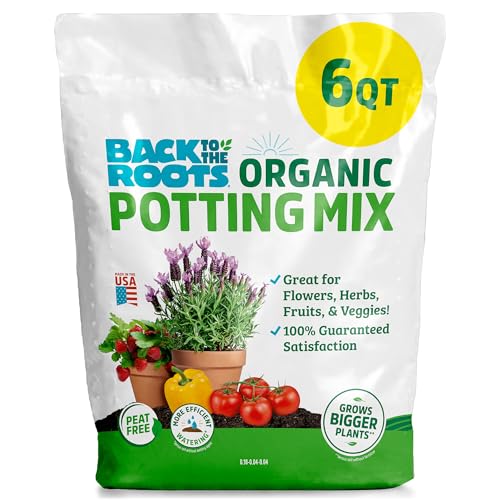
For general-purpose planting in a small quantity, this 6-quart blend is intended for herbs, vegetables, fruits and flowers. Back to the Roots says it is organic and peat-free, made with upcycled plant matter and wood fines, and includes yucca extract for moisture control plus dolomitic limestone for pH balancing. The bag size suits a few containers or a small planting task. It is not the specialized option for seed starting or succulents, so choose a purpose-built blend when those needs drive the decision.
Bottom line: Pick this for varied plants when you want one small all-purpose bag.
Back to the Roots Indoor Potting Soil, 12 qt

For indoor houseplants, this 12-quart mix is the dedicated option rather than a general garden blend. It contains organic yucca extract to help retain soil moisture, mycorrhizae for root development and nutrient uptake, and dolomitic limestone for balancing soil acidity and alkalinity. That makes it a fit for growers potting indoor plants such as pothos, monstera or ferns. The larger package may be more than needed for one small pot, and the mix is not described as a fast-draining cactus formulation; use the succulent-specific blend for that purpose.
Bottom line: Choose this for repotting several indoor plants.
Back to the Roots 3-in-1 Seed Starting Mix, 6 qt

For sowing seeds, this 6-quart 3-in-1 blend is the purpose-specific choice in this group. The organic, peat-free mix combines mycorrhizae, coconut coir and yucca extract; its uses include herbs, vegetables and flowers. Dolomitic limestone is also included for pH balancing. Choose it when planting begins with seeds rather than when you need a general potting medium for an established mixed planting. Its seed starting purpose makes it less suitable than the indoor blend for someone choosing soil specifically for a collection of houseplants.
Bottom line: Pick this when you are starting seeds rather than filling established pots.
Back to the Roots Succulent & Cacti Mix, 12 qt
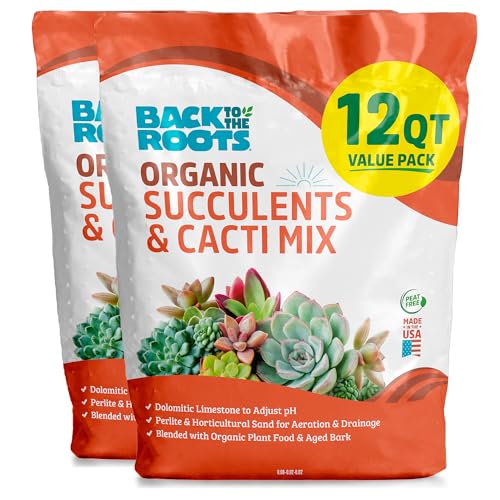
For cacti and succulents, this mix prioritizes drainage over the moisture-control emphasis of the all-purpose blends. Its aged bark supports soil structure and aeration, while perlite and horticultural sand are included to promote faster drainage and help avoid waterlogged soil. The 12-quart bag is the largest of the standard-size specialty mixes here. This is a narrower-use choice: it is designed for succulents and cacti, so a gardener potting herbs, vegetables or flowers should choose an all-purpose mix instead.
Bottom line: Choose this for succulents or cacti where rapid drainage is the priority.
How to choose a potting mix by plant
Choose by plant type and growing stage before comparing package size. Seed starting calls for a blend made for seeds, while established houseplants and outdoor containers can use a general potting mix if the plant does not need unusually fast drainage. Succulents and cacti are the exception: their roots are vulnerable to persistently wet soil, so a mix with coarse drainage components is a better match. Potting mixes are container media, not garden soil; their purpose is to provide a root zone with air, water and support in a confined pot. Use the table to narrow the blend by need rather than treating all-purpose soil and specialty mixes as interchangeable.
| Need | Mix type | Decision cue |
|---|---|---|
| Mixed herbs, flowers, vegetables | All-purpose potting mix | One blend for varied planting |
| Seeds | Seed starting mix | Choose for sowing and early growth |
| Cacti and succulents | Fast-draining mix | Look for coarse drainage ingredients |
For plants with specific soil preferences, match the mix to those needs rather than assuming a general blend is suitable.
Potting mix ingredients and drainage
Drainage depends on particle structure as well as watering habits. Perlite and horticultural sand create larger spaces in a mix, and aged bark can contribute structure and aeration; these ingredients suit plants that need excess water to move through the pot readily. Coconut coir and yucca extract are associated with moisture retention, so they can be useful where the goal is to hold water in the root zone. No ingredient guarantees correct watering: pot size, drainage holes, light and temperature all change how quickly a container dries. A practical rule is to use a pot with drainage holes for succulents and let the root zone dry between waterings rather than relying on soil to compensate for a pot that holds standing water.
Package size and how much mix to buy
Package size determines whether a blend is practical for a few containers or a large planting job. Six quarts is about 1.5 gallons, and 12 quarts is about 3 gallons; those amounts suit small home projects far better than a 60-cubic-foot bulk bag. One cubic foot equals about 7.5 gallons, so 60 cubic feet is roughly 449 gallons of mix. Container volume varies by pot shape, so measure the inside dimensions or use the pot maker’s volume before buying. A measurable choice rule: if you are filling only a handful of small pots, use a quart-size bag rather than opening a bulk quantity that may be difficult to store dry.
Common potting mix mistakes
Using garden soil in a container is a common mistake because dense soil can compact and restrict air around roots; choose a potting medium made for containers instead. Another mistake is applying the same watering schedule to every blend: a fast-draining cactus mix dries differently from a moisture-retentive indoor mix, and sunlight and pot size change the interval further. Do not leave pots sitting in water, especially for succulents and cacti, where prolonged wetness raises the risk of root rot. For new seeds, keep the medium evenly moist rather than saturated; a small seed tray can dry rapidly, but excess water can also deprive seeds of oxygen.
Frequently Asked Questions
Can I use indoor potting mix for outdoor plants?
Many ordinary container mixes can serve indoor or outdoor potted plants, but plant needs and weather matter. Outdoor pots in hot sun dry faster than indoor containers, so check moisture more often during warm, dry conditions.
How often should I replace potting mix in containers?
Refresh container mix about once a year for many actively grown houseplants, especially when it has compacted or drains poorly. Slow-growing plants may need less frequent repotting; root crowding and water movement are better cues than the calendar alone.
Should potting mix be wet before planting seeds?
Moisten seed starting mix before sowing so it is evenly damp, not waterlogged. Seeds need both moisture and oxygen, and standing water in a tray can reduce air around them.
Do succulents need pots with drainage holes?
Yes, drainage holes are strongly advisable because they let excess water escape from the root zone. A fast-draining mix still cannot prevent waterlogging if a pot retains standing water.
How much potting mix does a 10-inch pot hold?
A typical 10-inch round pot holds roughly 3 to 4 gallons, depending on its depth and shape. Check the pot’s capacity or measure the inside dimensions because wide, shallow pots hold less than deep ones of the same diameter.