
Covers for Metal Bed Frame Legs: Fit and Foam Compared

Jayen Foam Spiral Leg Covers suits most people seeking covers for metal bed frame legs because its flexible spiral wrap adjusts around different leg sizes without adhesive. Choose a sleeve instead if your frame leg fits its 0.6-inch inner opening; these foam guards cushion contact but do not support or stabilize the frame.
We earn a commission if you buy through links on this page. As an Amazon Associate I earn from qualifying purchases. Products are compared on manufacturer specifications, not hands-on testing.
- Best overall: Jayen Foam Spiral Leg Covers – The spiral design can be adjusted around different furniture leg sizes without adhesive.
- Best for 6-inch sleeves: ReliThick 6-Inch Foam Leg Covers – The sleeve measures 6 inches long and has a 0.6-inch inner diameter.
- Best for more legs: Tlence 8-Pack Foam Leg Covers – The pack contains eight 6-inch sleeves with a 0.6-inch inner diameter.
| Product | Best for | Pack count | Length | Inner diameter | Shop |
|---|---|---|---|---|---|
| Jayen Foam Spiral Leg Covers | Adjustable wrapping | 4 pieces | 6 in | — | Check Price on Amazon |
| ReliThick 6-Inch Foam Leg Covers | Fixed-size sleeves | 4 pieces | 6 in | 0.6 in | Check Price on Amazon |
| Tlence 8-Pack Foam Leg Covers | Eight-leg coverage | 8 pieces | 6 in | 0.6 in | Check Price on Amazon |
| 4-Piece Rubber Foam Leg Covers | Basic foam padding | 4 pieces | — | — | Check Price on Amazon |
Covers for Metal Bed Frame Legs Compared
Compare the wrap style, sleeve dimensions and pack count against your frame legs before choosing.
Jayen Foam Spiral Leg Covers

Jayen Foam Spiral Leg Covers stands apart with a slit spiral wrap rather than a straight sleeve, so the foam can be wound around a furniture leg without adhesive. The four black covers are made of NBR rubber and are intended for metal or wooden beds as well as other furniture. This is the most adaptable style here for buyers who do not want to slide a fixed-diameter sleeve over a leg. The tradeoff is that no inner diameter is provided, so measure the leg and confirm the wrap can cover its shape and circumference before ordering.
Bottom line: Choose this if an adjustable spiral wrap matters more than a fixed sleeve opening.
ReliThick 6-Inch Foam Leg Covers

ReliThick 6-Inch Foam Leg Covers is a straight reusable sleeve with a 6-inch length, 1.6-inch outer diameter and 0.6-inch inner diameter. Its EPDM rubber foam construction is intended to cushion bed legs and casters, and the four-piece pack is suited to a bed with four covered legs. The fixed opening makes leg fit the key limitation: compare the leg’s size and shape with the 0.6-inch opening before buying, especially for square or unusually wide metal tubing. The sleeve can be cut to length according to its product features.
Bottom line: Pick this for four legs that fit a 0.6-inch inner opening.
Tlence 8-Pack Foam Leg Covers

Tlence 8-Pack Foam Leg Covers provides eight NBR rubber sleeves, twice the count of the four-piece options, while retaining a 6-inch length and 0.6-inch inner diameter. The pack suits a frame or furniture setup with more legs to cover, or provides spares for replacements. Its sleeves are described as cuttable, which can help tailor length but does not enlarge the opening. Measure each leg before choosing: a wide or irregular metal leg may not pass through the fixed inner diameter. The black foam is a cushion, not a replacement for a proper floor protector or frame support.
Bottom line: Choose this when you need eight sleeves and the legs fit the opening.
4-Piece Rubber Foam Leg Covers
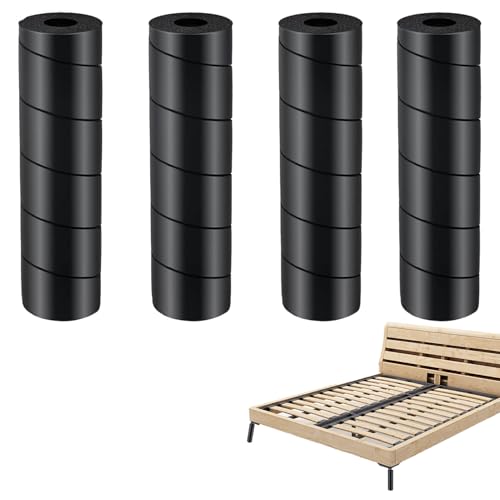
4-Piece Rubber Foam Leg Covers is a basic four-piece foam cover set with a rubber construction and a threaded seam for installation without glue. The closed round foam holes are intended to pad bed legs and casters, so it offers a removable alternative to adhesive-backed pads. Its distinguishing practical feature is the seam-based installation rather than a spiral shape or fixed sleeve dimensions. That makes checking leg fit especially important before purchase: compare the cover opening and the metal leg’s profile, and do not assume a square frame leg will fit a round opening. Foam padding will not keep a frame from shifting.
Bottom line: Pick this for a four-piece, no-glue foam cover if its opening fits your leg.
How to choose covers for metal bed frame legs
Choose by leg profile and size first, then by cover style and quantity. A sleeve with a 0.6-inch inner diameter is a close-fit option only when the frame leg can pass through that opening; a square tube with a larger diagonal can fail even when one side seems narrow. Measure the widest part of the leg, including any foot or cap that the sleeve must slide over. For a slit wrap, compare the wrap’s usable length with the leg’s circumference instead. Foam thickness and material affect cushioning, but neither turns a cover into a structural support. If a leg is wider than 0.6 inches or has a broad square profile, choose an adjustable wrap only after confirming it can fully encircle the leg.
Measure the leg before fitting a foam cover
Measure each leg at the point where the cover will sit; metal frames may use different profiles at the corner posts and center supports. For round legs, measure the outside diameter. For square tubing, measure both sides and account for the diagonal, since the diagonal is wider than either side. A straight sleeve must clear the largest part it passes over, while a wrap needs enough material to encircle the leg. Check whether the sleeve length leaves the frame foot and floor contact in their intended positions. If the leg is under 0.6 inches across, a sleeve with a 0.6-inch opening may be loose; if it is larger, it may not fit. Avoid forcing foam onto a leg.
Foam sleeves versus spiral leg wraps
Use a sleeve when a fixed opening fits the leg and a wrap when the leg size calls for an adjustable covering. Straight sleeves are pushed over the leg and can be cut shorter; slit wraps go around it without needing the end of the leg to be accessible. Either style can soften accidental contact, but neither should be used to level a bed or bear weight independently. The table summarizes the practical choice; fit still depends on actual leg measurements.
| Style | Fit check | Useful when |
|---|---|---|
| Fixed sleeve | Inner opening clears widest point | The leg is accessible from its end |
| Slit spiral wrap | Wrap can encircle leg | Sliding on a sleeve is inconvenient |
For floor protection, a soft toe cushion and a floor-contact pad solve different problems; check that the frame foot remains stable on the floor after fitting a cover.
Install and use bed leg covers safely
Install foam covers without adhesive only when their design permits it, and keep the frame foot firmly in contact with the floor. A cover that slips, bunches or lifts the leg can make the frame less stable, so remove it if the bed rocks or a leg no longer sits flat. Keep foam away from any hot component; foam materials are not heat shields. Check the cover periodically for tears, compression or looseness, particularly after moving the bed. These products cushion bumps, but they do not prevent all toe injuries and are not a substitute for keeping a clear path around the bed. For a metal frame with sharp edges, address the edge itself rather than relying on foam to repair structural damage.
Frequently Asked Questions
Will foam covers fit square metal bed legs?
A fixed sleeve with a 0.6-inch inner diameter may not fit a square leg whose diagonal exceeds the opening. Measure both sides and the diagonal, or verify that an adjustable wrap can fully encircle the profile.
Can bed leg covers protect hardwood floors?
Foam toe covers cushion contact but are not necessarily floor-protection pads. For hardwood, use a floor-contact protector made for the foot and make sure the frame remains stable and level.
Can I cut foam bed leg covers shorter?
The 6-inch sleeve options are described as cuttable, so trimming length is possible. Cutting changes length, not the 0.6-inch inner opening, so confirm fit before installation.
How many covers does a four-leg bed need?
A four-leg frame needs four covers if each leg is being covered. An eight-piece set leaves four extra for additional support legs or replacement, provided the same fit works for those legs.
Do foam leg covers keep a metal bed frame stable?
No; these covers provide cushioning, not structural support or leveling. Keep each foot fully on the floor, and remove a cover if it causes rocking or prevents firm floor contact.