
Backpacks for Feeding Tubes: Compare 4 Options

For a feeding tube backpack that fits bags up to 1,200 ml and names two compatible pump lines, choose Feeding Tube Backpack, Large. Choose LUXJA 500 ml Feeding Tube Backpack or Feeding Pump Backpack, Pink & Purple instead if you want a foil-lined bag, or pinklilycare Children’s Feeding Tube Backpack if you need a child-focused design; confirm pump and bag fit before ordering.
We earn a commission if you buy through links on this page. As an Amazon Associate I earn from qualifying purchases. Products are compared on manufacturer specifications, not hands-on testing.
- Best overall: Feeding Tube Backpack, Large – Accommodates feeding bags up to 1,200 ml and names Joey and Infinity Moog pump compatibility.
- Best for a 500 ml bag: LUXJA 500 ml Feeding Tube Backpack – Has straps for a 500 ml bag, tubing holes on both sides and a wipeable foil lining.
- Best for children: pinklilycare Children’s Feeding Tube Backpack – Includes a bag-hanging loop, a pump pocket and a tubing grommet.
- Best for pump access: Feeding Pump Backpack, Pink & Purple – Pairs a clear-window front pocket with a wipeable foil lining.
| Product | Best for | Bag capacity | Named pump compatibility | Lining | Shop |
|---|---|---|---|---|---|
| Feeding Tube Backpack, Large | Larger feeding bags | Up to 1,200 ml | Joey; Infinity Moog | — | Check Price on Amazon |
| LUXJA 500 ml Feeding Tube Backpack | Foil-lined storage | 500 ml | EnteraLite Infinity; Kangaroo Joey | Wipeable aluminum foil | Check Price on Amazon |
| pinklilycare Children’s Feeding Tube Backpack | Child-focused setup | 500 ml | — | — | Check Price on Amazon |
| Feeding Pump Backpack, Pink & Purple | Visible pump controls | — | EnteraLite Infinity | Wipeable aluminum foil | Check Price on Amazon |
Feeding Tube Backpacks Compared
Compare bag capacity, pump fit and access features to match a backpack to your feeding setup.
Feeding Tube Backpack, Large

For a larger feeding bag, this backpack supports bags up to 1,200 ml, more than the 500 ml capacity named for some other options here. The maker says it is designed for G, J and GJ tube setups and fits Joey and Infinity Moog pumps. A main compartment and multiple pockets provide room for the pump and other supplies; side mesh pockets offer quick access to small items. This is a sensible choice when you want extra capacity and storage. Its larger stated bag capacity may be unnecessary if your setup uses a smaller bag, so confirm the pump and bag fit before ordering.
Bottom line: Choose this if your feeding setup needs a bag capacity above 500 ml or you want extra supply storage.
LUXJA 500 ml Feeding Tube Backpack

The LUXJA is the clearest match for a 500 ml bag: interior straps hold the bag, while a separate mesh-and-buckle space accommodates a pump. Its wipeable aluminum foil lining and padded interior distinguish it from the options without a lining. Tubing holes on both sides and corner straps are intended to help route and secure tubing. The maker names EnteraLite Infinity and Kangaroo Joey compatibility. The bag is sized for children, so adults needing a larger bag or more room should consider a higher-capacity option instead.
Bottom line: Choose this for a 500 ml setup that benefits from separate pump storage and a wipeable liner.
pinklilycare Children’s Feeding Tube Backpack

For a child-focused setup, this backpack uses a small loop and carabiner to hang a feeding bag, plus a front-pocket grommet for the pump and a side grommet for tubing. The maker describes it for G, J and GJ tube use and says children can move while wearing it. That design may suit a caregiver seeking a wearable arrangement rather than a bag carried separately. The feature set does not name a compatible pump model, so check pump dimensions and the intended routing with the care team before relying on this bag for a particular setup.
Bottom line: Choose this for a child-focused bag-hanging and tubing-routing arrangement.
Feeding Pump Backpack, Pink & Purple
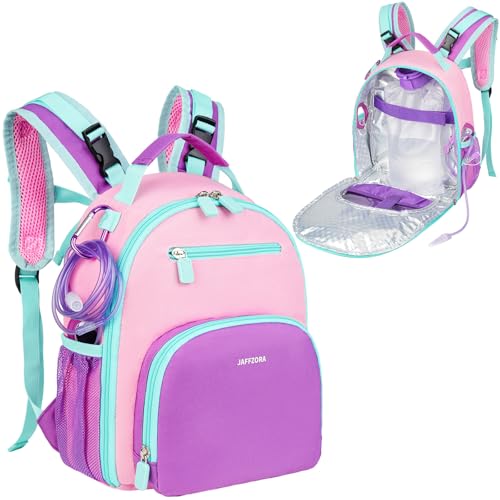
The clear-window front pocket is the distinguishing feature of this bag, allowing access to pump controls without opening the main compartment. It also has a wipeable aluminum foil lining, an elastic pocket with a hook-and-loop strap for an EnteraLite Infinity pump, a carabiner for extra tubing and two side pockets. The pump pocket measures 7.5 x 6 x 1.5 inches, which gives a concrete fit check for that device. The features name only the Infinity, so users of another pump should compare its measurements with the pocket before choosing this option.
Bottom line: Choose this if a clear-window pocket and a measured Infinity pump pocket suit your setup.
How to Choose a Feeding Tube Backpack
Start with the exact pump and feeding-bag dimensions, then compare the bag capacity and how the pump is secured. A capacity figure alone does not guarantee fit: pump pockets, straps and tubing openings vary by design. Match the bag to the pump manufacturer’s approved setup, and confirm fit before ordering if your pump model is not named. For a 500 ml bag, a backpack with dedicated bag straps can help keep the bag in place; a larger-capacity bag is useful only when your prescribed setup calls for it. Consider how tubing exits the bag, whether the pump controls remain accessible, and whether the interior can be wiped clean. Do not alter pump settings or feeding instructions to accommodate a backpack.
How to Route Tubing Through a Backpack
Route tubing through an intended opening and keep its path visible and free of sharp bends. A kink, compression or snag can interfere with flow, so check the full route from bag to the person before starting a feed and after changing position. Keep the pump secured as its instructions specify; a backpack is a carrier, not a substitute for the pump’s setup directions. Avoid placing heavy items where they press on the pump, bag or tubing. For children, a wearable bag does not replace caregiver observation: follow the care team’s positioning and supervision guidance, especially during sleep or active movement. If a setup requires a different tube route or pump position, resolve that with the clinician managing the feeding plan.
Cleaning and Everyday Care
Clean spills promptly, and use only a cleaning method compatible with the bag’s materials and the pump manufacturer’s instructions. A wipeable foil lining can simplify wiping the compartment, but it does not mean the entire backpack is washable or that medical equipment can be cleaned the same way. Keep the feeding pump and its connections dry unless their instructions explicitly allow otherwise. Separate formula-contact parts from the backpack when cleaning; the carrier is not a replacement for cleaning the feeding set. Inspect straps, buckles, seams and tubing openings regularly for damage that could let equipment shift or tubing catch. Before the next feed, confirm the pump is secure and the tubing is not trapped under a strap or pocket.
Frequently Asked Questions
Can a feeding tube backpack fit any enteral pump?
No; pump pockets and attachment methods vary, so a bag made for one model may not fit another. Compare the pump’s dimensions with the pocket dimensions, and verify compatibility when a model is not named.
How much can a feeding tube backpack carry?
Capacity depends on the bag design and the feeding setup. The options here include bags specified for 500 ml and one that supports bags up to 1,200 ml; choose the capacity your prescribed feeding bag requires.
Can a child move while wearing a feeding tube backpack?
Some child-focused bags are designed to be worn during movement, but caregivers still need to monitor the child, pump and tubing. Keep tubing clear of snags and follow the care team’s guidance for activity and positioning.
How should I clean a feeding pump backpack?
Wipe a wipeable lining with a method compatible with its material, and follow the pump maker’s cleaning instructions for the device itself. Do not assume that a wipeable interior makes the entire backpack machine-washable.
How do I keep feeding tube tubing from kinking?
Route tubing through the bag’s intended opening without tight bends, pinching or tension. Check the route after changing the bag’s position, since straps and movement can catch or compress tubing.