
Bar’s Oil Stop Leak: 4 Options Compared by Fit

Bar’s Leaks OS-1 Oil Seal Repair is the closest match for a general engine-oil leak because it targets seals and gaskets and also addresses oil burning. Choose Bar’s Leaks Rear Main Seal Repair instead for a rear main seal leak, or Bar’s Leaks 1334 One Seal Stop Leak for a minor leak when you want a product that also covers transmission or power-steering fluid.
Oil stop leak additives are poured into the lubricant system and are intended to address some seal-related seepage; they are not a substitute for repairing a damaged part or a serious leak.
We earn a commission if you buy through links on this page. As an Amazon Associate I earn from qualifying purchases. Products are compared on manufacturer specifications, not hands-on testing.
- Best overall: Bar’s Leaks OS-1 Oil Seal Repair – Its uses cover leaking main seals and gaskets as well as worn valve seals and guides.
- Best for rear main seals: Bar’s Leaks Rear Main Seal Repair – It is specifically designed for rear main seal leaks and also targets other oil leaks.
- Best for multiple fluid systems: Bar’s Leaks 1334 One Seal Stop Leak – One bottle is intended to treat a minor leak in an engine-oil, transmission-fluid or power-steering-fluid system.
| Product | Best for | Bottle size | Pack count | Intended scope | Shop |
|---|---|---|---|---|---|
| Bar’s Leaks OS-1 Oil Seal Repair | General engine leaks | 16.9 oz | 1 | Engine seals, gaskets, oil burning | Check Price on Amazon |
| Bar’s Leaks Rear Main Seal Repair | Rear main seals | 16.9 oz | 1 | Rear main, timing cover, cam seals | Check Price on Amazon |
| Bar’s Leaks 1334 One Seal Stop Leak | Multiple fluid systems | 11 oz | 1 | Engine oil, transmission, power steering | Check Price on Amazon |
| Bar’s Leaks 1334 One Seal, 5-Pack | Five-bottle supply | 11 oz each | 5 | Engine oil, transmission, power steering | Check Price on Amazon |
Bar’s oil stop leak options
Compare each formula by the leak type and fluid system it is intended to address.
Bar’s Leaks OS-1 Oil Seal Repair

Bar’s Leaks OS-1 Oil Seal Repair stands out for covering both oil leaks and oil burning, while the other options focus more narrowly on leaks or multiple fluid systems. The maker says it is designed for gasoline and diesel engines, including turbocharged and hybrid engines, and for 3-, 4-, 5-, 6-, 8- and 10-cylinder engines. The maker also says a vehicle is a candidate if it does not consume more than 1 quart of oil per day. That limit matters: severe oil consumption or a visibly damaged seal calls for diagnosis rather than relying on an additive.
Bottom line: Choose this for a general engine-oil leak when the vehicle fits the maker’s oil-consumption limit.
Bar’s Leaks Rear Main Seal Repair
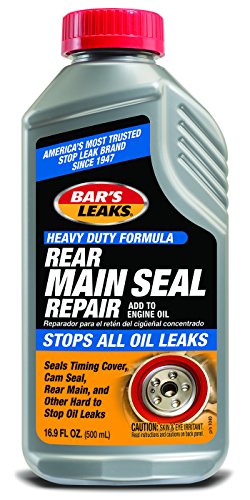
Bar’s Leaks Rear Main Seal Repair is the most targeted choice for a rear main seal leak, unlike the general oil seal treatment or multipurpose formula. The maker says to add the entire 16.9-ounce bottle to the crankcase, where engine oil is added, at or between oil changes, without overfilling. It also says most leaks stop within 100 miles or 2 days of driving. That is an expectation, not a guaranteed repair; a leak that continues, worsens or leaves oil pooling under the vehicle needs mechanical diagnosis.
Bottom line: Choose this when the leak is identified as a rear main seal or another listed engine seal.
Bar’s Leaks 1334 One Seal Stop Leak

Bar’s Leaks 1334 One Seal Stop Leak differs from the engine-specific options by also covering transmission and power-steering fluid leaks. The maker says one bottle treats one system leak and describes the product as intended for minor leaks from seals and gaskets associated with normal wear and age. That broad application can suit someone addressing one of those three fluid systems, but it does not establish that the product fits every fluid type or every leak. Identify which system is leaking before adding anything, and do not pour it into multiple systems based on the bottle’s cross-system use.
Bottom line: Choose this for one minor leak when the affected system is engine oil, transmission fluid or power steering.
Bar’s Leaks 1334 One Seal, 5-Pack

Bar’s Leaks 1334 One Seal, 5-Pack is the five-bottle version of the 11-ounce One Seal formula, so its distinction is package quantity rather than a different leak target. The maker describes each bottle as treating one engine-oil, transmission-fluid or power-steering-fluid system leak. That makes the pack relevant when several separate applications are planned, but a bottle is not a reason to treat a leak that has not been identified. Check the fluid system and its specified fluid before use; mixing products into the wrong reservoir can create a separate problem.
Bottom line: Choose this when you need multiple applications of the One Seal formula.
How to choose an oil stop leak
Match the additive to the leaking fluid and seal before choosing by bottle size. Engine-oil products are added through the engine-oil fill, while transmission and power-steering products go only into their respective systems; Bar’s Leaks 1334 One Seal Stop Leak is the only option here that names all three systems. A rear main seal leak points toward Bar’s Leaks Rear Main Seal Repair, while Bar’s Leaks OS-1 Oil Seal Repair is aimed at broader engine-seal concerns including oil burning.
Stop leak additives are generally intended to condition or swell compatible elastomer seals, not rebuild a worn bearing, replace a broken gasket, or close a crack. Use a measurable threshold: if the engine is losing more than 1 quart of oil per day, Bar’s Leaks OS-1 Oil Seal Repair’s maker says the vehicle is outside its candidate limit. A rapidly growing puddle or an oil-pressure warning also calls for prompt diagnosis rather than an additive.
How to add an oil stop leak safely
Add the product only to the fluid system named for it, and keep the engine at its correct fluid level. Engine oil expands as it warms, so check the level on level ground using the vehicle’s normal dipstick procedure; adding beyond the full mark can cause foaming or other engine trouble. For Bar’s Leaks Rear Main Seal Repair, the maker directs users to add the full bottle to the crankcase and specifically warns against overfilling.
Do not open a hot engine-oil fill cap when oil or engine parts may burn you, and wipe spills promptly because oil on a hot exhaust surface can smoke or ignite. Stop driving if the oil-pressure warning comes on; that warning signals a lubrication risk that a stop leak product cannot safely resolve. Confirm the leaking fluid before pouring anything in, since engine oil and transmission fluid use different reservoirs.
What oil stop leak can and cannot address
An additive may be a candidate for minor seepage from compatible seals, but a visible leak has several possible causes. Oil can come from a seal, gasket, filter, drain plug or a damaged component, and treating the wrong cause can delay the repair that actually stops the loss. A burning-oil smell or blue exhaust can also point to internal oil consumption rather than an external leak.
Use the leak’s location and rate as decision clues: a small seep with a stable dipstick level is different from oil dripping onto the ground or a falling level between checks. Bar’s Leaks OS-1 Oil Seal Repair includes oil-burning claims, whereas Bar’s Leaks Rear Main Seal Repair focuses on rear main and other seals; neither product’s use confirms the vehicle’s diagnosis. If leakage persists after use or the level drops quickly, arrange inspection and keep the engine properly filled meanwhile.
When to repair rather than use an additive
Choose mechanical diagnosis over a stop leak additive when the engine has an oil-pressure warning, a major leak, or oil consumption above the maker’s 1-quart-per-day limit for Bar’s Leaks OS-1 Oil Seal Repair. Additives cannot replace a damaged seal or gasket, and continued driving with low oil can cause serious engine damage. A technician can clean the area and trace the fresh oil to its source, which is more reliable than guessing from a stain under the vehicle.
Keep track of the dipstick level and note where and how quickly oil appears; those observations help distinguish seepage from a worsening leak. Do not combine several additives in the same crankcase unless the vehicle and product makers specifically permit it. For leaks involving more than one fluid system, identify each fluid separately and use a product only in its intended reservoir.
Frequently Asked Questions
How long does an oil stop leak take to work?
For Bar’s Leaks Rear Main Seal Repair, the maker says most leaks stop within 100 miles or 2 days of driving. That is a product-specific expectation, and a continuing or worsening leak needs diagnosis rather than repeated additive use.
Can oil stop leak fix a rear main seal?
Bar’s Leaks Rear Main Seal Repair is specifically designed for rear main seal leaks, but an additive cannot repair a physically damaged seal. If oil continues dripping or the level falls quickly, have the leak inspected.
Can I add oil stop leak between oil changes?
The maker says Bar’s Leaks Rear Main Seal Repair can be added at or between oil changes. Keep the crankcase below its full mark, because overfilling engine oil can cause problems.
Is blue smoke a sign of an oil leak?
Blue exhaust smoke can indicate that engine oil is being burned inside the engine rather than leaking externally. Check the oil level and seek diagnosis if smoke persists or consumption rises.
When should I stop driving with an oil leak?
Stop driving if the oil-pressure warning illuminates, because the engine may not have adequate lubrication. A fast-growing puddle or a rapidly falling dipstick level also warrants prompt inspection.