
Belt Sander With Vacuum Attachment: 3 Options Compared

For a handheld belt sander with a dust bag and vacuum adapter, choose Jellas 3-by-21-Inch Belt Sander; its 3-by-21-inch belt and 7-amp motor set it apart. Choose SKIL 3-by-18-Inch Belt Sander 7510-01 instead if you want to connect a standard 1-1/4-inch vacuum hose, or WEN 4-by-36-Inch Benchtop Belt and Disc Sander if a benchtop belt-and-disc machine better suits your workspace.
We earn a commission if you buy through links on this page. As an Amazon Associate I earn from qualifying purchases. Products are compared on manufacturer specifications, not hands-on testing.
- Best overall: Jellas 3-by-21-Inch Belt Sander – Includes a dust bag and a 2-in-1 vacuum adapter with a 3-by-21-inch belt.
- Best for standard vacuum hoses: SKIL 3-by-18-Inch Belt Sander 7510-01 – Fits standard 1-1/4-inch vacuum hoses and includes micro-filtration.
- Best for benchtop sanding: WEN 4-by-36-Inch Benchtop Belt and Disc Sander – Combines a tilting 4-by-36-inch belt with a 6-inch disc.
| Product | Best for | Belt size | Dust collection | Motor | Shop |
|---|---|---|---|---|---|
| Jellas 3-by-21-Inch Belt Sander | Adapter flexibility | 3 by 21 in. | Dust bag; vacuum adapter | 7 A | Check Price on Amazon |
| SKIL 3-by-18-Inch Belt Sander 7510-01 | Vacuum hose fit | 3 by 18 in. | Standard 1-1/4-in. hose; micro-filtration | 6 A | Check Price on Amazon |
| WEN 4-by-36-Inch Benchtop Belt and Disc Sander | Stationary projects | 4 by 36 in.; 6-in. disc | — | 4.3 A | Check Price on Amazon |
Belt Sanders With Vacuum Attachments
Compare handheld and benchtop formats, belt sizes and the dust collection setups that distinguish these options.
Jellas 3-by-21-Inch Belt Sander

Unlike the other options, this handheld sander includes both a detachable dust bag and a 2-in-1 vacuum adapter. Its 3-by-21-inch belt runs on a 7-amp motor, and six speed settings let you adjust the tool for different sanding tasks. The package includes ten aluminum-oxide belts from 40 to 180 grit and two C-clamps for securing the sander upside down as a bench tool. This suits buyers who want a longer handheld belt and multiple dust-collection choices. Its 9.7-pound weight may matter for extended overhead or one-handed work.
Bottom line: Pick this if you want a handheld tool with an included vacuum adapter and dust bag.
SKIL 3-by-18-Inch Belt Sander 7510-01

This is the only option explicitly described as fitting a standard 1-1/4-inch vacuum hose, making hose compatibility its distinguishing point. The 6-amp handheld sander also has micro-filtration, automatic belt tracking and pressure-control technology that warns when you apply excessive pressure. Flush-edge sanding is useful when working close to a surface boundary. Its 3-by-18-inch belt is shorter than the 3-by-21-inch belt on Jellas 3-by-21-Inch Belt Sander, so consider belt length if you want more contact area per pass. Choose it for a specified hose size and built-in pressure feedback.
Bottom line: Choose this if your vacuum hose is 1-1/4 inches and you want pressure feedback.
WEN 4-by-36-Inch Benchtop Belt and Disc Sander
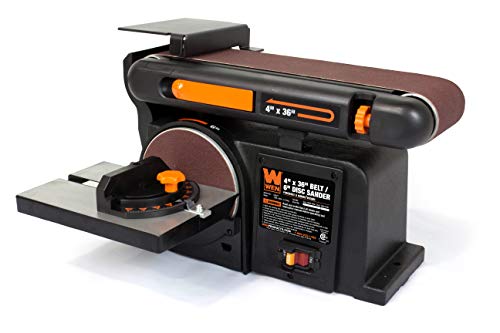
Unlike the handheld sanders, this WEN is a benchtop combination machine with a 4-by-36-inch belt and a 6-inch disc. The belt tilts from 0 to 90 degrees, and its cast-iron base is designed to reduce vibration. A 4.3-amp motor runs at up to 3,600 RPM, while a tension-release lever makes changing grits easier. This suits workshop tasks where a stationary belt and disc are useful. It is a partial fit for a vacuum-attachment search because its features do not establish a vacuum connection; confirm vacuum compatibility before choosing it for dust extraction.
Bottom line: Pick this for stationary belt-and-disc work, not when a confirmed vacuum hookup is essential.
How to Choose a Belt Sander With Vacuum Attachment
Choose by connection, belt size and how you plan to hold the work. A vacuum-ready port is useful only if the hose fits; SKIL 3-by-18-Inch Belt Sander 7510-01 specifies a standard 1-1/4-inch hose, while Jellas 3-by-21-Inch Belt Sander includes a 2-in-1 vacuum adapter and dust bag. Handheld sanders move over larger panels, while a benchtop machine holds the abrasive in place for smaller parts or controlled edge work. Belt length affects the area contacting the work: the 3-by-18-inch format has less belt length than a 3-by-21-inch belt. For frequent stationary sanding or disc work, the 4-by-36-inch belt and 6-inch disc on WEN 4-by-36-Inch Benchtop Belt and Disc Sander signal a different role. If you need vacuum extraction, confirm compatibility before choosing WEN 4-by-36-Inch Benchtop Belt and Disc Sander.
Belt Sander Grits and Sanding Sequence
Start with the least aggressive grit that can remove the material you need, then step up gradually. Coarse 40- to 60-grit abrasives remove material quickly, while 80- to 120-grit belts are more suitable for refining the surface; 150- to 180-grit can prepare many projects for final finishing. The included belts on Jellas 3-by-21-Inch Belt Sander span 40 through 180 grit. A belt sander removes material quickly, so keep it moving and avoid pressing hard or lingering in one spot, which can leave grooves or uneven areas. Sand with the grain when practical, and test the grit and motion on scrap before working a visible face. Belt-sander marks may still need finer sanding by hand or with another tool.
Vacuum Dust Collection and Safe Use
Vacuum connections and dust bags collect some sanding dust, but they do not eliminate airborne wood particles. Use a suitable dust mask or respirator and eye protection, and work with ventilation; wood dust can irritate the respiratory system. Keep the hose clear of the moving belt, secure the workpiece, and maintain a firm grip on handheld sanders. Before changing belts or clearing a jam, unplug the tool. Follow the sander’s belt direction and tracking setup so the belt stays centered. For a benchtop unit, clamp or bolt the base securely before sanding; a heavy base alone does not guarantee the machine cannot shift on a workbench.
Frequently Asked Questions
What vacuum hose size fits the SKIL belt sander?
The SKIL 7510-01 fits standard 1-1/4-inch vacuum hoses. Check the hose diameter before connecting it, since an adapter may be needed for other sizes.
Can I use a belt sander without a vacuum?
Yes, a dust bag can collect some debris, and sanding can also be done without a vacuum connection. Use ventilation and respiratory protection because dust collection does not capture every airborne particle.
What grit should I use first on wood?
Use the least aggressive grit that removes the material at an acceptable pace; 40 to 60 grit is a common coarse starting range for substantial stock removal. Start finer on smooth or delicate surfaces to reduce the risk of deep scratches.
How do I avoid gouges with a handheld belt sander?
Keep the running belt moving and use light, even pressure rather than holding it in one place. Practice on scrap first, since belt sanders remove wood quickly and can leave deep marks.
Is a benchtop belt sander suitable for large boards?
A benchtop belt sander holds the work against a fixed abrasive belt, so it is more suited to smaller parts and controlled shaping than moving a handheld sander across a large panel. Secure the machine to the bench and keep hands clear of the belt.