
Bendable Wire That Holds Shape: 5 Options Compared

For bendable wire that holds shape, the 3 mm Tenn Well armature wire is the strongest fit here because its maker describes it as stiff enough to hold a form while remaining bendable. Choose a thinner wire for jewelry wrapping or a thicker one for larger armatures, where added diameter matters more than flexibility.
We earn a commission if you buy through links on this page. As an Amazon Associate I earn from qualifying purchases. Products are compared on manufacturer specifications, not hands-on testing.
- Best overall: Tenn Well 9-Gauge Aluminum Wire – Its 3 mm diameter balances shape retention and bendability, with a 50-foot continuous strand.
- Best for delicate work: Tenn Well 18-Gauge Aluminum Wire – The 1 mm wire is suited to decorative jewelry and provides 165 feet.
- Best for large forms: Pelopy 1/4-Inch Aluminum Armature Wire – At 6 mm thick, it suits sculpting projects needing a heavier armature.
| Product | Best for | Diameter | Length | Shop |
|---|---|---|---|---|
| Tenn Well 9-Gauge Aluminum Wire | General armatures | 3 mm | 50 ft | Check Price on Amazon |
| Tenn Well 18-Gauge Aluminum Wire | Fine jewelry work | 1 mm | 165 ft | Check Price on Amazon |
| Pelopy 1/4-Inch Aluminum Armature Wire | Large sculpting forms | 6 mm | 20 ft | Check Price on Amazon |
| 3 mm Aluminum Craft Wire, 33 Feet | Shorter 3 mm coils | 3 mm | 33 ft | Check Price on Amazon |
| FIVEIZERO 14-Gauge Aluminum Wire | Long 14-gauge supply | 1.5 mm | 164 ft | Check Price on Amazon |
Bendable wire that holds shape
Compare wire diameter and coil length first, since thicker wire supports larger forms while thinner wire bends more easily.
Tenn Well 9-Gauge Aluminum Wire
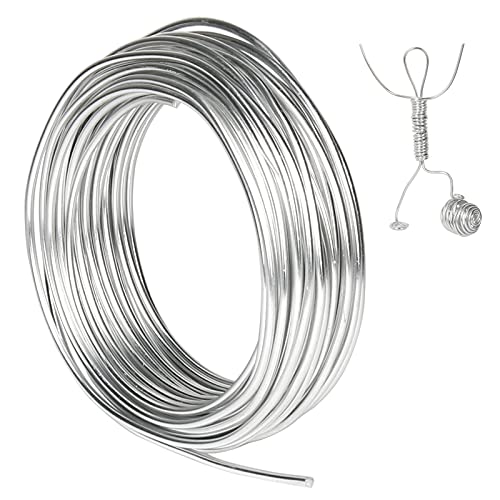
The 3 mm diameter makes this the balanced armature option: the maker says it is stiff enough to hold shape while remaining soft enough to bend. Its 50-foot continuous strand can be cut to length for sculpting, dolls, jewelry, floral arrangements, or bonsai training. The anodized 99.9% pure aluminum is corrosion-resistant and can be cut with wire cutters. Choose it when one medium-thick wire needs to serve several craft roles; delicate wrapping may be easier with a thinner gauge, while larger structures may need thicker wire.
Bottom line: Pick this for versatile armatures and forms that need a middle-ground wire thickness.
Tenn Well 18-Gauge Aluminum Wire

The 1 mm diameter and 165-foot length distinguish this coil for fine decorative work rather than heavy structural support. The maker describes the aluminum as soft and flexible, suitable for jewelry, beading, wire wrapping, and smaller sculpting or floral projects. It has an anodic oxide finish, is corrosion-resistant, and can be cut with wire cutters. Its thin profile is easier to bend into details, but that same thinness makes it a poor match for large armatures or forms that need substantial support.
Bottom line: Choose this for fine wraps and decorative pieces, not load-bearing forms.
Pelopy 1/4-Inch Aluminum Armature Wire

The 6 mm diameter is the thickest clearly sized wire among these options, making this 20-foot coil the choice for larger sculpting forms and doll armatures. The aluminum wire is described as bendable, rust- and fade-resistant, and easy to cut and affix. Its thickness can provide a more substantial framework than 1 mm or 3 mm wire, though shaping it into small jewelry details is less convenient. Choose this when the form itself is large enough to benefit from a quarter-inch armature rather than a fine wrapping wire.
Bottom line: Choose this for larger armatures where a 6 mm framework is useful.
3 mm Aluminum Craft Wire, 33 Feet

The 3 mm diameter matches a medium armature size, but this coil is 33 feet long rather than the 50-foot length of the other 3 mm option. The aluminum wire has a shiny silver surface and is described as flexible, easy to bend and cut, and reusable. It comes coiled, which the maker says helps avoid knots and tangles during use. This is a practical fit when a 3 mm wire suits the project and 33 feet is enough; buyers needing a longer continuous supply should compare the longer coil instead.
Bottom line: Pick this when 3 mm wire fits the project and a 33-foot coil is sufficient.
FIVEIZERO 14-Gauge Aluminum Wire

The 1.5 mm diameter and 164-foot coil place this wire between fine 1 mm jewelry wire and 3 mm armature wire. The maker positions aluminum as easy to shape and offers several gauges, but this selected size is 14 gauge. Its length suits many repeated wrapping or craft projects without moving to a thicker structural wire. The smaller diameter is useful for detail work, but a large sculpture needing a rigid support frame will generally call for a thicker diameter than 1.5 mm.
Bottom line: Choose this for long runs of medium-fine wire and repeated craft details.
How to choose wire that holds a shape
Start with diameter: thicker wire generally resists bending more, while thinner wire is easier to form into tight curves. Among these choices, 1 mm is the fine-work option, 1.5 mm and 3 mm cover intermediate craft uses, and 6 mm is the largest armature size. Match wire thickness to the scale of the form, not just the length of the coil. A useful decision rule is to use 1 mm for small wraps and details, and move to at least 3 mm when building a larger armature that must support its own shape. Aluminum is workable by hand, but repeated sharp bends can still weaken a metal wire.
Wire gauge and diameter for craft projects
Gauge numbers run in reverse relative to thickness: a lower gauge number means thicker wire. For these products, 18 gauge is 1 mm, 14 gauge is 1.5 mm, 9 gauge is 3 mm, and the quarter-inch wire is about 6 mm. Compare diameter in millimeters or inches rather than relying on gauge alone, especially when mixing wire from different suppliers. The table maps the main size choices to common project needs; project scale and desired bend resistance still decide the final fit.
Use this size guide to narrow the wire by the detail or structure you need.
| Diameter | Typical craft fit |
|---|---|
| 1 mm | Fine wrapping and jewelry detail |
| 1.5 mm | Medium-fine craft shaping |
| 3 mm | General armatures and bonsai training |
| 6 mm | Larger sculpting forms |
Cutting and shaping aluminum craft wire
Use wire cutters suited to the wire diameter; ordinary scissors are not the right tool for 3 mm or 6 mm metal wire. Cut a little longer than the final span, then shape the wire gradually around a form or with pliers to reduce kinks. Aluminum wire is easy to manipulate compared with stiffer structural metals, but a tight repeated bend concentrates stress in one spot and can cause fatigue or breakage. Keep cut ends pointed away from eyes and skin, and consider eye protection when cutting thicker wire because the cut end can spring or shift.
Choosing coil length and project fit
Coil length matters when a project needs long uninterrupted runs: the choices here range from 20 feet to 165 feet, while diameter changes how much wire is practical for each task. A longer, thinner coil offers more material for repeated decorative pieces, while thick armature wire consumes length more quickly in structural frames. Sketch the form and estimate its main spans before cutting so short coils are not wasted on oversized work. For bonsai training or repeated shapes, choose diameter by branch or framework size and wrap the wire without crushing delicate material; use a different thickness when the same coil feels too stiff to shape safely.
Frequently Asked Questions
What wire diameter is easiest to bend by hand?
The 1 mm aluminum wire here is the thinnest and is described by its maker as soft and flexible. Thicker 3 mm and 6 mm wire suits more substantial forms but requires more effort to shape.
Does thicker wire hold its shape better?
Generally, a larger diameter resists bending more than a thinner wire of the same material. For these options, 3 mm is a middle-ground armature size, while 6 mm is better suited to larger forms.
Can aluminum craft wire be cut with scissors?
Use wire cutters rather than household scissors for metal craft wire, especially at 3 mm or 6 mm diameter. Keep the cut end pointed away from your face because wire can shift as it is severed.
Which gauge is 3 mm craft wire?
A 3 mm wire is approximately 9 gauge in these products. Gauge conventions can vary slightly, so compare the diameter when matching wire across packages.