
Best 12 Volt Air Conditioner for Semi Trucks: 5 Picks

12V 12,000 BTU Mini Split suits most semi-truck sleepers because it pairs a claimed 12,000 BTU capacity with a claimed noise level below 50 dB. Choose a different model if you need a lighter unit, a current range, or a lower capacity.
These 12-volt split AC systems use a compressor and separate indoor and outdoor units; battery capacity and installation fit can matter as much as cooling capacity for parked use.
We earn a commission if you buy through links on this page. As an Amazon Associate I earn from qualifying purchases. Products are compared on manufacturer specifications, not hands-on testing.
- Best overall: 12V 12,000 BTU Mini Split – Its 12,000 BTU capacity and below-50 dB noise claim balance cooling and quieter rest.
- Best for current specs: 12V Split AC Kit, 12,000 BTU – It gives a 60–80 A current range, 960 W power rating and indoor and outdoor unit dimensions.
- Best for lower capacity: 12V DC Split AC, 9,000 BTU – Its 9,000 BTU rating is lower than the 10,000–12,000 BTU options.
| Product | Best for | Cooling capacity | Noise | Weight | Shop |
|---|---|---|---|---|---|
| 12V 12,000 BTU Mini Split | Quieter rest | 12,000 BTU | Below 50 dB | 45 lb | Check Price on Amazon |
| 12V Split AC Kit, 12,000 BTU | Electrical planning | 12,000 BTU | 45 dB | 58 lb | Check Price on Amazon |
| VEVOR 12V Mini Split, 10,000 BTU | Midrange capacity | 10,000 BTU | 65 dB | 56.44 lb | Check Price on Amazon |
| 12V DC Split AC, 9,000 BTU | Lower capacity | 9,000 BTU | 40 dB | 53 lb | Check Price on Amazon |
| 12V Mini Split, 12,000 BTU | Inverter compressor | 12,000 BTU | — | 60 lb | Check Price on Amazon |
12 Volt Air Conditioners for Semi Trucks
Compare the capacities and dimensions with your sleeper and electrical system before choosing a unit.
12V 12,000 BTU Mini Split

This model combines a claimed 12,000 BTU cooling capacity with a claimed noise level below 50 dB, distinguishing it from models with lower capacity or a 40–45 dB rating. It weighs 45 lb and includes a remote, inverter compressor and sleep mode. It is a reasonable match for a sleeper where quieter operation is a priority, provided the cab has room for the split components and the electrical system can support overnight use.
The dimensions are 12.6 × 6.3 × 18.1 inches; confirm the mounting clearances and component orientation before ordering.
Bottom line: Choose this if quieter rest and a 12,000 BTU capacity are your priorities.
12V Split AC Kit, 12,000 BTU

This model is the clearest choice for planning around current draw: its maker gives 60–80 A, 960 W and a 12 V rating, along with indoor and outdoor unit dimensions. The maker claims 45 dB operation. At the maximum current, a parked truck needs a battery system sized for sustained loads, not just a brief start-up; this matters especially for overnight cooling.
The 58 lb unit is heavier than the 45 lb and 53 lb options here. Check the mounting location and its load capacity before installation.
Bottom line: Choose this when a current range helps you plan the electrical system.
VEVOR 12V Mini Split, 10,000 BTU
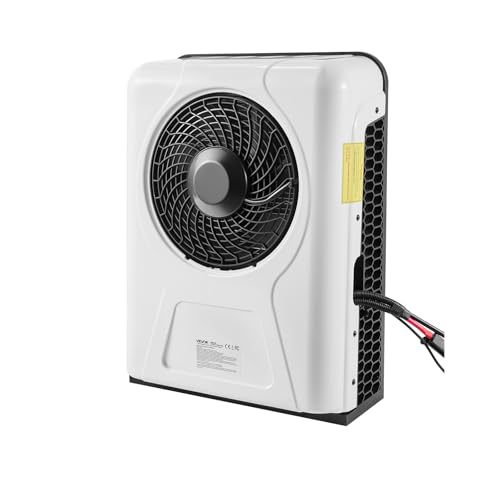
This VEVOR model has a 10,000 BTU cooling rating, between the 9,000 BTU and 12,000 BTU options in this group. The maker claims 400 m³/h airflow, 6–8 hours of operation on a 12 V battery and noise as low as 65 dB. Its 56.44 lb weight and 21.26 × 25.59 × 9.45 inch dimensions are useful for checking installation space.
The 65 dB noise claim is higher than the claimed figures for several alternatives, so sleepers who are sensitive to sound may prefer another model.
Bottom line: Choose this for a 10,000 BTU capacity and midrange cooling rating.
12V DC Split AC, 9,000 BTU

This model has the lowest capacity in the comparison at 9,000 BTU, making it the distinct option for buyers who do not need the 10,000–12,000 BTU ratings of the other units. The maker claims a 40 dB indoor noise level and recommends a battery capacity above 200 Ah; it also gives 850 W and approximately 60 A. At 53 lb, it is lighter than the 58 lb model but heavier than the 45 lb option.
Its recommendation is not a runtime guarantee: battery chemistry, usable capacity and other loads affect how long cooling can run.
Bottom line: Choose this if its lower stated capacity matches your cab and power plan.
12V Mini Split, 12,000 BTU

This 12,000 BTU model specifies a 20 cc scroll compressor and variable-frequency inverter operation, making its compressor description the differentiator among these choices. The maker claims it can cool the interior in 8 minutes and says the unit can run with the engine off; treat runtime as dependent on the battery setup and operating conditions. It weighs 60 lb, the heaviest of the five options.
Noise is described as quiet without a decibel figure, so buyers comparing sleeper sound levels numerically should favor a model with a rating.
Bottom line: Choose this if the 20 cc compressor specification matters more than a noise figure.
How to choose a 12 volt semi-truck air conditioner
Start with the sleeper’s heat load and the electrical draw, not the largest BTU number alone. A 12,000 BTU/h unit removes more heat per hour than a 9,000 BTU/h model under rated conditions, but sun exposure, insulation, window area and outside temperature change the cooling demand. For parked use, calculate battery runtime from usable amp-hours divided by the AC’s running amps; actual runtime will be shorter as voltage falls and other loads draw power. Compare noise ratings only when they use comparable measurement conditions. A difference of 10 dB is generally perceived as roughly twice as loud, though cab acoustics and measurement distance affect what sleepers hear.
Battery capacity and 12 volt current
A 12 V appliance drawing 60 A uses about 720 W at nominal voltage, while 80 A is about 960 W; current is a major constraint for engine-off cooling. A 200 Ah lead-acid battery bank typically offers about 100 Ah of usable capacity when limiting routine discharge near 50%, so a continuous 60 A load would theoretically use that in under two hours, before accounting for voltage drop, battery condition or other loads. Lithium batteries may allow a deeper discharge, but the battery’s approved discharge rate and management system set the limit. Use correctly rated fuses and wiring sized for current and cable length; have a qualified installer verify the circuit.
Measure the sleeper before choosing a split AC
Measure both the interior mounting area and the exterior location before selecting a split system. Allow room for the indoor unit’s air path and service access, and verify that the outdoor unit can reject heat without being blocked by bodywork or cargo. A 12 V compressor circuit can carry tens of amps, so cable length, routing, fuse location and terminals matter; a long run may require larger conductors to limit voltage drop. Check the truck’s available mounting structure and clearances, especially where an exterior unit sits near doors, windows or other equipment. Do not assume that a dimension set describes every component: compare the maker’s separate indoor and outdoor unit measurements where available.
Common mistakes with parked truck AC
The most common planning error is treating battery amp-hours as fully usable runtime. A 200 Ah battery is not necessarily a two-hundred-amp-hour cooling reserve: battery chemistry, safe discharge depth, age, temperature and starting or accessory loads reduce the amount available. Another mistake is relying on a cooling-capacity figure without considering cab insulation and direct sun; a poorly shaded sleeper can need more cooling than a smaller, well-insulated cab. Finally, engine-off cooling can leave a truck unable to start if the AC drains the starting battery. Use a separate appropriately protected house bank or a verified low-voltage cutoff arrangement, and confirm the truck’s charging system can safely replenish the bank.
Frequently Asked Questions
How many amps does a 12 volt truck air conditioner use?
At 12 V, 60 A is about 720 W and 80 A is about 960 W. Actual draw changes with compressor speed, ambient heat and operating conditions, so size wiring and protection for the unit’s specifications.
How long can a 12V truck AC run on batteries?
Estimate runtime by dividing usable battery amp-hours by the AC’s running amps. For example, a 200 Ah lead-acid bank with roughly 100 Ah available at a 50% discharge limit would theoretically run a 60 A load for under two hours, before other loads and losses.
Can a semi truck air conditioner run with the engine off?
A battery-powered 12 V system can run with the engine off if the battery bank and wiring support the load. Keep enough reserve to start the truck; a low-voltage cutoff or separate house battery can help protect the starting battery.
What does 12,000 BTU mean for a truck AC?
BTU/h is a cooling-capacity rating: 12,000 BTU/h is a higher rated heat-removal capacity than 9,000 BTU/h. Cab insulation, sun exposure and outside temperature affect whether that capacity is sufficient.
Is a quieter dB rating better for sleeping in a truck?
A lower decibel rating indicates less measured sound when ratings use comparable conditions. A 10 dB difference is generally perceived as roughly twice as loud, but installation and cab acoustics also affect sleeper noise.