
Best 24-Inch Undercounter Refrigerators Compared

EUHOMY 24-Inch Beverage Refrigerator suits most people looking for a 24-inch undercounter beverage refrigerator because its 23.4-inch width and front ventilation pair with a 37–65°F range. Choose a different unit if you need colder settings, a stainless-steel door, or a particular capacity format.
These beverage refrigerators chill cans and bottles in a cabinet sized for under-counter use; measure the opening and confirm ventilation needs before choosing one.
We earn a commission if you buy through links on this page. As an Amazon Associate I earn from qualifying purchases. Products are compared on manufacturer specifications, not hands-on testing.
- Best overall: EUHOMY 24-Inch Beverage Refrigerator – Its 23.4-inch width, front ventilation, and 37–65°F adjustment make it a flexible fit.
- Best for colder settings: Ca’Lefort 24-Inch Beverage Refrigerator – Its 34–54°F range reaches lower than the other temperature ranges.
- Best for mixed storage: Frigidaire Gallery 4.95-cu.-ft. Beverage Refrigerator – It gives 4.95 cu. ft. of capacity and adjustable glass shelves.
| Product | Best for | Width | Height | Temperature range | Shop |
|---|---|---|---|---|---|
| EUHOMY 24-Inch Beverage Refrigerator | Flexible installations | 23.4 in | 34.3 in | 37–65°F | Check Price on Amazon |
| Ca’Lefort 24-Inch Beverage Refrigerator | Colder drink settings | 23.8 in | 33.8 in | 34–54°F | Check Price on Amazon |
| Feelfunn 24-Inch Beverage Refrigerator | Quiet drink storage | 24.5 in | 34.3 in | 37–65°F | Check Price on Amazon |
| Icyglee 24-Inch Beverage Refrigerator | Stainless door finish | 23.4 in | 34.25 in | 37–65°F | Check Price on Amazon |
| Frigidaire Gallery 4.95-cu.-ft. Beverage Refrigerator | Larger mixed storage | 23.4 in | 33.9 in | — | Check Price on Amazon |
24-Inch Undercounter Refrigerators
Compare cabinet dimensions and temperature controls first, then match the unit to the drinks and installation space you have.
EUHOMY 24-Inch Beverage Refrigerator

At 23.4 inches wide, this beverage refrigerator is narrower than the other 24-inch models with dimensions provided, while its front ventilation supports built-in or freestanding placement. It holds up to 180 standard-sized cans and has three pull-out shelves that fit five height positions. The adjustable temperature range is 37–65°F, and the maker says the temperature variation will not exceed 3.6°F. It suits buyers who want movable shelf spacing and a broad drink-cooling range. Its silver glass-door design is less suited to anyone specifically seeking a solid stainless-steel door.
Bottom line: Choose it if a narrower cabinet and repositionable shelves matter.
Ca’Lefort 24-Inch Beverage Refrigerator

Ca’Lefort 24-Inch Beverage Refrigerator offers the lowest temperature range among these models, adjustable from 34 to 54°F, which may suit buyers who prefer drinks colder than the other ranges allow. Its cabinet is 33.8 inches high and 23.8 inches wide, and it holds up to 180 cans on three adjustable shelves. The maker says its compressor cooling uses 360-degree air circulation and includes automatic defrost to limit frost accumulation. This choice has a narrower upper temperature limit than models reaching 65°F, so it is less flexible for users who want warmer drink settings.
Bottom line: Pick it when a lower minimum setting is the deciding factor.
Feelfunn 24-Inch Beverage Refrigerator
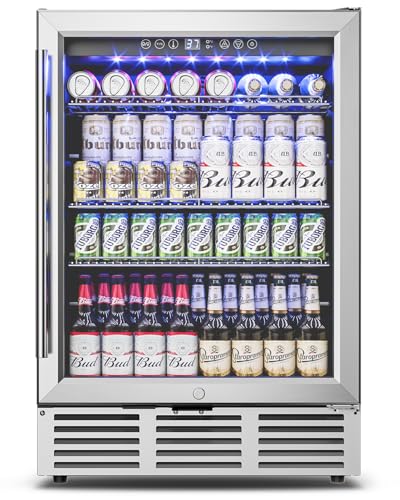
Feelfunn 24-Inch Beverage Refrigerator is the widest model with complete dimensions here at 24.5 inches, so it needs a little more width than the other measured cabinets. It stores up to 180 cans on three removable shelves and adjusts from 37 to 65°F. The maker describes the unit as operating below 40 dB and identifies a safety lock, glass door, and front vent for built-in or freestanding use. Its silver finish suits a beverage-focused setup. Buyers with a tight opening should compare the 24.5-inch cabinet width against the actual available space before choosing it.
Bottom line: Choose it if its lock and stated low-noise operation suit your setup.
Icyglee 24-Inch Beverage Refrigerator

Icyglee 24-Inch Beverage Refrigerator combines a stainless-steel door with a 23.4-inch width, making the door material its clearest distinction from the glass-door options. It holds up to 180 cans on three removable shelves, and the temperature control spans 37–65°F. The maker says the temperature memory feature restores the set temperature after a power outage, and the unit has soft LED lighting and adjustable bottom feet. Buyers should note that its width is still only one part of fit: the opening height and depth also need to accommodate the cabinet.
Bottom line: Select it if a stainless-steel door is more important than a glass display.
Frigidaire Gallery 4.95-cu.-ft. Beverage Refrigerator

Frigidaire Gallery 4.95-cu.-ft. Beverage Refrigerator stands apart with a 4.95-cubic-foot capacity rather than a can-count figure, making it useful for buyers organizing mixed beverage types. It is 23.4 inches wide and 33.9 inches high, with adjustable glass shelves, front venting, frost-free cooling, and a reversible door. The maker gives a 142-liter capacity figure as well. No temperature range is provided in the specifications, so this model is a weaker match when a specific cooling setting is essential; verify the control range before buying if temperature is a deciding requirement.
Bottom line: Choose it for adjustable mixed-beverage storage and a reversible door.
How to Choose a 24-Inch Undercounter Refrigerator
Start with the opening dimensions, not the nominal 24-inch label: the cabinets here range from 23.4 to 24.5 inches wide. Measure width, height, and depth at several points because trim, flooring, and an uneven cabinet can reduce usable clearance. Front-vented designs are intended to move exhaust air through the grille rather than needing side or rear exhaust space, but the grille must remain unobstructed. Confirm the manufacturer’s installation clearances before placing any unit in a tight enclosure. If the opening is under 24 inches wide, favor a model no wider than the measured space and allow for the required installation gap. Also choose by beverage temperature needs: the adjustable ranges span 34–54°F and 37–65°F.
Fitting a 24-Inch Beverage Refrigerator
Nominal 24-inch beverage refrigerators are not all 24 inches wide; listed cabinet widths in this group range from 23.4 to 24.5 inches. Check the product’s full width, height, and depth against the finished opening, including countertop overhang and base trim. Depth is especially easy to overlook when a door, handle, or plug projects beyond the cabinet body, so account for the actual installation profile. A front-vented appliance can be built into cabinetry only when its front grille has an open path for airflow; do not cover it with a toe kick or door panel. For freestanding placement, leave room to open the door and pull shelves out. Use the manufacturer’s required clearances rather than assuming every front-vented model installs identically.
Temperature Range and Drink Storage
Temperature range is a practical way to separate beverage coolers: the models begin between 34°F and 37°F and top out between 54°F and 65°F. Choose a lower minimum if you want the option to chill drinks more aggressively, and choose a higher maximum if you need flexibility for less-cold beverages. A beverage refrigerator is not a substitute for a food refrigerator unless its manual confirms that it can maintain safe food-storage temperatures; many beverage coolers are designed around drinks, not perishable food. Leave space around containers so cold air can circulate, and avoid blocking interior airflow with oversized bottles. Door openings and warm room conditions can make the cabinet work harder to recover its set temperature.
Can Count, Shelves, and Door Style
Can capacity is a planning estimate, not a guarantee that every mix of bottles and cans will fit: standard cans pack more efficiently than tall bottles or irregular containers. Several models here advertise 180-can capacity and three adjustable or removable shelves, while one uses a cubic-foot capacity figure instead. Measure taller bottles against the available shelf spacing before filling the cabinet, and keep heavier bottles on stable lower shelves. Glass doors show the contents but may allow more light exposure than solid doors; keep light-sensitive beverages away from direct sunlight. A reversible door can help with access in a tight room, but confirm the hinge can be switched before installation if the opening direction matters.
| Buyer need | What to compare | Selection rule |
|---|---|---|
| Narrow opening | Cabinet width | Choose a width smaller than the measured opening, with required clearance. |
| Colder settings | Lowest adjustable temperature | Favor the lowest minimum range that matches your drinks. |
| Mixed bottles and cans | Shelf adjustment and capacity format | Check shelf spacing, not only the can-count claim. |
| Built-in placement | Front vent and grille clearance | Keep the front airflow path unobstructed. |
Frequently Asked Questions
Can an undercounter beverage refrigerator go under a counter?
A front-vented model can be designed for built-in placement, but the grille must remain clear for airflow. Confirm the exact installation clearances and opening dimensions in its manual before fitting it into cabinetry.
What temperature should a beverage refrigerator use?
There is no single setting for every drink, but these models offer adjustment from 34°F to 65°F depending on the unit. Start with the beverage maker’s recommended serving range and adjust the cooler to suit the contents.
How much width does a 24-inch beverage fridge need?
The cabinets compared here are 23.4 to 24.5 inches wide, despite the shared 24-inch class label. Measure the opening and preserve the manufacturer’s required clearance rather than treating 24 inches as an exact cabinet width.
Can a beverage refrigerator store perishable food safely?
Do not assume a beverage cooler is suitable for perishable food; use one only if its manual confirms it maintains food-safe temperatures. Food refrigerators are generally kept at 40°F or below, so verify actual operating performance before storing perishables.
How many cans fit in a 24-inch beverage refrigerator?
Several models compared here advertise capacity for up to 180 cans, but bottles and mixed container sizes reduce usable space. Check shelf spacing and the dimensions of your tallest containers before relying on a can-count estimate.