
Best Adhesive for Upholstery Foam: 3 Sprays Compared

3M Foam Fast Spray Adhesive 74, Clear suits most upholstery-foam projects because it is designed for foam and fabric and offers 30 seconds to 15 minutes of adjustment time. Choose a different adhesive if you need foam-to-foam bonding called out directly, a multipurpose craft glue, or a product not limited to industrial use.
We earn a commission if you buy through links on this page. As an Amazon Associate I earn from qualifying purchases. Products are compared on manufacturer specifications, not hands-on testing.
- Best overall: 3M Foam Fast Spray Adhesive 74, Clear – Designed for foam and fabric, with a 30-second to 15-minute repositioning window.
- Best for foam-to-foam: Camie 313 Fast TACK Upholstery Adhesive – Formulated for foam-to-foam and foam-to-fabric bonds.
| Product | Best for | Bonding focus | Spray pattern | Size | Shop |
|---|---|---|---|---|---|
| 3M Foam Fast Spray Adhesive 74, Clear | Foam and fabric | Foam and fabric | Lace spray | 16.9 oz net | Check Price on Amazon |
| Camie 313 Fast TACK Upholstery Adhesive | Foam-to-foam bonds | Foam-to-foam, foam-to-fabric | Web spray | 12 oz | Check Price on Amazon |
| 3M Foam Fast Spray Adhesive 74 Low VOC | Industrial foam bonding | Foam and fabric | Lace spray | 19 oz net | Check Price on Amazon |
Upholstery Foam Adhesives Compared
Match the adhesive’s intended materials and application style to the surfaces you need to join.
3M Foam Fast Spray Adhesive 74, Clear

Designed specifically for foam and fabric, this industrial spray is the clearest fit for upholstery foam when you need time to position the pieces. The maker gives a 30-second to 15-minute working window and describes its tack as fast and aggressive for high-stress bonds. Listed uses include foam lamination and attaching foam or fabric to wood, as well as acoustic panels. The limitation is important: this product is for industrial or occupational use, so it is not the right pick for a casual household repair.
Bottom line: Choose this when you need an industrial foam-and-fabric adhesive with adjustment time.
Camie 313 Fast TACK Upholstery Adhesive
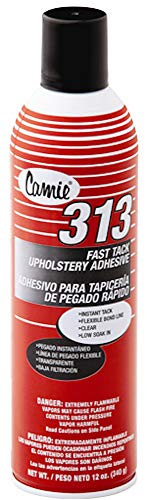
Unlike general fabric sprays, Camie 313 explicitly targets foam-to-foam as well as foam-to-fabric bonding. Its web spray pattern, low soak-in and instant tack suit upholstery assembly where excess adhesive soaking into foam is a concern. The maker says the resulting bonds can be flexible and temporary or permanent, and lists wood, particle board, cardboard, metal and fiberglass among additional surfaces. Its 12-ounce can is smaller than the larger sprays here, so it may be less convenient for extensive foam lamination.
Bottom line: Choose this for direct foam-to-foam or foam-to-fabric assembly.
3M Foam Fast Spray Adhesive 74 Low VOC

This version shares the foam-and-fabric focus and lace-spray format of the other 3M Foam Fast adhesive, while its distinguishing feature is the Low VOC designation and 19-ounce net weight. The maker gives a 30-second to 15-minute working window and lists upholstery, foam lamination, and foam or fabric attachment to wood among possible uses. The same industrial-use restriction applies, making it unsuitable for someone seeking an ordinary household craft adhesive. Its larger net contents suit a project needing more adhesive than a single smaller can.
Bottom line: Choose this industrial option when Low VOC designation and larger net contents matter.
How to choose an upholstery foam adhesive
Start with the foam and the surface it must bond to: foam-to-foam, foam-to-fabric, and foam-to-wood are distinct use cases. Spray contact adhesives commonly need coating on both surfaces, a brief flash-off, then firm contact; exact timing depends on the adhesive formulation. Open time is the window for positioning before the bond grabs, so a 30-second to 15-minute window favors careful alignment over instant assembly. For a direct foam-to-foam job, choose a formula that explicitly names that bond rather than relying on a general multipurpose claim. Apply a light, even coat: saturating foam can cause soak-through and a stiff, uneven area.
Spray patterns and upholstery fit
Spray pattern affects coverage more than the label’s broad surface list. A lace or web pattern lays down strands with gaps, while a fine mist spreads more continuously; test a small scrap to gauge overspray and soak-in before coating the upholstery. Foam can be open-cell or closed-cell, and backing fabric, plastic, or painted metal may each change adhesion, so match the named substrate as well as the foam. As a practical rule, for seams and small patches choose a controlled, low-soak pattern; for broad panels choose a spray designed for foam coverage. Protect surrounding material because aerosol overspray can mark surfaces.
Upholstery adhesive safety and application
Aerosol adhesives can create flammable vapors, so work with strong ventilation and keep the spray away from flames, sparks, heaters and smoking. Industrial-use wording is a meaningful limit: select a product intended for the setting and user rather than assuming every spray is household-safe. Cover adjacent upholstery and wear eye protection; spray in short, even passes instead of pooling adhesive in one spot. Let the coating reach the adhesive’s specified tack before joining, then press evenly across the bond. A scrap test helps catch discoloration or soak-through before visible fabric is involved.
Which upholstery foam adhesive fits the job
Use the intended bond as the deciding factor: a dedicated foam-and-fabric formula fits broad upholstery assembly, while a foam-to-foam formulation is more directly suited to joining foam blocks or layers. Automotive headliners and trim can require bonding foam or fabric to metal or plastic, so surface compatibility matters as much as the foam itself. A multipurpose craft spray can cover varied materials, but its broad use does not establish suitability for every foam. For a small repair, prioritize controllable application and low soak-in; for large lamination work, consider open time and net contents.
| Job | Choose by | Key check |
|---|---|---|
| Foam to foam | Explicit foam-to-foam use | Soak-in and working time |
| Foam to fabric | Foam-and-fabric formulation | Coverage and repositioning |
| Foam to hard backing | Named backing material | Compatibility with the surface |
Frequently Asked Questions
Can spray adhesive soak into upholstery foam?
Yes, excess adhesive can soak into open-cell foam and leave a stiff or uneven patch. Use light, even passes and test on scrap foam before treating a visible area.
Should upholstery spray adhesive go on both surfaces?
Many contact-style spray adhesives call for coating both surfaces before joining, but the required method depends on the formula. Respect the product’s tack window; joining too early can weaken handling and alignment.
How long should spray adhesive tack before joining foam?
The wait depends on the adhesive: one foam spray here allows 30 seconds to 15 minutes for repositioning. Follow the specified window for the chosen formulation rather than using a universal wait time.
Is aerosol adhesive safe to use indoors?
Aerosol adhesive requires strong ventilation because the spray creates vapors, and flammable formulations must be kept away from ignition sources. Industrial-use-only products should not be assumed suitable for casual indoor household repairs.