
Room Dividers to Keep Cats Out: 5 Options Compared

For separating a room from cats, Reinforced 72-Inch Retractable Cat Gate is the closest match because its retractable barrier stands 72 inches tall and fits openings up to 55 inches wide. Choose Single-Panel Freestanding Privacy Screen or Four-Panel Folding Privacy Screen instead when privacy matters more than blocking a pet; the screen doors in Upgraded Pet Screen Door, 36 x 81-Inch and QWR Pet Screen Door, 36 x 84-Inch attach across door openings but are not freestanding room dividers.
We earn a commission if you buy through links on this page. As an Amazon Associate I earn from qualifying purchases. Products are compared on manufacturer specifications, not hands-on testing.
- Best overall: Reinforced 72-Inch Retractable Cat Gate – A 72-inch-tall retractable barrier covers openings up to 55 inches wide.
- Best for shorter doorways: Upgraded Pet Screen Door, 36 x 81-Inch – The mesh screen fits openings up to 36 by 81 inches and closes with zippers.
- Best for broad privacy: Four-Panel Folding Privacy Screen – Four panels span 88 inches wide and stand 71 inches tall.
| Product | Best for | Barrier type | Maximum width | Height | Shop |
|---|---|---|---|---|---|
| Reinforced 72-Inch Retractable Cat Gate | Wide doorways | Retractable mesh gate | 55 in | 72 in | Check Price on Amazon |
| Upgraded Pet Screen Door, 36 x 81-Inch | Shorter openings | Zipper mesh screen | 36 in | 81 in | Check Price on Amazon |
| QWR Pet Screen Door, 36 x 84-Inch | Taller openings | Vinyl-coated wire mesh | 36 in | 84 in | Check Price on Amazon |
| Single-Panel Freestanding Privacy Screen | Visual privacy | Freestanding panel | 60 in | 75.6 in | Check Price on Amazon |
| Four-Panel Folding Privacy Screen | Wide privacy | Folding panel screen | 88 in | 71.3 in | Check Price on Amazon |
Room dividers to keep cats out
Match the barrier to your opening and decide whether pet containment or visual privacy matters more.
Reinforced 72-Inch Retractable Cat Gate

For a doorway barrier rather than a room-spanning privacy screen, this retractable gate combines the greatest height here with coverage up to 55 inches wide. Its mesh rolls up when unused, and reinforced support rods are intended to limit sagging and crawling underneath. The height and opening range suit homes where a shorter barrier may be easy for a cat to clear. Before choosing it, measure the opening: the width range ends at 55 inches, so wider spaces need another solution.
Bottom line: Choose this for a doorway within 55 inches wide where a tall, retractable pet barrier is the priority.
Upgraded Pet Screen Door, 36 x 81-Inch

Unlike freestanding panels, this mesh screen is sized to cover a door opening up to 36 inches wide and 81 inches high. Double zippers allow passage through the screen, and its see-through construction can separate pets while they see and smell one another. That makes it suited to a standard-height doorway where a visual connection is useful. It is not an opaque room partition, and the size applies to the opening rather than the frame; measure the clear opening before selecting it.
Bottom line: Choose this for a doorway no larger than 36 by 81 inches when a zippered mesh separator suits the space.
QWR Pet Screen Door, 36 x 84-Inch

This screen door differs from the shorter mesh option by fitting openings up to 84 inches high while retaining a maximum width of 36 inches. Its features specify thickened vinyl-coated steel-wire mesh and reinforced stitching, aimed at resisting clawing and climbing. The black mesh can divide adjoining areas while preserving visibility, but it does not provide the visual privacy of an opaque panel. The opening size, not the surrounding frame, determines fit, so measure both width and height before deciding.
Bottom line: Choose this for a narrow, taller doorway when visibility and a zippered mesh barrier matter more than privacy.
Single-Panel Freestanding Privacy Screen
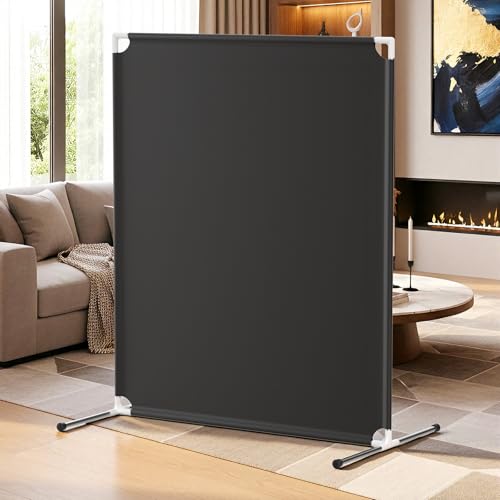
For visual separation rather than a doorway seal, this single freestanding screen provides an opaque PE fabric panel measuring 60 inches wide by 75.6 inches high. The fabric is described as waterproof and tear-resistant, and the steel frame is designed to stand without tools; its weight is 7.9 pounds. Its portability suits temporary room zoning in a dorm, studio, or office. A freestanding panel is not a cat-proof barrier: a determined pet may go around or climb over it, so do not rely on it to contain an animal.
Bottom line: Choose this for portable visual privacy, not for reliably containing cats.
Four-Panel Folding Privacy Screen
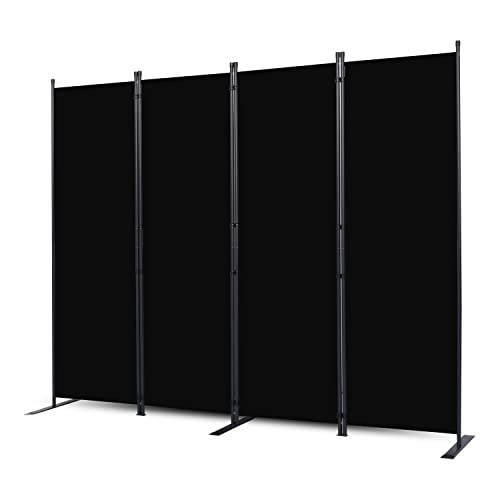
This four-panel screen creates the widest partition here, spanning 88 inches across at 71.3 inches tall. Its 240-gram-per-square-meter polyethylene fabric is non-see-through and tear-resistant, while wider feet support the iron frame. Folding panels can be arranged to divide a broad area, making this more adaptable as a privacy screen than a single-panel. It is still a visual partition, not a secure pet gate; cats can potentially climb it or pass around its edges, so it is unsuitable when containment is essential.
Bottom line: Choose this for a broad, flexible privacy partition when pet containment is not required.
How to choose a barrier for cats
Start with the barrier’s purpose: a gate or fitted mesh screen addresses passage through an opening, while an opaque room divider mainly blocks sightlines. Measure the clear opening width and height at several points; use the narrowest width and shortest height because trim, uneven floors, and sloped thresholds can change the fit. For a retractable gate, choose it only if the opening is no wider than 55 inches. For an opening up to 36 inches wide, select screen door height to match: the available options cover up to 81 or 84 inches. If privacy is the main goal, a panel may be more suitable, but a freestanding screen is not a secure pet enclosure.
Screen doors, gates, and privacy panels
Barrier construction predicts how it works: zippered mesh screens close a doorway while allowing visibility, retractable mesh gates roll away when unused, and opaque fabric panels divide sightlines. The mesh products here top out at 36 inches wide, whereas the gate reaches 55 inches and the panels span 60 or 88 inches. Taller is not automatically safer: a cat may climb mesh or go around a panel, and a freestanding privacy divider does not close the full perimeter. Use a physical gate or door when preventing passage is essential, and supervise introductions between unfamiliar cats rather than relying on a screen alone.
| Need | Barrier style | Fit to check |
|---|---|---|
| Passage through a narrow doorway | Zipper mesh screen | Up to 36 in wide; height up to 81 or 84 in |
| Retractable doorway barrier | Tall mesh gate | Up to 55 in wide; 72 in tall |
| Visual privacy | Freestanding panel | 60 or 88 in wide; about 71–76 in tall |
Measure for a reliable fit
Measure the opening itself, not the door frame or trim, because both mesh screen products specify opening dimensions. Record width at the top, middle, and bottom and height at both sides; a difference of even an inch can leave a gap or prevent attachment. Compare the smallest width and height with the product’s maximum opening size, and make sure thresholds or handles will not interfere with closing. Room dividers have a different fit question: a 60-inch or 88-inch panel span may still leave gaps at the sides, and a single straight panel is less enclosing than panels arranged at an angle. Do not assume a privacy screen blocks a cat’s route.
Frequently Asked Questions
Can a room divider keep a cat in one room?
A freestanding privacy panel is not a dependable containment barrier because a cat may climb it or go around its edges. Use a gate or fitted screen across the actual passage, and verify that the opening falls within its width and height limits.
How do I measure a doorway for a pet screen?
Measure the clear opening width at the top, middle, and bottom, then use the narrowest measurement; measure height on both sides and use the shorter one. The mesh screens here fit openings up to 36 inches wide, with height limits of 81 or 84 inches.
Are mesh screens useful when introducing cats?
A zippered mesh screen can separate cats while preserving sight and smell, which may help with gradual introductions. Keep supervision in place because a screen is not a substitute for managing interactions or checking that pets cannot push through it.
What is the difference between a screen door and a room divider?
A screen door spans a doorway and uses mesh, while a room divider is a freestanding panel intended mainly to block visibility. The screens here are at most 36 inches wide; the panel options span 60 or 88 inches.