
Best Angled Chair Leg Floor Protectors for Slanted Legs

Angled Silicone Caps, Large is the best match for most angled chair legs because its 15° to 25° slanted base is made to sit flat on the floor. Choose Three-Size Silicone Felt Caps instead if flexible size choices matter more; its three sizes cover multiple diameters and it also accommodates angled legs.
We earn a commission if you buy through links on this page. As an Amazon Associate I earn from qualifying purchases. Products are compared on manufacturer specifications, not hands-on testing.
- Best overall: Angled Silicone Caps, Large – Its 15° to 25° slanted base is designed for a flat floor contact.
- Best for size options: Three-Size Silicone Felt Caps – Three diameter ranges provide more sizing flexibility.
- Best for wrapped felt: PISAO Wrapped-Felt Caps, Medium – Its felt pad wraps around the bottom edge for coverage on angled legs.
| Product | Best for | Fit range | Pack count | Bottom pad | Shop |
|---|---|---|---|---|---|
| Angled Silicone Caps, Large | Slanted-leg fit | 1.06–1.3 in | 8 | High-density felt | Check Price on Amazon |
| Three-Size Silicone Felt Caps | Flexible sizing | 0.59–1.42 in across sizes | 24 | Felt | Check Price on Amazon |
| PISAO Wrapped-Felt Caps, Medium | Wrapped felt edge | 0.76–1.18 in | 24 | 360° wrapped felt | Check Price on Amazon |
Angled Chair Leg Floor Protectors Compared
Compare the angle fit, size range, and felt construction before choosing caps for your chairs.
Angled Silicone Caps, Large

Angled Silicone Caps, Large is the only option here with a molded 15° to 25° slanted base, which is intended to keep the felt bottom flat against the floor on tilted legs. The clear silicone caps come in an 8-pack sized for 1.06 to 1.3-inch legs, with a thick felt bottom for hard floors. This focused fit makes it the straightforward choice when chair-leg angle is the main concern. Its smaller pack is a limitation for furnishing a large dining set, and the fit range should be measured carefully.
Bottom line: Choose this for legs tilted 15° to 25° that measure 1.06 to 1.3 inches.
Three-Size Silicone Felt Caps

Three-Size Silicone Felt Caps stands out for its three-size bands rather than one specialized base: small fits 0.59 to 0.83 inches, medium 0.83 to 1.1 inches, and large 1.1 to 1.42 inches. The 24 caps are described as compatible with legs tilted 15° to 25°, so this set can suit mixed chair sizes when each leg is measured. The cap body is silicone with a felt floor-contact surface. The limitation is that the selected medium size only covers 0.83 to 1.1 inches, so larger legs need the separate large size.
Bottom line: Pick this for a group of chairs with different leg diameters.
PISAO Wrapped-Felt Caps, Medium
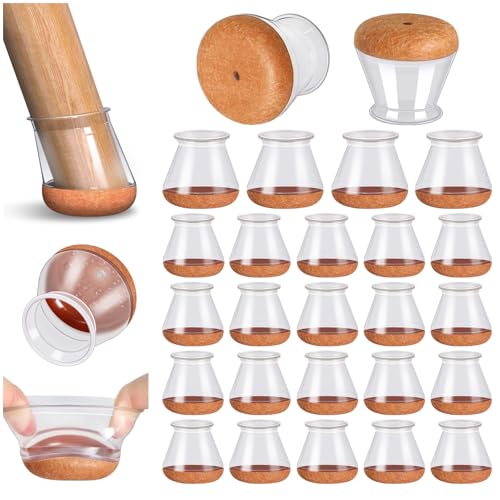
PISAO Wrapped-Felt Caps, Medium differs through its 360° felt wrap, which covers the chair-leg edge and is intended to resist tearing even when used on legs that meet the floor at an angle. The 24 clear silicone caps fit 0.76 to 1.18-inch legs and are described as suitable for wood and metal chair legs. Their wrapped bottom helps reduce scraping noise as chairs move on hard floors. The medium fit is narrower than the multi-size set, so measure the leg rather than relying on a chair’s appearance.
Bottom line: Select this for medium legs and felt that wraps the cap edge.
How to Choose Angled Chair Leg Floor Protectors
Measure leg diameter where the cap will grip, then match the cap’s fit range before comparing felt design. Chair legs that meet the floor at a slant need a bottom that can make broad contact; a flat adhesive pad on an angled cut may contact only an edge and wear unevenly. A purpose-made angled base specifying a 15° to 25° tilt is useful when the chair’s angle falls in that band. For an unknown angle, compare the cap’s bottom against the floor with the chair upright and check that the felt rests evenly. Hard-floor caps are not suitable for every surface: felt can collect grit, which may scratch floors as chairs move.
Measure Chair Legs Before Buying
Measure the leg at the point where the cap will stretch over it, not at the widest point near the seat. For round legs, use a ruler or caliper across the diameter; for non-round legs, check both width and depth because a round cap may not fit securely. If a measurement falls exactly at a range boundary, the flexible silicone fit can vary with leg shape, so check the cap’s actual fit before covering a full set. A cap that is too loose can slip off, while one stretched beyond its size range can strain at the bottom seam. Match each chair’s legs individually when wear or replacement has changed their dimensions.
Felt Bottoms and Silicone Caps Compared
Silicone forms a flexible sleeve around a chair leg, while felt provides the sliding contact surface against a hard floor. Felt thickness and wrap shape affect where the cap meets the floor: cup-shaped felt follows a cap bottom, and a 360° wrap extends around its edge. The table separates the main tradeoffs; it does not replace checking fit for a particular leg.
| Design | Useful when | Fit check |
|---|---|---|
| Angled molded base | Legs have a defined slant | Match specified angle and diameter |
| Flexible multi-size cap | Chairs have mixed diameters | Select the correct band for each leg |
| Wrapped felt edge | Edge coverage is a priority | Confirm cap diameter and floor contact |
Keep Chair Leg Protectors Working
Inspect felt regularly and replace caps when the pad is worn through, detached, or holding visible grit. Fine debris trapped in felt can act like sandpaper, so brush or vacuum the bottoms when cleaning hard floors and check them after moving chairs between rooms. Push-on caps can loosen with repeated chair movement; verify that each sleeve still grips the leg, especially after cleaning. Felt is meant for smooth hard surfaces rather than carpet, where it will not provide the same glide. Avoid dragging a chair with a cap that has come loose, since an exposed leg can scrape the floor.
Frequently Asked Questions
How do I measure a chair leg for a silicone cap?
Measure the diameter at the point where the cap will grip, using a ruler or caliper across a round leg. If the leg is tapered, use the diameter at the cap’s seated position rather than at the top.
Do angled chair leg caps fit straight chair legs?
Some flexible silicone caps are made for straight or angled legs, while a molded slanted base is tailored to a defined tilt. Match the leg’s angle to the cap’s range, such as 15° to 25°, when one is given.
Can felt chair caps scratch hardwood floors?
Felt can scratch hardwood if grit becomes trapped in the pad. Inspect the bottoms and remove dust or debris regularly, especially after moving chairs across dirty floors.
When should chair leg felt protectors be replaced?
Replace a felt protector when the pad is worn through, detached, or no longer provides an even contact surface. Check all chair legs together because uneven wear can make one leg scrape while the others glide.