
Best Automatic Feed Drywall Screw Guns Compared

The Makita XRF02Z suits most buyers because it combines cordless 18V operation with a 4,000 RPM motor and supports collated screws from 1 to 2-1/8 inches. Choose a different tool if you prefer corded power, need a complete battery kit, or already own a compatible driver for an attachment.
An automatic-feed drywall screw gun advances collated screws to the bit, reducing repeated hand-loading during installation.
We earn a commission if you buy through links on this page. As an Amazon Associate I earn from qualifying purchases. Products are compared on manufacturer specifications, not hands-on testing.
- Best overall: Makita XRF02Z 18V Autofeed – Cordless 18V operation, 4,000 RPM and a 1 to 2-1/8 inch screw range.
- Best for corded use: SENCO DS232-AC 2-Inch Corded – Corded operation with tool-free screw length and drive-depth adjustments.
- Best for existing DEWALT drivers: 18V 2-in-1 Cordless Drywall Gun – A collated attachment that fits onto a compatible screw gun and rotates 360 degrees.
| Product | Best for | Power / speed | Screw range | Weight | Shop |
|---|---|---|---|---|---|
| Makita XRF02Z 18V Autofeed | Cordless fastening | 18V cordless; 4,000 RPM | 1–2-1/8 in. | 4.6 lb | Check Price on Amazon |
| SENCO DS232-AC 2-Inch Corded | Corded control | Corded; up to 2,500 RPM | 2 in. | 5.8 lb | Check Price on Amazon |
| 18V 2-in-1 Cordless Drywall Gun | Included battery kit | 18V cordless; 5,000 RPM | — | 4.4 lb | Check Price on Amazon |
| VISHIGH Cordless Collated Screw Gun | Longer screw range | 20V cordless | #6–#12; 1/2–2 in. | 6 lb | Check Price on Amazon |
Automatic Feed Drywall Screw Guns
Compare each tool’s power setup, screw capacity and feed configuration against the way you work.
Makita XRF02Z 18V Autofeed

The Makita XRF02Z stands out for its 4,000 RPM speed and broad collated screw range, from 1 to 2-1/8 inches. Its aluminum dust-proof auto-feed housing slides smoothly, and the screw guide folds against the housing for storage. The 16-3/4-inch tool is a cordless option for drywall installers who want reach without a power cord. Makita specifies the motor speed and screw capacity; those figures do not establish runtime or drive depth. Choose another option if you need the included battery and charger identified in the tool package.
Bottom line: Choose this for cordless use and a wide collated screw length range.
SENCO DS232-AC 2-Inch Corded

The SENCO DS232-AC is the corded choice, with a motor speed up to 2,500 RPM and controls for adapting to the task. Its tool-free screw-length and depth-of-drive adjustments, depth lock, variable-speed trigger, reverse and quick-slide bit change distinguish it from the cordless kits. A corner-fit feed system is designed to keep feeding smooth, and the belt hook can be configured for either hand. This model suits users who value adjustments and a corded setup. Its 2-inch screw capacity is narrower than the range on the Makita, so confirm screw length compatibility before choosing it for longer fasteners.
Bottom line: Pick this for corded operation and accessible depth adjustments.
18V 2-in-1 Cordless Drywall Gun
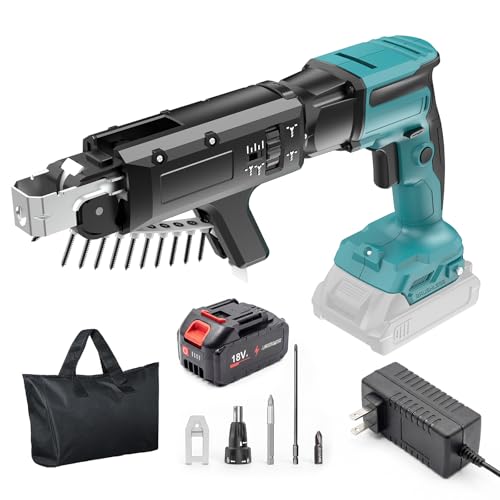
The 18V 2-in-1 cordless gun is the speed-focused kit, with a maker-claimed 5,000 RPM brushless motor and a 4.0Ah battery, charger, collated attachment and tool bag included. It is described for Makita 18V battery compatibility as well, which may help users with that battery platform. The two-in-one design is intended for both individual screw driving and magazine-fed installation. This package suits buyers who want the battery and charger in the box rather than a tool-only format.
Bottom line: Choose this if a bundled cordless kit and high claimed speed matter most.
VISHIGH Cordless Collated Screw Gun

The VISHIGH cordless kit provides a defined fastener range: #6 to #12 screws measuring 1/2 to 2 inches, adjustable at the attachment. It includes a 20V 5Ah battery, charger, PH bit and 100 collated screws, making it a ready-to-start package. This kit suits buyers who want a battery, charger and starter screws bundled together. At 6 pounds, it is heavier than the Makita and 2-in-1 gun weights, a practical consideration for overhead drywall work.
Bottom line: Pick this for a bundled 20V kit with a screw size range.
How to choose an automatic feed drywall screw gun
Choose first by power source, then by screw range and control features. Cordless tools avoid a trailing cord across a room; corded drivers keep working without battery swaps but require outlet access and cord management. Motor speed alone is not a guarantee of faster installation: feed alignment, screw length adjustment and consistent depth setting also affect the pace of work.
For routine drywall fastening, prioritize a depth control that can be set repeatably so screw heads seat without breaking the paper face. If the job uses screws longer than 2 inches, favor a model with capacity beyond that length rather than assuming a magazine can accept them. A tool with a known capacity for the actual screw length is the safer selection rule.
Matching screw length and collated strips
Match the fastener length to the material stack, and confirm the magazine accepts that exact length before starting. Drywall screws commonly range from about 1-1/4 to 2 inches, with framing material and board thickness driving the choice; longer fasteners may be used where the assembly requires them. Collated strips also vary by screw size and feed geometry, so a magazine that accepts a length does not automatically accept every strip.
Use the tool’s adjustment to keep the screw head just below the drywall surface without tearing its paper. Overdriving weakens the board’s hold at that point, while proud heads interfere with finishing. Run a few fasteners on scrap board and framing to establish depth before driving across a full sheet.
Depth setting and safe operation
Set the depth so each screw head sits slightly below the surface while the paper remains intact. A torn paper face means the fastener has been driven too far; add another screw nearby rather than relying on the damaged spot. Keep hands clear of the magazine nose and trigger while loading or clearing a jam, and disconnect the cord or remove the battery before servicing the feed assembly.
Drywall work is commonly done overhead, where tool weight and balance affect fatigue. Use a stable platform rather than overreaching from a ladder, and keep the cord routed away from the work area on corded models. Clean dust from feed components regularly because gypsum dust can hinder sliding and strip alignment.
Automatic feed versus a standard screw gun
An automatic-feed setup advances collated fasteners one at a time, while a standard screw gun requires manual placement for each screw. The feed setup helps with repeated fastening; a standard driver is more flexible for one-off fastening, corners, and mixed screw types. An attachment can add collated feeding to a compatible driver, but it is not interchangeable with a complete screw gun.
The following distinctions help match the tool format to the job:
| Format | Best use | Tradeoff |
|---|---|---|
| Complete cordless gun | Rooms without easy outlet access | Battery runtime and charging matter |
| Complete corded gun | Long continuous sessions near power | Cord routing needs attention |
| Feed attachment | Owners of a compatible driver | Requires the matching base tool |
Frequently Asked Questions
How deep should drywall screws sit?
A drywall screw head should sit slightly below the board surface with the paper face intact. If the paper tears, the fastener is overdriven and another screw should be added nearby.
What screw length is typical for drywall?
Drywall screws commonly measure about 1-1/4 to 2 inches, depending on board thickness and framing. Confirm that the feed magazine accepts the selected length before loading a strip.
Can an automatic feed attachment work on any driver?
No, an attachment must match a compatible driver platform. Check the specific driver compatibility and the attachment’s screw range before buying.
Why do collated screws jam in a feed gun?
Misaligned strips, incompatible screw lengths, and gypsum dust can disrupt feeding. Remove the battery or unplug the tool before clearing a jam, then clean the feed path and reload a compatible strip.
How can I avoid overdriving drywall screws?
Set the depth control on scrap board first, aiming for a slightly recessed head without breaking the paper. Recheck the setting when board thickness or framing changes.