
Copper Backing Plates for Welding: 3 Types Compared

For general sheet-metal patching and joint support, scottchen PRO 3-Pc Copper Welding Spoon Set offers three paddle shapes in 3 mm copper; choose it when the work includes flat, curved, or 90° areas. Magnetic Backing Copper Welding Spoon, 2 × 5 in is the magnetic option for butt-welding sheet metal, while Strong Hand Tools AGK320 Hole Plug Magnet is aimed at hands-free hole welds. A copper backing plate supports the weld pool from behind thin metal.
Raw copper bars are stock material rather than ready-shaped welding backers, so they suit buyers prepared to cut and adapt material.
We earn a commission if you buy through links on this page. As an Amazon Associate I earn from qualifying purchases. Products are compared on manufacturer specifications, not hands-on testing.
- Best overall: scottchen PRO 3-Pc Copper Welding Spoon Set – Its three 3 mm paddle shapes cover flat, curved, and 90° work.
- Best for magnetic butt-weld support: Magnetic Backing Copper Welding Spoon, 2 × 5 in – Its magnetic backer is designed for sheet-metal butt welds.
- Best for hands-free hole welds: Strong Hand Tools AGK320 Hole Plug Magnet – Its spring-loaded arm and pivoting magnetic base support hole-weld positioning.
| Product | Best for | Backer form | Size or shapes | Shop |
|---|---|---|---|---|
| scottchen PRO 3-Pc Copper Welding Spoon Set | Multi-angle patching | Three paddles | Flat, curved, 90° | Check Price on Amazon |
| Magnetic Backing Copper Welding Spoon, 2 × 5 in | Magnetic butt welds | Magnetic panel | 2 × 5 in | Check Price on Amazon |
| Strong Hand Tools AGK320 Hole Plug Magnet | Hands-free hole welds | Pivoting magnetic V-pad | 5.5 in arm | Check Price on Amazon |
Copper backing plates for welding
Match the backer’s shape and mounting style to the joint or hole you need to support.
scottchen PRO 3-Pc Copper Welding Spoon Set

Three paddle shapes distinguish this set: flat, curved, and 90° options address different panel contours and angles. Each plate is 3 mm solid copper, and the wound handle is intended to spread heat without a rubber grip. The set is suited to closing plug-weld holes or supporting thin-sheet repairs where a shaped backer can sit behind the opening. Its limitation is that it is a hand-positioned paddle set rather than a magnetic hands-free backer, so it matters when the work area is awkward to reach or hold steady.
Bottom line: Choose this set when one flat paddle alone would not suit the panel contours.
Magnetic Backing Copper Welding Spoon, 2 × 5 in
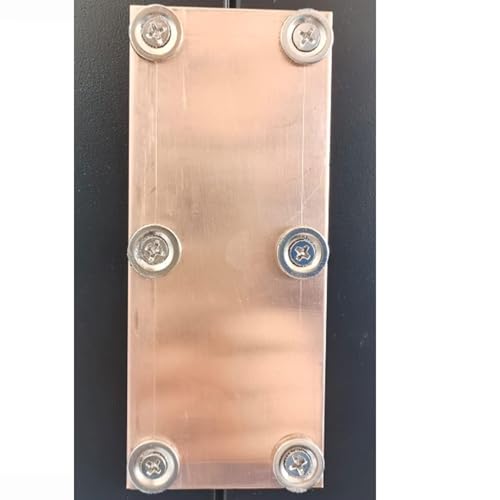
Magnetic mounting sets this backer apart for butt-welding sheet-metal panels: it holds against the work without requiring someone to hold a spoon by hand. The copper panel is described for supporting the joint and limiting distortion or burn-through, and its detachable magnet can be replaced. This form suits accessible steel panels where the magnet can seat behind the joint. Its limitation is the flat-panel format, which may not follow a tight curve or reach a corner as readily as shaped paddles.
Bottom line: Pick this magnetic panel for sheet-metal butt joints on accessible steel.
Strong Hand Tools AGK320 Hole Plug Magnet

A spring-loaded arm and pivoting magnetic V-pad base distinguish this tool from handheld spoons and flat magnetic panels. Its copper pad is intended to dissipate heat and resist sticking to the weld; the arm separates the base from the heated work area. The design targets hands-free hole welds, particularly where a curved steel panel can accept the magnetic base. Its limitation is its specific hole-weld setup: it is not a broad flat backer for supporting a long butt joint.
Bottom line: Choose this tool when positioning a backer behind individual hole welds is the main task.
How to choose a copper welding backer
Choose by the joint first: a butt joint needs support along the seam, while a plug weld needs a backer positioned behind an opening. Copper conducts heat away from the weld area and is commonly used as a backing surface because steel weld metal does not readily fuse to it. A flat panel is practical on a straight, accessible joint; a paddle is easier to position at an angle or behind a localized hole. Magnetic mounting can free a hand on steel, but it depends on a secure, flat seat. If the joint curves or turns a corner, select a shaped paddle rather than assuming a flat backer will make full contact.
Matching backer shape to the panel
Panel contour decides whether the backer can support the weld evenly: a gap between copper and sheet metal leaves less direct support for the molten pool. Flat paddles suit flat areas, while curved and 90° paddles address contours or corners. Magnetic backers need enough steel contact to stay positioned; paint, gaps, or an unsuitable surface can undermine the hold. Before welding, place the backer directly behind the opening or joint and check that it does not obstruct the torch path. Keep the copper where it supports the pool, not where it can become trapped in the finished weld. For a difficult reach, plan how to retrieve or reposition the backer before starting.
Backer types and their best uses
Ready-shaped backers save setup time, while raw copper stock requires cutting and fitting. A hand-held spoon can be maneuvered around small repairs; a magnetic panel can stay against an accessible steel surface; a spring-arm tool is specific to supporting hole welds. Use the comparison below to narrow the form by task, not by a claimed quality ranking. Copper’s high thermal conductivity helps move heat away, but it does not eliminate the need to control heat input or keep the plate in contact with the work.
| Backer type | Useful condition | Trade-off |
|---|---|---|
| Hand-held paddle | Localized repair or changing angles | Requires positioning by hand |
| Magnetic panel | Accessible steel butt joint | Needs a suitable magnetic seat |
| Spring-arm hole tool | Individual hole welds | Specialized for hole support |
| Raw copper bar | Custom size or shape needed | Needs cutting and adaptation |
Safe setup and common mistakes
Secure the work and wear welding PPE even when a copper backer is used; backing metal does not prevent arc flash, hot spatter, or burns. Copper moves heat efficiently, but a poorly seated plate or excessive heat input can still leave a thin panel distorted or burned through. Make sure the backer contacts the panel and stays clear of the torch and finished weld. Do not assume the magnet can tolerate weld heat merely because it holds the tool in place; keep the magnetic base away from direct heating. Allow the plate and workpiece to cool before handling, since copper can retain and spread heat beyond the weld area.
Frequently Asked Questions
Why use copper behind a thin sheet-metal weld?
Copper conducts heat away from the weld area and provides a surface to support the molten pool. It can help reduce burn-through risk, but it cannot compensate for excessive heat input or a gap behind the panel.
Can a copper backer be used for butt welds?
Yes, a backer can support a butt joint from behind when it sits closely along the seam. A flat magnetic panel is suited to accessible straight sheet-metal joints; a shaped paddle may fit contours better.
Does a magnetic welding backer work on every panel?
No, the magnet needs a suitable steel surface and firm contact to hold position. Paint, curvature, gaps, or nonmagnetic material can make the hold unreliable, so test the seat before welding.
How do I avoid trapping copper in a weld?
Keep the copper behind the work as a backing surface rather than letting it enter the weld pool. Position it directly under the joint or hole and check that it remains out of the torch path.
Can copper welding spoons be reused?
Copper backers can be reused if they remain in usable shape and still sit securely against the work. Let a hot backer cool before handling and check for distortion or damage that would prevent close contact.