
Best Balls for 2 Year Olds: 4 Picks by Play Style

For most 2-year-olds, Move2Play Interactive Plush Ball is the best fit because its soft 6-inch plush design is made for ages 1 to 3 and supports indoor or outdoor play. Choose a different pick if your child wants a soccer ball or a ride-on hopper, but note that those options have different age and balance demands.
We earn a commission if you buy through links on this page. As an Amazon Associate I earn from qualifying purchases. Products are compared on manufacturer specifications, not hands-on testing.
- Best overall: Move2Play Interactive Plush Ball – The 6-inch plush ball is made for ages 1 to 3 and responds to kicks, passes, shots, and dribbles.
- Best for soccer play: Hedstrom Paw Patrol Jr. Soccer Ball – This 7-inch soccer ball offers a familiar ball shape, but its recommended age starts at 3.
- Best for bouncing: Hedstrom Spider-Man Hopper Ball – The vinyl hopper inflates up to 15 inches for seated bouncing play.
- Best for ride-on play: Bouncy Pals Unicorn Hopper – The four-legged inflatable unicorn is designed for hopping and balance practice.
| Product | Best for | Play style | Size | Material | Shop |
|---|---|---|---|---|---|
| Move2Play Interactive Plush Ball | Soft active play | Interactive kick ball | 6 inches | Plush from recycled bottles | Check Price on Amazon |
| Hedstrom Paw Patrol Jr. Soccer Ball | Soccer practice | Soccer ball | 7 inches | PVC | Check Price on Amazon |
| Hedstrom Spider-Man Hopper Ball | Bouncing play | Seated hopper | Up to 15 inches | Vinyl | Check Price on Amazon |
| Bouncy Pals Unicorn Hopper | Ride-on hopping | Ride-on hopper | 20 inches high | Inflatable body | Check Price on Amazon |
Balls for 2 Year Olds
Match the ball to your toddler’s play style, space, and ability to keep balance.
Move2Play Interactive Plush Ball

Unlike the other picks, this 6-inch plush ball reacts to shots, passes, dribbles, and kicks with music and sound effects. The maker says it is designed for ages 1 to 3, and it is machine-washable for indoor or outdoor play. Three AAA batteries are included, with high and low volume settings. Its soft covering suits toddlers practicing basic ball play, especially indoors. The limitation is its electronic response: families seeking a quiet, traditional ball may prefer a simple soccer ball instead.
Bottom line: Choose this for a soft, interactive ball suited to early kicking and passing.
Hedstrom Paw Patrol Jr. Soccer Ball

This is the only conventional soccer ball in the group, with a 7-inch size and Paw Patrol graphics. The maker says it is intended for ages 3 and up; for a 2-year-old, treat it as a supervised introduction rather than an age-matched pick. The ball ships deflated, so inflation is part of getting it ready to play. Its PVC construction and bounce make it better suited to outdoor kicking or a roomy play area than the plush option. It is not the choice for a toddler who needs a soft, quiet ball.
Bottom line: Pick this for supervised soccer-style play if your toddler is ready for a firmer ball.
Hedstrom Spider-Man Hopper Ball

Instead of being kicked or tossed, this is a vinyl hopper that grows to 15 inches when inflated and is made for seated bouncing. Its Spider-Man graphics and indoor-or-outdoor design distinguish it from the smaller balls, while the larger size calls for more room to move. Hopper play requires a child who can sit astride and maintain balance; use a flat, open area away from stairs and hard edges. The specifications do not give an age fit, so confirm your child’s age and size suitability before buying.
Bottom line: Choose this only when a toddler is ready for supervised seated bouncing.
Bouncy Pals Unicorn Hopper
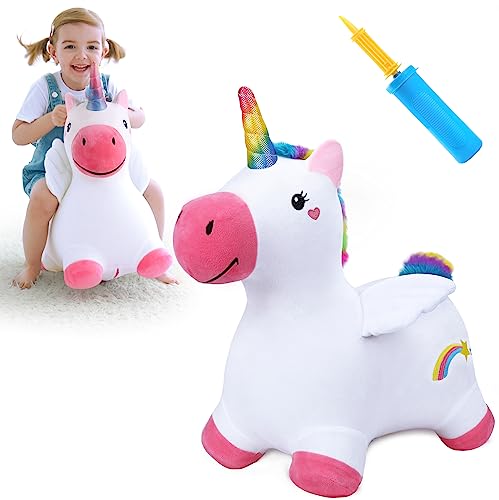
This inflatable unicorn is a ride-on hopper rather than a ball for kicking, making it the pick for toddlers interested in holding on and bouncing. It measures 20 inches high and has four legs intended to help steady the toy. The maker describes it for indoor and outdoor settings and advises direct adult supervision for children under 2; active supervision remains sensible for a 2-year-old using a bouncing toy. Its animal shape and larger body need more floor space than a small ball, so it is a poor fit for tight rooms or children not yet steady when seated.
Bottom line: Choose this for a toddler ready for supervised animal-shaped hopping play.
How to choose balls for 2 year olds
Start with the play action: a soft 5- to 7-inch ball is easier to kick or roll than a hopper, while ride-on bouncers require balance and open floor space. The 6-inch plush pick is the closest match for general toddler ball play; the soccer and hopper options are narrower choices. For children under 3, avoid small balls: U.S. small-parts rules use a cylinder about 1.25 inches wide and 2.25 inches long, and balls under 1.75 inches across can pose a choking risk. Keep ball play supervised and remove any ball that becomes damaged or sheds pieces. In a room with less than 3 feet of clear play space, choose a soft ball for rolling rather than a hopper.
| Play need | Choose | Why |
|---|---|---|
| Early indoor kicking | Soft 6-inch ball | Plush covering |
| Soccer introduction | 7-inch soccer ball | Soccer shape; maker age starts at 3 |
| Seated bouncing | Hopper | Requires balance and open floor |
Ball size and age fit
A 6- to 7-inch ball is a practical range for toddler kicking and rolling because it is large enough to grasp and far larger than a small ball. Age guidance still matters: the plush ball is made for ages 1 to 3, while the soccer ball’s maker recommends age 3 and up. Hopper toys are a different fit question: their inflated height or body size must suit the child’s seated position and balance. Keep all balls and detachable parts away from children’s mouths, and supervise play closely. If choosing the 15-inch hopper, confirm age and size suitability before buying, since the product facts give no age fit.
Soccer balls and hopper balls compared
Soccer balls are for kicking, rolling, and simple passing; hopper balls are for sitting astride and bouncing. A soft 6-inch ball works for basic play with less risk of hard impact than a firm ball, while a 7-inch soccer ball suits children ready for a more sport-like feel. The 15-inch hopper is an inflatable vinyl ball, and the unicorn hopper is an animal-shaped inflatable ride-on. The right choice depends on a child’s coordination and the room available, not just the word “ball.” Use hoppers only on level, clear ground, away from stairs, traffic, furniture corners, and other children.
Safe ball play for toddlers
Close supervision matters because 2-year-olds may mouth toys and have developing balance. Keep balls at least 1.75 inches in diameter to avoid the small-ball choking hazard category, and inspect soft coverings, seams, and inflatable toys for damage before play. For bouncing toys, use a dry, level surface and keep a clear buffer from steps, pools, roads, and sharp edges; an adult should stay within reach. A toddler who cannot sit astride and stay balanced should use a floor ball instead of a hopper. Avoid throwing balls at faces or using a firm ball in a confined room.
Frequently Asked Questions
What size ball works for a 2-year-old?
A ball around 5 to 7 inches across is a useful size for toddler kicking and rolling. Avoid balls under 1.75 inches across because small balls can present a choking hazard.
Can a 2-year-old use a soccer ball?
A 2-year-old can explore supervised rolling or gentle kicking, but the soccer ball here is recommended by its maker for age 3 and up. A soft, smaller-feeling ball is a more age-aligned starting point.
Are hopper balls safe for toddlers?
Hopper balls require seated balance and a clear, level area, so they are not right for every 2-year-old. Keep an adult within reach and stay away from stairs, roads, and hard edges.
How much space does a toddler need for ball play?
Allow at least 3 feet of clear floor for rolling and gentle kicking, with more room for running or bouncing. Keep play away from stairs, furniture corners, and other children.