
Best Heat Tape for Plumbing: 5 Options Compared

For most plumbing, Cupohus 3-Foot Thermostat Cable is the practical pick because its built-in thermostat turns on below 41°F and switches off at 59°F. Choose 50-Foot Pipe Heating Cable or 30-Foot Self-Regulating Heat Tape instead if you need a longer run, and YeloDeer 300-Foot Cut-to-Length Roll if you need a bulk roll that can be cut to length.
Heat tape is an electric heating cable installed along water pipes to limit freezing; select a cable compatible with the pipe and the full run rather than assuming one length fits every job.
We earn a commission if you buy through links on this page. As an Amazon Associate I earn from qualifying purchases. Products are compared on manufacturer specifications, not hands-on testing.
- Best overall: Cupohus 3-Foot Thermostat Cable – The 3-foot cable has a built-in thermostat with 41°F-on and 59°F-off thresholds.
- Best for a 50-foot run: 50-Foot Pipe Heating Cable – It provides a 50-foot cable at 5W per foot and 120V.
- Best for custom lengths: YeloDeer 300-Foot Cut-to-Length Roll – The 300-foot self-regulating roll can be cut to length.
| Product | Best for | Cable length | Output | Pipe compatibility | Shop |
|---|---|---|---|---|---|
| Cupohus 3-Foot Thermostat Cable | Short pipe sections | 3 ft | 5 W/ft | Metal and plastic | Check Price on Amazon |
| 50-Foot Pipe Heating Cable | Longer straight runs | 50 ft | 5 W/ft | Metal and plastic | Check Price on Amazon |
| 30-Foot Self-Regulating Heat Tape | Medium pipe runs | 30 ft | 5 W/ft | Water pipes | Check Price on Amazon |
| YeloDeer 300-Foot Cut-to-Length Roll | Custom long runs | 300 ft | 5 W/ft | Metal, PEX, PVC, plastic | Check Price on Amazon |
| BDDFOTO 3-Foot Heat Tape | Short metal lines | 3 ft | Up to 8 W/ft | Metal or PVC | Check Price on Amazon |
Heat Tape for Plumbing
Compare the cable length, control approach and pipe compatibility against the water line you need to protect.
Cupohus 3-Foot Thermostat Cable

For a short pipe section, this 3-foot cable includes a thermostat that starts heating below 41°F and shuts off at 59°F. The maker says it can protect water hoses down to -40°F and maintain pipe temperature above 59°F. It is rated at 5 W/ft and 120V, and its compatibility covers metal and plastic pipes.
The fixed length suits a small exposed section, but it will not cover a longer run; measure the pipe before choosing it. The on/off thresholds also make it a different fit from a cable that continuously self-regulates without fully shutting off.
Bottom line: Pick this for a short water-pipe section where thermostat on/off control is useful.
50-Foot Pipe Heating Cable

The 50-foot length makes this cable a fit for a substantially longer run than the short thermostat models. It operates at 120V and 5 W/ft, and the maker says it protects water-filled metal or plastic pipes down to -40°F. Its features include a grounded plug with indicator light and an aluminum-alloy shield.
This cable is intended for water-filled pipes, not fuel lines or gutters; the maker warns that using it without water can cause overheating. Choose it when the run fits 50 feet rather than relying on a cable that must be cut or extended.
Bottom line: Choose this for an extended water-pipe run that fits its fixed 50-foot length.
30-Foot Self-Regulating Heat Tape

This 30-foot cable bridges the gap between a short section and the 50-foot option, while its self-regulating design adjusts output with surrounding temperature. It is rated at 5 W/ft and 120V. The maker describes it for indoor and outdoor water lines, including plumbing at cabins, farms, barns and RVs.
The features also describe the cable as safe for cross-overlap, but that claim does not establish compatibility with every pipe or installation arrangement. Its fixed 30-foot length is the main constraint, so measure the exposed pipe and route before selecting it.
Bottom line: Pick this when a 30-foot self-regulating cable matches your water-pipe run.
YeloDeer 300-Foot Cut-to-Length Roll

The 300-foot bulk roll is the choice here for custom long runs: its self-regulating cable can be cut to length and includes a wire splitter and end cap. It is rated at 5 W/ft, and the maker says it is suitable for metal, PEX, PVC and plastic pipes up to 2 inches in diameter, plus RV hoses and other applications.
The maker says output adjusts in cold weather and reduces as temperatures rise, but the cable never shuts off completely. This roll is better suited to someone able to size and terminate a cable run than to a buyer wanting a ready-made short length.
Bottom line: Choose this for custom, extended runs when you can handle cut-to-length installation.
BDDFOTO 3-Foot Heat Tape
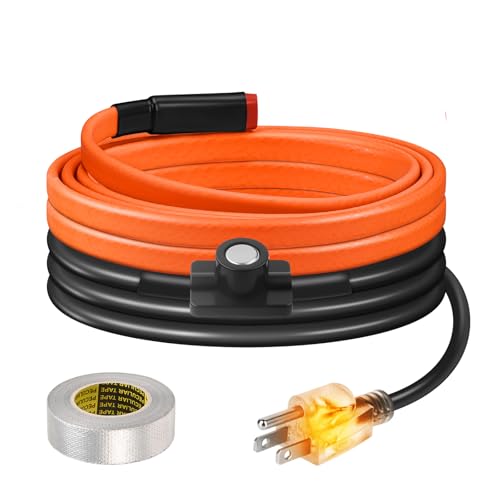
Unlike the other short thermostat option, this 3-foot cable advertises output up to 8 W/ft and an IP65 waterproof rating. Its features identify a temperature sensor, a 3-foot power cord and compatibility with metal or PVC water lines. The maker says the cable turns on below 41°F and describes higher output in colder conditions.
The power figure needs attention: the package may say 5 W/ft even though the cable supports up to 8 W/ft. Confirm the required output and the cable’s fit for your pipe before choosing it; its short length limits it to small sections.
Bottom line: Pick this for a short metal or PVC water line when its output rating suits the job.
How to choose heat tape for plumbing
Start with the pipe material, the full exposed length and the cable’s controls. These five options range from 3 feet to a 300-foot cut-to-length roll; three are rated at 5 W/ft, while BDDFOTO 3-Foot Heat Tape claims up to 8 W/ft. A fixed cable should cover the measured section without stretching or splicing unless the product is designed for it.
Check the voltage and intended application before installation: the fixed-length cables use 120V except BDDFOTO 3-Foot Heat Tape, which specifies 110V. Use pipe heating cable only on water lines where the maker identifies that use, and keep it away from fuel lines or gutters when prohibited. For plastic pipe, compatibility matters; the roll identifies PEX, PVC and plastic, while other models give broader or narrower material descriptions. At under 3 feet of exposed pipe, a 3-foot model is the closest fit; for longer sections, compare the 30- or 50-foot option or a cut-to-length roll.
Heat tape length and pipe fit
Measure the pipe run, including the section that needs protection, before matching cable length. The fixed choices here are 3, 30 and 50 feet; YeloDeer 300-Foot Cut-to-Length Roll offers a 300-foot roll that can be cut to length. A cable’s rated length is not a promise that it fits every route: bends, valves and connection points can affect how much cable is needed.
Pipe diameter can also limit a fit. The cut-to-length roll is identified for pipes up to 2 inches in diameter, while the other products do not provide a diameter range in the specifications, so confirm the allowed diameter before ordering if that is critical. Pipe material is just as important: metal, PVC, PEX and other plastics are not interchangeable assumptions. Do not select a cable solely because its length seems right.
Thermostat and self-regulating cable differences
A thermostat-controlled cable switches on and off at set temperatures, while a self-regulating cable varies heat output as its surroundings change. Cupohus 3-Foot Thermostat Cable gives clear thresholds: on below 41°F and off at 59°F. BDDFOTO 3-Foot Heat Tape also describes temperature sensing, with on below 41°F and output changing with cable temperature.
Self-regulating models are not all equivalent: YeloDeer 300-Foot Cut-to-Length Roll says its cable never shuts off completely, while 30-Foot Self-Regulating Heat Tape says it adjusts output based on surrounding temperature. A control approach affects how the cable operates, but does not replace correct sizing or pipe compatibility. The 5 W/ft figure is a power rating, not a guarantee that every pipe will remain above freezing in every exposure; insulation, wind and temperature affect heat loss.
Safe heat tape installation and use
Electric heat tape must be compatible with both the pipe and the installation conditions. Use a grounded electrical connection where the product calls for one, and keep a heating cable on water-filled plumbing when the maker warns against dry use. 50-Foot Pipe Heating Cable specifically warns that use without water can overheat the cable, and it excludes fuel lines and gutters.
Follow the cable’s own routing and attachment requirements rather than wrapping or crossing it based on appearance alone. Even when a maker describes a cable as overlap-safe, that statement does not establish the rule for another model. Protect connections from moisture as specified by the maker, and inspect outdoor cable and insulation before cold weather for cuts, loose sections or damage. Disconnect damaged equipment instead of continuing to use it.
Frequently Asked Questions
How many watts per foot should plumbing heat tape have?
The options here are rated at 5 W/ft, with BDDFOTO 3-Foot Heat Tape claiming up to 8 W/ft. Required output depends on pipe size, insulation, wind exposure and cold severity, so match the cable to the maker’s application limits rather than treating wattage alone as a freeze guarantee.
Can heat tape go on PVC water pipes?
Some cable types identify plastic-pipe use, but PVC compatibility is not universal. YeloDeer 300-Foot Cut-to-Length Roll names PVC and plastic pipes up to 2 inches; check the cable’s material limits before fitting any other model to PVC.
Does self-regulating heat tape turn off?
Not always: YeloDeer 300-Foot Cut-to-Length Roll says its self-regulating cable never shuts off completely, while Cupohus 3-Foot Thermostat Cable uses thermostat thresholds to switch on below 41°F and off at 59°F. The control behavior is model-specific.
Can pipe heat tape be used on a dry pipe?
Do not assume a dry line is safe: 50-Foot Pipe Heating Cable warns that using its cable without water can cause overheating. Use a model only in the conditions allowed for that cable.
What length of heat tape should I get for a water pipe?
Measure the full exposed section and compare it with the available cable length: fixed options here are 3, 30 and 50 feet, while YeloDeer 300-Foot Cut-to-Length Roll is a cut-to-length roll. Account for the actual route around pipe fittings rather than choosing by straight-line distance alone.