
Best Bench Grinder Belt Sander Attachments Compared

Original Multitool 2 x 36-Inch Attachment suits the widest range of bench grinders here because it fits 1/2-inch or 5/8-inch shafts and can mount horizontally or vertically. Choose another attachment if you need a wider 4-inch belt, a 2-by-48-inch belt, or a model specified for a particular grinder size or motor.
A bench grinder belt sander attachment adds a moving abrasive belt—and in these models, a disc—to a compatible bench grinder, so shaft fit and available power are key.
We earn a commission if you buy through links on this page. As an Amazon Associate I earn from qualifying purchases. Products are compared on manufacturer specifications, not hands-on testing.
- Best overall: Original Multitool 2 x 36-Inch Attachment – Its shaft fit covers both 1/2-inch and 5/8-inch grinders, with multiple mounting orientations.
- Best for wide belts: KFMK BD3647 4 x 36-Inch Attachment – The 4-by-36-inch belt provides a wider sanding surface, and the attachment is designed for 8- or 10-inch grinders.
- Best for long belts: KFMK 2 x 48-Inch Attachment, 5/8-Inch Arbor – Its 2-by-48-inch belt is the longest belt size among these options.
- Best for compact setup: KFMK BD3627B 2 x 36-Inch Attachment – The 2-by-36-inch attachment weighs 6 pounds and specifies a 5/8-inch arbor.
| Product | Best for | Belt size | Disc size | Grinder fit | Shop |
|---|---|---|---|---|---|
| Original Multitool 2 x 36-Inch Attachment | Flexible mounting | 2 x 36 in | 7 in | 1/2- or 5/8-in shaft | Check Price on Amazon |
| KFMK BD3647 4 x 36-Inch Attachment | Wide belt work | 4 x 36 in | 7 in | 8- or 10-in grinder; over 3/4 HP | Check Price on Amazon |
| KFMK 2 x 48-Inch Attachment, 5/8-Inch Arbor | Long belt reach | 2 x 48 in | 7 in | 5/8-in arbor; 1/2 HP recommended | Check Price on Amazon |
| KFMK BD3627B 2 x 36-Inch Attachment | Lightweight choice | 2 x 36 in | 7 in | 5/8-in arbor; 1/2 HP minimum | Check Price on Amazon |
| KFMK 2 x 48-Inch Attachment with 7-Inch Wheel | Contact wheel use | 2 x 48 in | 7-in disc; 7-in contact wheel | 8- or 10-in grinder; 1 HP recommended | Check Price on Amazon |
Bench grinder belt sander attachments
Match the attachment’s arbor or grinder-size requirement and motor recommendation to your grinder before choosing a belt layout.
Original Multitool 2 x 36-Inch Attachment

Original Multitool 2 x 36-Inch Attachment stands out for its compatibility with bench grinders using either a 1/2-inch or 5/8-inch shaft and its horizontal, vertical, or intermediate mounting positions. The 2-by-36-inch belt has three grinding surfaces, and the 7-inch disc adds a second abrasive format. Its quick-change belt system includes automatic tensioning and tracking adjustment. This is a practical fit when shaft size or mounting direction rules out a more narrowly specified attachment. The belt is 2 inches wide, so buyers who need a wider sanding surface should consider a 4-inch belt model instead.
Bottom line: Choose this when broad shaft fit and flexible mounting matter more than belt width.
KFMK BD3647 4 x 36-Inch Attachment

KFMK BD3647 4 x 36-Inch Attachment is the only option here with a 4-inch-wide belt, making its sanding surface twice as wide as the 2-inch belt models. It pairs a 4-by-36-inch belt with a 7-inch disc and is designed for 8- or 10-inch bench grinders with more than 3/4 horsepower. Four nuts allow the belt unit to be repositioned, and the belt-release mechanism supports tool-free changes. The wide belt can suit broader sanding tasks, but this attachment is a poor match for a grinder outside its specified size or without the recommended motor power.
Bottom line: Pick this for a compatible grinder when a 4-inch-wide belt is your priority.
KFMK 2 x 48-Inch Attachment, 5/8-Inch Arbor

KFMK 2 x 48-Inch Attachment, 5/8-Inch Arbor pairs a 2-by-48-inch belt with a 7-inch disc, giving it the longest belt length in this group. It is specified for a bench grinder with a 5/8-inch arbor, and a grinder of at least 1/2 horsepower is recommended. Three nuts allow angle adjustment, while the belt tension lock board uses a single nut for belt changes. The longer belt can be useful when you want more abrasive length than a 36-inch setup. Its arbor requirement is narrower than models that accept both 1/2-inch and 5/8-inch shafts, so verify the grinder shaft first.
Bottom line: Choose this for a 5/8-inch grinder when the 48-inch belt is the deciding feature.
KFMK BD3627B 2 x 36-Inch Attachment
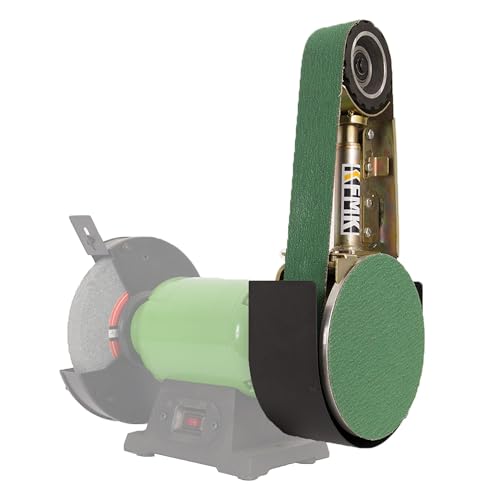
KFMK BD3627B 2 x 36-Inch Attachment combines a 2-by-36-inch belt and 7-inch disc in a 6-pound attachment, the lightest unit with a weight here. The maker specifies a 5/8-inch arbor and a minimum 1/2-horsepower motor. The belt angle adjusts by loosening three nuts, and a tool-free release makes belt changes straightforward. Its shorter belt and narrow width suit buyers who want a compact belt format rather than the longer 48-inch option or wider 4-inch belt. The arbor and motor requirements limit its fit, so confirm those specifications against the grinder before selecting it.
Bottom line: Pick this for a 5/8-inch grinder when low attachment weight and a 36-inch belt suit your setup.
KFMK 2 x 48-Inch Attachment with 7-Inch Wheel

KFMK 2 x 48-Inch Attachment with 7-Inch Wheel adds a 7-inch contact wheel to its 2-by-48-inch belt and 7-inch disc arrangement, distinguishing it from the other 48-inch option. It fits popular bench grinder brands according to the maker, which recommends at least a 1-horsepower grinder. Three nuts provide angle adjustment, and automatic tension and tracking assist belt replacement. This model can suit buyers who specifically want a contact wheel in addition to a disc. The 1-horsepower recommendation is higher than the 1/2-horsepower recommendation for the other 48-inch model, so grinder power is a key selection constraint.
Bottom line: Choose this when you want the added contact wheel and have a grinder meeting its power recommendation.
How to choose a bench grinder belt sander attachment
Start with the grinder shaft, then check motor power and the belt format. These models specify 1/2-inch or 5/8-inch shafts, particular 8- or 10-inch grinder sizes, or a horsepower recommendation; those are not interchangeable requirements. A 2-inch belt suits narrower contact areas, while a 4-inch belt covers a wider strip per pass. Belt length is also a real difference: 36-inch and 48-inch options are represented here. Match the abrasive belt and disc to the material and task; coarse grit removes material faster, while finer grit refines the surface. If shaft size or grinder diameter does not match the attachment’s fit, do not assume an adapter will make it safe.
Bench grinder attachment fit and motor power
Check the shaft diameter directly, because a 1/2-inch shaft and a 5/8-inch shaft require different fit. The products also distinguish grinder size: one is designed for 8- or 10-inch grinders, while another names an 8-inch grinder. Horsepower recommendations range from at least 1/2 horsepower to at least 1 horsepower, and one model calls for more than 3/4 horsepower. Use the stricter requirement given for the specific attachment rather than assuming that grinder diameter tells you motor capacity. A grinder that meets the shaft dimension but falls short of the recommended power is still a poor match. Before assembly, verify that the attachment can be securely mounted and that the belt path clears the grinder and workbench.
Belt size and disc versus contact wheel
Belt width and length determine the abrasive layout: the options here use 2-by-36-inch, 2-by-48-inch, or 4-by-36-inch belts. A wider belt can cover more surface at once, while the longer belt changes the available belt path; neither automatically makes an attachment right for every job. Every model includes a 7-inch disc, while one 48-inch model also specifies a 7-inch contact wheel. Use the table to narrow the format before checking grinder fit.
| Need | Attachment format | Fit check |
|---|---|---|
| Wider belt | 4 x 36 in | 8- or 10-in grinder; over 3/4 HP |
| Longer belt | 2 x 48 in | Check arbor or power recommendation |
| Added contact wheel | 2 x 48 in with wheel | At least 1 HP recommended |
| Flexible mounting | 2 x 36 in | 1/2- or 5/8-in shaft |
Safe setup and belt changes
Disconnect the grinder from power before installing the attachment, changing belts, or adjusting tracking; an unexpected start can cause severe injury. Keep guards in place and use eye protection, since grinding and sanding can throw abrasive particles and workpiece debris. Secure the attachment and check belt alignment by hand before reconnecting power. A tracking adjustment helps keep the belt centered, but it does not replace a secure mount or a properly tensioned belt. During sanding, hold the workpiece firmly and avoid loose clothing, jewelry, and gloves near moving abrasive surfaces. Stop and disconnect power if the belt slips, wanders, or shows damage rather than trying to correct it while running.
Frequently Asked Questions
What belt grit should I use for metal sanding?
Coarse belts around 40 to 80 grit remove material more quickly, while 120 to 220 grit is more suited to refining a surface. Use a finer grit after coarse work if you want to reduce visible scratches, and follow the abrasive maker’s material guidance.
Can a bench grinder attachment fit any grinder?
No; shaft diameter, grinder size, and motor power can all limit compatibility. Measure the arbor and compare it with the attachment’s fit, then check the horsepower recommendation before mounting.
Should I use the belt or disc for sanding?
Use the belt for work against its flat or curved contact areas and the disc for supported work against the disc face. Keep the workpiece controlled and use the tool’s work rest or guard where provided; do not press material into an unsupported edge.
How do I keep a sanding belt tracking straight?
With the grinder disconnected, set belt tension and tracking according to the attachment’s adjustment mechanism, then turn the belt by hand to check that it stays centered. Recheck alignment after each belt change and do not run a belt that drifts off the rollers.
When should I replace a sanding belt?
Replace a belt when it is torn, cracked, glazed, contaminated, or no longer cuts effectively. Stop and disconnect the grinder before inspection; a damaged belt can break or leave the rollers during operation.