
Upside Down Suet Feeder: Four Models Compared

For an upside down suet feeder that holds two cakes and has a metal roof, start with Kingsyard Double Suet Feeder. Choose Nature’s Way Cedar Inverted Feeder or Birds Choice Recycled Plastic Feeder instead if a one-cake cedar or recycled plastic feeder better suits your setup; Songbird Essentials Driftwood Feeder is another option, though its cake capacity is not clear.
These feeders let clinging birds feed from below, a design that can make access harder for birds that prefer a perch.
We earn a commission if you buy through links on this page. As an Amazon Associate I earn from qualifying purchases. Products are compared on manufacturer specifications, not hands-on testing.
- Best overall: Kingsyard Double Suet Feeder – Holds two standard suet blocks and has a metal roof over a recycled plastic body.
- Best for cedar construction: Nature’s Way Cedar Inverted Feeder – Combines a cedar body with a hinged roof and holds one standard suet cake.
- Best for tail support: Birds Choice Recycled Plastic Feeder – Its tail prop supports clinging birds, and the feeder holds one suet cake.
| Product | Best for | Capacity | Main material | Dimensions (inches) | Shop |
|---|---|---|---|---|---|
| Kingsyard Double Suet Feeder | Two-cake capacity | 2 cakes | Recycled plastic, metal roof | 6.7 × 6.7 × 3.9 | Check Price on Amazon |
| Nature’s Way Cedar Inverted Feeder | Natural cedar body | 1 cake | Cedar, steel cable | 7.3 × 6.3 × 11.5 | Check Price on Amazon |
| Birds Choice Recycled Plastic Feeder | Tail-prop support | 1 cake | Recycled poly lumber, steel grid | 7 × 6 × 4 | Check Price on Amazon |
| Songbird Essentials Driftwood Feeder | Simple hanging setup | — | — | 7.5 × 3 × 7.3 | Check Price on Amazon |
Upside Down Suet Feeders
Compare cake capacity, construction and dimensions to match a feeder to the birds and space in your yard.
Kingsyard Double Suet Feeder
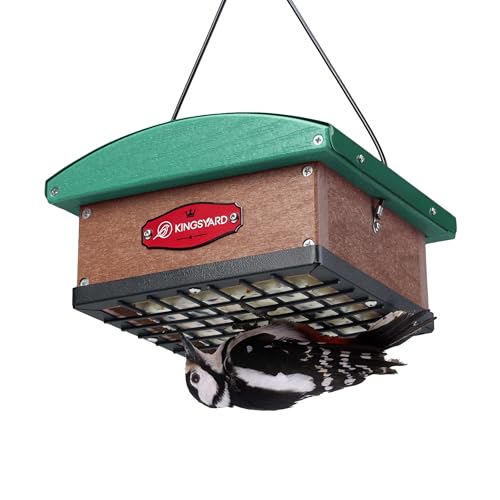
Among these feeders, this is the only one explicitly sized for two standard suet blocks, making it a fit for yards where refills should be less frequent. Its 5.5-inch-square housing sits beneath a metal roof, and a metal seal lines the bottom. The body is recycled plastic. Kingsyard says the materials are intended for year-round weather exposure and that the edging helps deter squirrels. The larger capacity is useful when birds visit often, but the feeder takes more space than a one-cake design; measure the hanging spot before choosing it.
Bottom line: Choose it if you want space for two standard suet blocks and a roofed design.
Nature’s Way Cedar Inverted Feeder

The cedar construction distinguishes this one-cake feeder from the recycled plastic options, while a hinged black roof lifts for loading. It uses a vinyl-coated steel hanging cable and stainless-steel screws, and its roof is intended to shield suet from sun and rain. The inverted access is aimed at clinging birds such as woodpeckers, chickadees, titmice and nuthatches. Choose it if you prefer a cedar feeder and refill one cake at a time. Its single-cake capacity is the main limitation for busy feeding spots, where a two-cake model may require fewer refills.
Bottom line: Pick it for cedar construction and a hinged loading roof with one-cake capacity.
Birds Choice Recycled Plastic Feeder
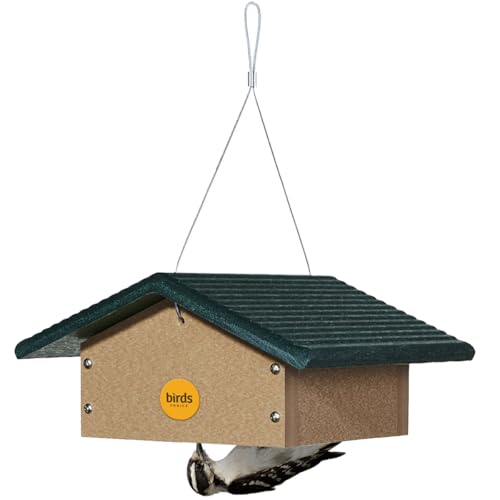
A tail prop sets this one-cake feeder apart by giving clinging birds a place to brace while they feed. The body is recycled poly lumber, and the vinyl-coated grid and stainless-steel screws form its feeding structure. Birds Choice describes the inverted design as starling-proof; treat that as a design aim rather than a guarantee against every unwanted visitor. The wide opening is intended to simplify access when replacing a cake. This is a practical match for a single-cake setup, but its capacity is smaller than the two-block Kingsyard.
Bottom line: Choose it if tail support for clinging birds matters more than holding multiple cakes.
Songbird Essentials Driftwood Feeder
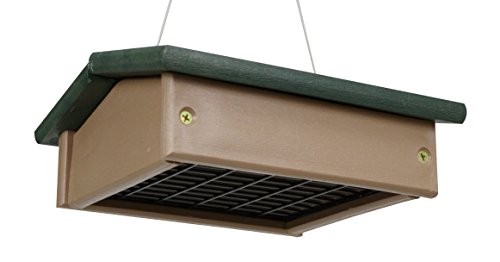
This model stands out for its 100-year guarantee, an unusually long warranty claim compared with the features provided for the other feeders. Songbird Essentials describes its construction as durable and environmentally safe, and identifies Driftwood and Hunter Green as available finishes. The dimensions are 7.5 by 3 by 7.25 inches, giving it a relatively narrow listed width among these options. Choose it if the guarantee and slim shape are priorities.
Bottom line: Pick it if the long guarantee and narrow dimensions suit your hanging space.
How upside down suet feeders work
Upside down suet feeders make birds cling beneath the food rather than perch above it. Woodpeckers, nuthatches, chickadees and titmice are among the birds that can cling to a feeder; species that prefer a broad perch may find access less convenient. This can discourage some nuisance birds, but it does not make a feeder universally squirrel-proof or starling-proof. Select a one-cake or two-cake feeder based on how often you want to refill: a two-cake capacity gives more food between refills, while a one-cake model uses less hanging space. A roof can shield the cake from rain and direct sun, but it does not replace routine cleaning or keeping the feeder in sound condition.
Choosing capacity and placement
Choose capacity by matching the feeder to your refill routine and available hanging space. Standard suet cakes are commonly about 4.5 inches square and 1.5 inches thick, but check the cake dimensions against the feeder opening before buying. A two-cake model can reduce refill frequency; a one-cake feeder limits how much food is exposed at once. Hang a feeder roughly 5 feet above ground and about 10 feet from dense cover when practical: this gives birds space to approach while avoiding an easy launch point for some predators. Use a sturdy branch or hook that can carry the filled feeder. The models here range from 3 inches to 11.5 inches tall, so compare feeder height with the clearance under the chosen hook.
The table links common yard needs to a practical choice.
| Yard need | Useful choice | Reason |
|---|---|---|
| Fewer refills | Two-cake capacity | Holds two blocks |
| Single cake at a time | One-cake capacity | Limits feeder capacity |
| Low hanging clearance | Shorter feeder | Measure total height first |
Keeping suet feeders clean and safe
Clean a suet feeder about every two weeks in active use, and sooner if food residue or droppings build up. Remove old food, scrub the feeder with hot soapy water, then rinse and dry it fully before refilling; dry surfaces help limit mold. For disinfection after contamination, a 1-part household bleach to 9-parts water solution is a common bird-feeder ratio; rinse thoroughly and air-dry before birds return. Wear gloves when cleaning, and wash hands afterward. Discard suet that smells rancid, looks moldy or has been contaminated. In hot weather, fat-based cakes can soften, so check them regularly and remove spoiled food rather than letting it remain in the feeder.
Frequently Asked Questions
How many suet cakes fit in a standard feeder?
Many suet feeders are built around one standard cake, roughly 4.5 inches square and 1.5 inches thick. Check the feeder opening and capacity before selecting a cake size.
Do upside down suet feeders keep squirrels away?
An inverted design can make access harder for animals that cannot cling beneath the feeder, but it is not a guarantee against squirrels. Hang the feeder well away from launch points such as branches and fences; squirrels can jump several feet horizontally.
How often should I clean a suet feeder?
Clean a feeder about every two weeks during regular use, and sooner if you see droppings, wet residue or mold. Scrub with hot soapy water, rinse thoroughly and let it dry before adding fresh food.
When should I remove suet in hot weather?
Check suet daily in hot weather because fat-based cakes can soften or spoil faster in heat. Remove any cake that is moldy, rancid-smelling or contaminated rather than leaving it for birds.
Where should I hang an upside down suet feeder?
A common starting point is about 5 feet above ground and roughly 10 feet from dense cover. Use a stable support and keep enough overhead clearance for the feeder to hang and swing freely.