
Best Brace for Shoulder Impingement: 4 Options Compared

For most people seeking a shoulder brace for impingement, the Sparthos brace is the most adaptable pick because its universal design fits either arm and has adjustable straps. Choose a different option if you need a specific size, a longer wrap, or a gel pad for training.
Shoulder impingement describes pain associated with shoulder movement; a brace may offer support but does not replace assessment or rehabilitation.
We earn a commission if you buy through links on this page. As an Amazon Associate I earn from qualifying purchases. Products are compared on manufacturer specifications, not hands-on testing.
- Best overall: Sparthos Universal Shoulder Brace – Universal sizing, adjustable straps and compatibility with either arm make fit more flexible.
- Best for size choice: FIGHTECH Shoulder Brace, Large/X-Large – Available in four sizes, with the model specifying a 12–17-inch bicep fit.
- Best for padded training: Anaconda Fightwear Shoulder Brace, Large – Includes a detachable gel pad and an adjustable left- or right-shoulder fit.
| Product | Best for | Fit | Distinct feature | Shop |
|---|---|---|---|---|
| Sparthos Universal Shoulder Brace | Flexible fit | Universal; left or right arm | Adjustable straps | Check Price on Amazon |
| FIGHTECH Shoulder Brace, Large/X-Large | Size-specific fit | Large/X-Large; bicep 12–17 in | 72 in listed length | Check Price on Amazon |
| Komoko Shoulder Brace | Neoprene construction | Adjustable; left or right arm | 9.8 × 6.7 × 1.9 in | Check Price on Amazon |
| Anaconda Fightwear Shoulder Brace, Large | Padded training | Large; left or right shoulder | Detachable gel pad | Check Price on Amazon |
Shoulder Braces for Impingement
Compare each brace’s fit and construction, then choose based on how much adjustability and coverage you need.
Sparthos Universal Shoulder Brace

The Sparthos brace stands out for its universal sizing and adjustable chest and arm straps, which allow a more customizable fit than a fixed-size option. The design is a compression sleeve with a strap system, and the maker says it provides gentle compression and moderate stabilization for mild to moderate shoulder discomfort. It is intended to allow movement rather than immobilize the shoulder. That makes it a fit for someone seeking adjustable support during ordinary activity. The maker cautions that the brace is not intended for severe immobilization, so it is not the right choice when a clinician has prescribed stronger restriction.
Bottom line: Choose this if flexible sizing and adjustable straps matter most.
FIGHTECH Shoulder Brace, Large/X-Large

The FIGHTECH brace offers a size-specific option: the Large/X-Large model is identified for a 12–17-inch bicep, unlike universal-fit designs. Its long wrap-style construction is described by the maker as providing medium to strong support through constant pressure and as a reminder against overextension. Check the bicep range against your measurement before choosing this size; a poor fit can make a compression brace uncomfortable. The product name gives four sizes overall, but this particular option is Large/X-Large. Its broad wrap may be less convenient for someone who wants a compact sleeve.
Bottom line: Choose this if your bicep measurement falls within its range.
Komoko Shoulder Brace
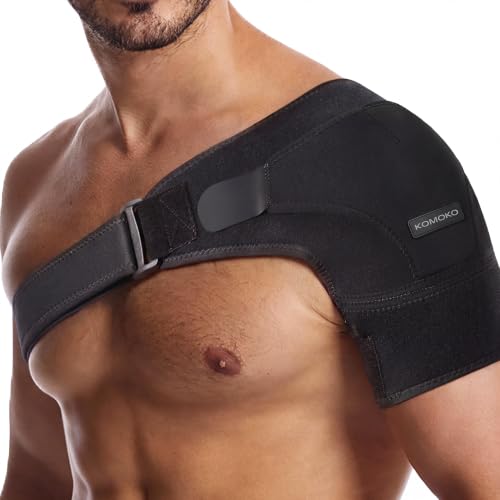
The Komoko brace is distinguished by its neoprene-rubber construction and stated dimensions of 9.8 × 6.7 × 1.9 inches. It is adjustable for either arm, while the FIGHTECH option instead identifies a specific bicep range. The maker describes the brace as providing support while limiting overextension and says the material is designed to withstand repeated washing. This may suit someone who wants a compact, adjustable brace for varied activities. Its dimensions do not establish a body-fit range, so take care to assess comfort and strap placement rather than assuming those measurements correspond to a particular shoulder size.
Bottom line: Choose this if neoprene and an adjustable either-arm design suit your needs.
Anaconda Fightwear Shoulder Brace, Large

The Anaconda Fightwear brace is the option here with a detachable gel pad, a feature aimed at added padding during training. It is a Large-size compression support with an adjustable fit for either shoulder. The maker describes its 3D compression as intended for athletic use and says the pad is detachable. That makes it a more targeted choice for someone who wants padding while training rather than a universal everyday fit. The size is Large, so it may not suit someone whose shoulder or torso fit calls for another size; confirm the fit before relying on it for activity.
Bottom line: Choose this if you want a detachable pad for training and the Large fit suits you.
How to Choose a Shoulder Brace for Impingement
Shoulder impingement symptoms often occur with arm elevation, and care commonly focuses on adjusting aggravating activity and guided exercises rather than immobilizing the shoulder. A compression sleeve or wrap may provide a feeling of support, but it does not establish a diagnosis or correct the cause of pain. Prefer adjustable straps when you need to fine-tune pressure; choose a measured size when the product gives a body measurement range. If a brace causes numbness, tingling, increased pain, or a cold or discolored hand, loosen or remove it. Seek clinical advice for persistent pain, marked weakness, or a recent injury.
Shoulder Brace Fit and Sizing
A shoulder brace should feel secure without restricting circulation or causing new pain. Measure the body area named by the manufacturer, such as the bicep, rather than using the brace’s package dimensions as a substitute for a fit range. For the FIGHTECH Large/X-Large model, compare your bicep measurement with its 12–17-inch fit range. Universal sizing can simplify choosing an arm side, but it does not guarantee a comfortable fit on every torso. Straps should lie flat and stay clear of the neck and armpit; reassess fit after moving the arm. A brace that slips or requires very tight straps is a poor match, even if its size label seems right.
Use this comparison to decide which stated fit feature matters most.
| Need | Relevant feature |
|---|---|
| Adjustable fit across either arm | Universal or adjustable design |
| Body-measurement guidance | Published bicep range |
| Padding during training | Detachable gel pad |
When to Wear a Shoulder Support
A brace is best treated as an optional support, not a substitute for restoring shoulder movement and strength. Pain with overhead reaching is common in shoulder-related conditions, so temporarily reducing a painful activity can be more useful than forcing movement through symptoms. A clinician or physical therapist can help distinguish impingement-like pain from other causes and select exercises. Avoid wearing a tight brace for long periods if it increases discomfort, causes skin irritation, or creates tingling. Do not use a support to return to contact sports or heavy lifting while pain or weakness remains; the brace cannot guarantee protection from a sudden injury.
Common Shoulder Brace Mistakes
The most common mistake is choosing a brace by its claimed condition list instead of checking size, strap placement, and the level of restriction it provides. A loose brace can slide during movement, while an overly tight brace can cause pressure or circulation symptoms. Another mistake is treating compression as treatment: braces do not replace a plan to address mobility, strength, and activity triggers. A sling-like or restrictive support may reduce movement more than intended for routine impingement symptoms. Stop using a brace that worsens pain or creates numbness, and get medical advice for severe pain, sudden weakness, or symptoms after a fall.
Frequently Asked Questions
Can a shoulder brace fix shoulder impingement?
A shoulder brace does not fix the underlying cause of impingement-like pain. Management commonly includes changing painful activities and guided exercises to improve shoulder movement and strength.
Should I wear a shoulder brace all day?
Continuous wear is not automatically appropriate for shoulder discomfort. Remove or loosen the brace if you develop numbness, tingling, skin irritation, or increased pain, and ask a clinician how long to use it.
How tight should a shoulder compression brace be?
A compression brace should feel secure without causing tingling, numbness, increased pain, or a cold or discolored hand. If any of those symptoms appear, loosen or remove it.
Can I exercise while wearing a shoulder brace?
A brace does not make painful or high-load exercise safe. Reduce or stop movements that increase pain, especially overhead activity, and get professional guidance before returning to heavy lifting or contact sports.
When should shoulder pain be checked by a clinician?
Get medical advice for persistent pain, significant weakness, or pain after a fall or other injury. Sudden severe pain or major loss of arm movement warrants prompt evaluation.