
Best Cold Laser Therapy Devices for Home Use

The best cold laser therapy device for most people is Cold Laser Device with 3 Heads, whose three replaceable heads and adjustable wavelength controls give it flexibility across body areas. Choose another model if a 60-minute timer, pulse mode, or emergency stop is a priority; these devices use light for home wellness routines and are not a substitute for medical care.
We earn a commission if you buy through links on this page. As an Amazon Associate I earn from qualifying purchases. Products are compared on manufacturer specifications, not hands-on testing.
- Best overall: Cold Laser Device with 3 Heads – Three replaceable heads and adjustable controls across 635 nm, 810 nm, and 980 nm.
- Best for longer sessions: Cold Laser Device, 3 Wavelengths – Offers a timer up to 60 minutes, three power levels, and pulse mode.
- Best for a safety cutoff: Cold Laser Device with Emergency Stop – Includes a side emergency stop button and three replaceable heads.
| Product | Best for | Wavelengths | Attachments | Maximum timer | Shop |
|---|---|---|---|---|---|
| Cold Laser Device with 3 Heads | Flexible body areas | 635, 810, 980 nm | 3 replaceable heads | — | Check Price on Amazon |
| Cold Laser Device, 3 Wavelengths | Longer sessions | 650, 808, 980 nm | — | 60 minutes | Check Price on Amazon |
| Handheld Cold Laser with 3 Heads | Short sessions | Multiple wavelengths; unspecified | 3 interchangeable heads | 20 minutes | Check Price on Amazon |
| ACGEFIR Cold Laser for Humans and Pets | Pulse settings | 660, 810, 980 nm | — | 6 timer settings; duration unspecified | Check Price on Amazon |
| Cold Laser Device with Emergency Stop | Safety cutoff | 635, 810, 980 nm | 3 replaceable heads | — | Check Price on Amazon |
Cold laser therapy devices compared
Compare the wavelength combinations and controls first, then choose attachments and session limits that suit your routine.
Cold Laser Device with 3 Heads

Three replaceable heads make this model the most adaptable choice here for routines that move between body areas. It uses 635 nm, 810 nm, and 980 nm wavelengths, with touch controls for intensity and timer settings plus human preset modes and a temperature display. The cylindrical, round, and probe attachments are intended for different areas, including face and oral-area routines. It also operates at low noise.
Bottom line: Pick this if you want multiple attachments and adjustable wavelength controls.
Cold Laser Device, 3 Wavelengths
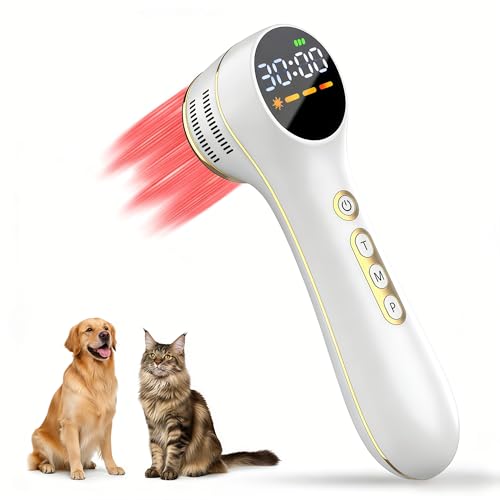
A 60-minute timer distinguishes this device from the models whose timer limits are shorter or unspecified. Its system combines 4 × 980 nm, 5 × 808 nm, and 16 × 650 nm emitters, with pulse mode, three power levels, and a 7,000 mAh battery. The maker describes the wavelength mix as intended for different tissue depths and use with people or pets. It suits buyers who prioritize longer sessions and battery operation. The tradeoff is fewer stated fit cues: no attachment set is identified, so it may be less adaptable across small and large treatment areas.
Bottom line: Choose this if you want a longer timer, pulse mode, and battery power.
Handheld Cold Laser with 3 Heads

A 20-minute timer gives this handheld device a clear session limit, while three interchangeable heads offer more area-specific options than the model with the 60-minute timer. It has multiple wavelengths with independently adjustable power, plus intensity and timer controls. The included cylindrical, round, and probe heads are intended for different areas, including around the eyes, ears, nose, and oral area. This suits a buyer who wants adjustable power and attachments for shorter routines.
Bottom line: Pick this for multiple heads and a defined 20-minute maximum session.
ACGEFIR Cold Laser for Humans and Pets

Six timer settings and a 30 Hz pulse mode set this model apart for buyers who want selectable session options. Its 660 nm red, 810 nm infrared, and 980 nm infrared combination is described for surface and deeper light application, and it is designed for people and pets. The controls include a high-definition LED display. This may suit households looking for a single handheld device for several users.
Bottom line: Choose this if pulse mode and multiple timer settings matter most.
Cold Laser Device with Emergency Stop

A side emergency stop button is the distinguishing control on this three-head, three-wavelength model. The 635 nm, 810 nm, and 980 nm combination comes with a touch LCD, human preset modes, independent intensity and timer controls, and real-time temperature monitoring. Its cylindrical, round, and probe heads support routines across multiple body zones, and the motor is described as ultra-low-noise. This model suits buyers who value a quick cutoff alongside adjustable controls.
Bottom line: Pick this if a physical emergency stop control is a priority.
How to choose a cold laser therapy device
Start with controllable settings and a use case, not a claim about tissue depth. These five handheld devices span 635 nm to 980 nm wavelengths, but their controls differ: timer limits range from 20 minutes to 60 minutes where a duration is given, and some have pulse modes or independent power controls. Match attachments to the size and location of the area you intend to use; probe-style heads are for more localized areas, while round or cylindrical heads can cover broader areas. A measurable rule: if you need sessions longer than 20 minutes, rule out the model with a 20-minute maximum and favor the one with a 60-minute timer. Treat wellness-device claims cautiously, and ask a clinician about persistent pain or an injury.
Wavelengths and device types
Red wavelengths around 635–660 nm and near-infrared wavelengths around 810–980 nm are common in consumer light therapy devices. Wavelength alone does not establish the dose delivered to tissue; irradiance, treatment distance, exposure time, and beam area all affect energy per area. The product choices here include multi-wavelength handheld units with different head designs, plus a battery-powered model with a 7,000 mAh capacity. Compare controls and included attachments alongside wavelength range rather than assuming that a larger wavelength count means a better fit. The table separates practical design differences without treating maker claims about depth or recovery as proven outcomes.
| Device type | Useful distinction | Best match |
|---|---|---|
| Multi-head handheld | Interchangeable localized and broader-area heads | Changing body areas |
| Long-timer model | Timer to 60 minutes, pulse mode, battery | Longer sessions |
| Pulse/timer model | 30 Hz pulse and six timer settings | Selectable session options |
Safe use around eyes, mouth, and pets
Never point a laser or bright therapeutic light toward the eyes, and use eye protection appropriate to the device’s wavelength and output. A probe head described for use around eyes or oral areas is not a reason to direct light into the eye or mouth; follow the device’s safety labeling and consult a clinician before treating a sensitive area. Animals may not signal discomfort clearly, so keep sessions supervised and stop if a pet resists or shows irritation. The products’ references to pets do not establish veterinary effectiveness or safety for a specific condition. Avoid using light therapy as a substitute for prompt evaluation of wounds, infection, severe pain, or sudden symptoms.
Session timing and common selection mistakes
Timer settings limit a session but do not tell you the dose received; output power, distance, treatment area, and duration all matter. Avoid assuming that the longest timer, most emitters, or most wavelengths produces better results. Use only the settings and exposure pattern supported by the device’s safety directions, and stop for discomfort, eye exposure, or unexpected skin changes. A 20-minute timer is a clear constraint, while six selectable timer settings are not equivalent to a known maximum duration. If session duration is a deciding factor, confirm the maximum timer before ordering rather than relying on the number of settings.
Frequently Asked Questions
Can a cold laser therapy device replace medical treatment?
No; a home light device should not replace diagnosis or treatment for persistent pain, wounds, or sudden symptoms. Seek clinical advice when symptoms are severe, worsening, or unexplained.
Are infrared wavelengths safe to use near the eyes?
Keep light sources out of direct eye exposure, including near-infrared devices that may not look bright. Use wavelength-appropriate eye protection and follow the device’s safety directions.
What does a 60-minute timer tell me about dose?
A 60-minute timer gives the session ceiling, not the energy delivered to tissue. Output, beam area, distance, and exposure time affect dose, so a longer timer does not mean a stronger treatment.
Can these devices be used on dogs or cats?
Some listed models are marketed for pets, but that does not establish safety or effectiveness for a particular animal or condition. Ask a veterinarian before using light therapy on an injured or ill pet.