
Best Commercial Sink Faucets With Sprayer Compared

GIMILI 25-Inch Wall-Mount Faucet suits most buyers seeking a commercial sink faucet with sprayer because its 25-inch height and 8-inch adjustable wall centers fit a common configuration. Choose a 36-inch model for a taller pre-rinse assembly, or compare add-on spout lengths when sink reach matters.
A pre-rinse faucet combines a pull-down spray head with a separate swivel outlet, so buyers should match the wall plumbing and clearance before choosing.
We earn a commission if you buy through links on this page. As an Amazon Associate I earn from qualifying purchases. Products are compared on manufacturer specifications, not hands-on testing.
- Best overall: GIMILI 25-Inch Wall-Mount Faucet – A 25-inch faucet with adjustable 7.75- to 8.25-inch wall centers and a 12-inch swivel spout.
- Best for taller clearance: BESTJEEF 36-Inch Faucet – A 36-inch model pairs the pre-rinse assembly with a 12-inch add-on spout.
- Best for a compact spout reach: iVIGA 25-Inch Faucet – The 25-inch faucet has a 9.6-inch add-on swing spout.
| Product | Best for | Height | Wall centers | Add-on spout | Shop |
|---|---|---|---|---|---|
| GIMILI 25-Inch Wall-Mount Faucet | Common wall centers | 25 in | 7.75–8.25 in | 12 in | Check Price on Amazon |
| BESTJEEF 36-Inch Faucet | Taller installations | 36 in | 7.75–8.25 in | 12 in | Check Price on Amazon |
| iVIGA 25-Inch Faucet | Shorter add-on reach | 25 in | 8 in | 9.6 in | Check Price on Amazon |
| BESTJEEF 36-Inch Faucet, 1.42 GPM | Specified spray flow | 36 in | 8 in | 12 in | Check Price on Amazon |
| HWM 25-Inch Faucet | Shorter installations | 25 in | 7.75–8.25 in | 10 in | Check Price on Amazon |
Commercial Sink Faucets With Sprayer
Match wall-inlet spacing, overall height and spout reach to your sink and the space above it.
GIMILI 25-Inch Wall-Mount Faucet
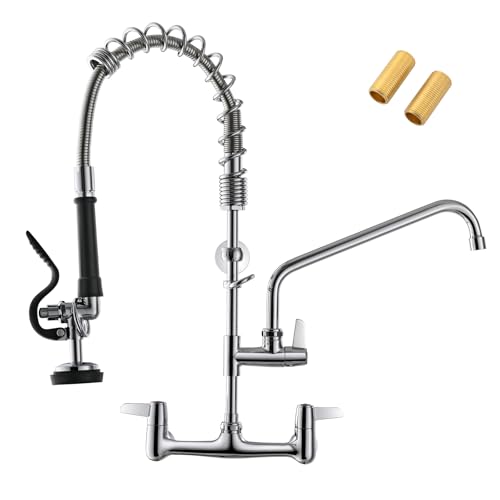
For a 25-inch wall-mount setup, GIMILI 25-Inch Wall-Mount Faucet combines adjustable inlet spacing with a 12-inch swivel outlet. Its solid brass body has a polished chrome finish, and the spout turns 360 degrees; the outlet includes an ABS bubbler. The adjustable 7.75- to 8.25-inch center range is useful when existing plumbing is close to, but not exactly, 8 inches apart. This is a fit-oriented choice for sinks needing a wall connection and a separate spray head. The 12-inch outlet may extend farther than needed on a narrow basin, so measure the sink width and mounting clearance first.
Bottom line: Choose it when the wall centers fall within its adjustment range and a 12-inch swivel outlet suits the basin.
BESTJEEF 36-Inch Faucet

BESTJEEF 36-Inch Faucet is the taller choice, with a 36-inch faucet height and a 12-inch add-on spout. Its wall inlets adjust from 7.75 to 8.25 inches, and the faucet uses a chrome-finished brass construction. The added height can suit a work area that needs more vertical room for handling larger cookware beneath the spray assembly, provided overhead clearance allows it. The assembly dimensions also give a 26.4-inch length and 13.4-inch width, useful figures to compare against nearby shelving or equipment. This model occupies more vertical space than the 25-inch options, so check clearance above the sink before selecting it.
Bottom line: Pick it when a 36-inch assembly fits your overhead space and you want a 12-inch outlet.
iVIGA 25-Inch Faucet

iVIGA 25-Inch Faucet pairs a 25-inch pre-rinse assembly with a 9.6-inch add-on swing spout, the shortest outlet reach among these picks. Its polished chrome finish and wall-mount design target dish rinsing before a commercial dish machine. The shorter separate spout can be a better match when a 12-inch outlet would reach too far across a compact basin. A replacement hose length of 18.5 inches is specified for faucets under 25 inches high, so this 25-inch model is at the boundary of that stated hose application; confirm the hose configuration before ordering. A 3-year limited warranty is included.
Bottom line: Choose it if you want a shorter 9.6-inch add-on spout on a 25-inch faucet.
BESTJEEF 36-Inch Faucet, 1.42 GPM

BESTJEEF 36-Inch Faucet, 1.42 GPM distinguishes itself with a spray flow of 1.42 gallons per minute and stream and spray modes. This 36-inch wall-mount faucet has an 18-inch hose, a 12-inch spout that swivels 360 degrees, and stainless steel springs to steady the hose. Those specifics help buyers comparing spray behavior and hose setup, rather than height alone. The 1.42 GPM figure applies to the spray head as described, not necessarily the add-on outlet. Its 36-inch assembly needs more headroom than a 25-inch faucet, so measure from the sink deck to any shelf or hood before choosing.
Bottom line: Pick it when the 1.42 GPM spray and 18-inch hose fit your setup.
HWM 25-Inch Faucet

HWM 25-Inch Faucet is a 25-inch wall-mount faucet with a 10-inch add-on swing spout and a spray flow of 1.42 gallons per minute. Its inlet spacing adjusts from 7.75 to 8.25 inches, and its G1/2-inch female inlets connect to matching water lines. The 10-inch outlet is between the 9.6-inch and 12-inch spout options here, which can help when basin reach is the deciding dimension. The hose length is 18 inches. Measure the sink and hose path before choosing, particularly if the installation requires more hose reach than that length provides.
Bottom line: Choose it for a 25-inch faucet with adjustable centers and a 10-inch outlet.
How to choose a commercial sink faucet with sprayer
Start with wall-center spacing, then check total height and the add-on spout reach. The faucets here use an adjustable 7.75- to 8.25-inch center range or an 8-inch center, while their heights are 25 or 36 inches. Measure from the finished wall to the existing inlet centers and from the sink deck to the lowest overhead obstruction. A 36-inch faucet needs 11 inches more vertical space than a 25-inch unit. Next, compare outlet reach with basin width: the spouts range from 9.6 to 12 inches. A swiveling outlet can cover more of the basin, but a longer reach can crowd a small work area.
Wall-mount commercial faucets connect at the wall rather than through deck holes. Confirm that the wall outlets line up with the faucet inlets and that the connection type matches; the HWM model specifies G1/2-inch female inlets. If measurements fall outside the faucet’s adjustment, do not assume the fittings will compensate.
Wall spacing and clearance for sink faucets
Measure center to center between the two water outlets; an 8-inch nominal spacing is common among these models, with several allowing a quarter inch of adjustment on either side. Record the measurement at the finished wall, not from the outside edges of the fittings. A center mismatch can prevent the faucet from seating squarely, even when the nominal spacing looks close.
Use this quick fit guide before selecting a configuration:
| Measured need | Choice to compare | Check |
|---|---|---|
| 7.75–8.25 in centers | Adjustable-center model | Inlet thread and wall depth |
| 9.6–10 in outlet reach | Shorter add-on spout | Basin width and swivel path |
| 12 in outlet reach | Longer add-on spout | Nearby equipment clearance |
| 36 in faucet height | Tall pre-rinse assembly | Overhead obstruction height |
Leave room for the spray handle and hose to move without striking a shelf or wall. If any dimension is close to a limit, verify the actual mounting and connection dimensions before ordering.
Pre-rinse spray flow and safe installation
A pre-rinse spray head directs water to remove food residue before dishes go through a commercial dish machine; some assemblies also have a separate stream outlet. Among these options, two specify a spray rate of 1.42 gallons per minute, while the others provide no flow figure. Use the flow only for the product that gives it, and do not treat it as a guarantee of the building’s pressure or of the add-on spout’s flow.
Commercial faucets connect to pressurized hot and cold water, so shut off both supply lines before removing an old faucet. Support the faucet while loosening wall connections, and inspect for leaks after installation before putting the station into service. A leaking pressurized joint can damage surrounding surfaces; keep water away from electrical equipment during setup and cleanup.
Keeping a commercial sink faucet working
Rinse mineral deposits from spray openings regularly, especially where hard water leaves visible scale; deposits can narrow openings and distort the spray pattern. Clean the chrome finish with a soft cloth and mild soap rather than abrasive pads, which can scratch the surface. Check the hose, spring, swivel joint and wall connections during routine kitchen maintenance for visible wear, looseness or drips.
Replace a worn hose or seal with a part that matches the faucet’s connection and dimensions. A hose that is too short can limit pull-down movement, while excess slack can snag on stored items. Keep the spray head seated when not in use and avoid using the hose as a support or handle; the assembly is intended to deliver water, not carry a load.
Frequently Asked Questions
How far apart should commercial faucet wall outlets be?
Many wall-mount commercial faucets use 8-inch centers, measured from the center of one outlet to the center of the other. Some models allow 7.75 to 8.25 inches, but measure your finished-wall outlets and confirm the faucet’s inlet range.
How much clearance does a pre-rinse faucet need?
Measure from the sink deck to the lowest shelf, hood or cabinet edge. A 36-inch faucet is 11 inches taller than a 25-inch model, so choose the shorter height if overhead clearance is limited.
What does a commercial pre-rinse sprayer do?
A pre-rinse sprayer rinses food residue from dishes before they enter a commercial dish machine. The separate add-on spout handles a steady stream, while spray heads may offer different modes depending on the faucet.
Can I install a wall-mount faucet on a deck-mount sink?
A wall-mount faucet connects to water outlets in the wall, not holes in the sink deck. Use it only when the plumbing is configured for wall connections and the outlet spacing matches the faucet.
How often should a commercial faucet hose be checked?
Inspect the hose and its connections during routine kitchen maintenance, and replace the hose if it leaks, cracks or no longer moves freely. A kinked or undersized replacement can restrict pull-down travel.