
Best Coolant Leak Stop Products Compared by Fit

K-Seal ST5501 Coolant Leak Repair, 8 oz is the best coolant leak stop for most drivers because its 8-ounce formula is compatible with all antifreeze types and covers several cooling-system components. Choose another formula if you specifically want a larger bottle or a pelletized formula that addresses coolant-to-oil leaks.
Coolant stop leak products are additives intended to seal small leaks inside a cooling system; they are not a substitute for repairing a failed hose, radiator, or engine component.
We earn a commission if you buy through links on this page. As an Amazon Associate I earn from qualifying purchases. Products are compared on manufacturer specifications, not hands-on testing.
- Best overall: K-Seal ST5501 Coolant Leak Repair, 8 oz – Its maker says the 8-ounce, one-step formula works with all antifreeze types and addresses leaks in multiple components.
- Best for coolant-to-oil leaks: Bar’s Leaks Radiator Stop Leak, 11 oz – Its maker says the pelletized formula seals internal, external, and coolant-to-oil leaks.
- Best for metal radiators: Bar’s Leaks Cooling System Radiator Stop Leak, 16.9 oz – Its maker says the formula seals leaks in plastic, aluminum, and metal radiators.
| Product | Best for | Bottle size | Coolant compatibility | Claimed coverage | Shop |
|---|---|---|---|---|---|
| K-Seal ST5501 Coolant Leak Repair, 8 oz | Broad leak coverage | 8 oz | All antifreeze types | Radiator, head gasket, freeze plugs, block | Check Price on Amazon |
| Bar’s Leaks Radiator Stop Leak, 11 oz | Coolant-to-oil leaks | 11 oz | All types and colors; water | Radiators, heater cores, blocks, heads | Check Price on Amazon |
| Bar’s Leaks Cooling System Radiator Stop Leak, 16.9 oz | Radiator material coverage | 16.9 oz | — | Plastic, aluminum, and metal radiators | Check Price on Amazon |
| Bar’s Leaks 1150 High Mileage Repair, 16.9 oz | High mileage systems | 16.9 oz | All brands; conventional and OAT/HOAT | Cooling-system leaks | Check Price on Amazon |
Best coolant leak stop products
Compare the claimed coverage and compatibility before choosing an additive for your cooling system.
K-Seal ST5501 Coolant Leak Repair, 8 oz

K-Seal ST5501 Coolant Leak Repair, 8 oz stands out for its one-step approach and broad range of components. The maker says its 8-ounce formula works with all types of antifreeze and can address leaks in the radiator, head gasket, freeze plugs, block, heater matrix, and water pump. It is intended for water-cooled cars and light trucks with up to 12 cylinders, and the product name says no flushing is required.
This is the clearest fit when broad compatibility matters. The maker cautions that bubbles in the radiator or reservoir may indicate an over-pressurized system, so this additive is a poor choice until that condition is diagnosed.
Bottom line: Choose this for broad component coverage and compatibility with different antifreeze types.
Bar’s Leaks Radiator Stop Leak, 11 oz

Bar’s Leaks Radiator Stop Leak, 11 oz is the only option here whose maker explicitly claims coverage for coolant-to-oil leaks as well as internal and external leaks. Its dissolved pelletized formula is claimed to work with all types and colors of antifreeze, including conventional silicate-based and extended-life OAT/HOAT coolants, or straight water.
The maker also says the formula includes water-pump lubricant and inhibits rust and scale. Those added claims make it a different choice from a product focused on a one-step application, but stop leak additive is not a repair for a damaged component that needs replacement.
Bottom line: Pick this when the claimed coolant-to-oil leak coverage and broad fluid compatibility match your need.
Bar’s Leaks Cooling System Radiator Stop Leak, 16.9 oz
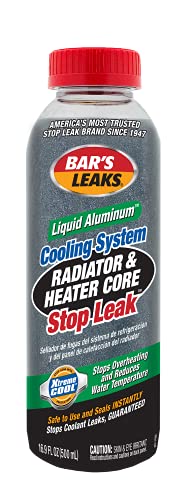
Bar’s Leaks Cooling System Radiator Stop Leak, 16.9 oz makes the radiator materials explicit: the maker says its liquid aluminum formula seals leaks in plastic, aluminum, and metal radiators. It also claims coverage for freeze plugs, gaskets, and heater cores, with a 16.9-ounce bottle.
Choose it for the radiator-material range rather than for a claim about coolant-to-oil leaks or coverage of the block and water pump.
Bottom line: Choose this when the radiator materials and targeted component coverage fit the repair.
Bar’s Leaks 1150 High Mileage Repair, 16.9 oz

Bar’s Leaks 1150 High Mileage Repair, 16.9 oz is differentiated by its high mileage positioning and carbon-fiber formulation. The maker says it stops cooling-system leaks and is compatible with all brands of antifreeze, including conventional green or blue and extended-life red/orange or yellow OAT/HOAT coolant. Its 16.9-ounce bottle is larger than the 8-ounce option.
The claims here are broader than a component-by-component repair description, so this is best for a buyer choosing by high mileage system positioning and coolant compatibility.
Bottom line: Consider this for a high mileage cooling system when broad antifreeze compatibility is the deciding factor.
How coolant stop leak additives work
Coolant stop leak additives circulate with the coolant and are intended to seal small openings as fluid moves through the system. They do not replace a failed hose, cracked radiator, or damaged engine part. Cooling systems normally operate under pressure, and overheating can cause severe engine damage; never remove a radiator cap while the system is hot. A growing puddle, rapid coolant loss, steam, or a temperature gauge climbing above normal calls for stopping the engine and diagnosing the cause rather than repeatedly topping up with additive.
Use stop leak only when the product is compatible with the coolant and the suspected leak is within its claimed scope. A leak that mixes coolant and oil is especially serious: stop driving and arrange a diagnosis instead of treating additive as proof the fault is repaired.
How to choose a coolant leak stop
Choose by coolant compatibility first, then match the claimed leak locations to the part that appears to be leaking. Coolant formulations commonly use inorganic additive technology (IAT), organic acid technology (OAT), or hybrid organic acid technology (HOAT); color alone is not a reliable way to identify chemistry because manufacturers use different dyes. Check the vehicle manual or coolant label for the required specification before adding a product.
Use a measurable decision rule: if you cannot identify the coolant type, choose only a formula whose maker explicitly claims compatibility with all types, or confirm the required specification before pouring anything in. Also compare the named coverage: a radiator-focused claim is not the same as a claim covering a water pump, head gasket, or coolant-to-oil leak.
Stop leak limits and cooling-system safety
Stop leak additives are intended for leaks small enough for the product to seal, not for major coolant loss or a system that overheats. A temperature gauge rising into the hot zone, visible steam, or coolant pouring out is a stop-driving condition; continuing can warp cylinder heads or damage the engine. Let the engine cool fully before inspecting the reservoir or radiator, since hot pressurized coolant can cause serious burns.
Persistent bubbles in a reservoir can indicate combustion gases or excess system pressure rather than a simple seep. Do not keep adding additive when symptoms continue: pressure testing and inspection can distinguish a radiator or hose leak from a head-gasket problem. Follow product dosing and application instructions, since the bottle sizes and recommended amounts differ by formula.
Common mistakes when using coolant stop leak
The most common mistake is treating an additive as a guaranteed fix for any leak. A split hose, visibly damaged radiator, failing water pump, or severe internal leak needs mechanical diagnosis; an additive claim does not establish that the vehicle is safe to drive afterward. Another mistake is choosing by coolant color alone, since blue, green, red, orange, and yellow dyes do not identify one universal chemistry.
Do not open a hot cooling system or mix an unfamiliar additive with coolant before checking compatibility. Use the vehicle’s coolant specification and the product’s coverage, and monitor the temperature gauge after any repair attempt. If coolant keeps disappearing or overheating returns, stop driving and have the cooling system inspected rather than repeating the treatment.
Frequently Asked Questions
Can coolant stop leak fix a blown head gasket?
Some formulas claim coverage for head-gasket leaks, but that does not confirm the gasket is repaired or make an overheating vehicle safe to drive. Bubbles in the reservoir or continued coolant loss warrant a cooling-system diagnosis.
Can stop leak clog the heater core?
A heater core has narrow passages, so any additive should be used only when its maker claims heater-core compatibility or coverage. If cabin heat drops or overheating appears after treatment, stop driving and have the system inspected.
Should I add coolant stop leak to a hot engine?
No; never open a hot radiator or pressurized reservoir because escaping coolant can cause severe burns. Let the system cool fully and follow the product’s application directions.
How do I know which antifreeze type is in my car?
Check the coolant specification in the owner’s manual or on the coolant container, since color alone does not reliably identify IAT, OAT, or HOAT chemistry. Use an additive only if its compatibility claim matches that specification.
Can I keep driving after adding stop leak?
Only if the engine stays at normal temperature and coolant loss has stopped; an overheating gauge, steam, or rapid loss means stop safely and shut the engine off. Additive does not establish that a mechanical fault is repaired.