
Best Depend for Men: 3 Styles Compared by Fit

Depend Fresh Protection in Large is the best all-around choice here because it combines maximum absorbency with a 72-count package for men whose waists measure 35–43 inches. Choose Depend Real Fit S/M, 56 Count instead for a 28–40-inch waist and a body-conforming Real Fit design, or Depend Fresh Protection Large, 28 Count if you want the same Fresh Protection features in a 28-count package.
Disposable incontinence underwear is pull-on absorbent underwear; the right choice depends first on a secure fit and then on the absorbency and design you prefer.
We earn a commission if you buy through links on this page. As an Amazon Associate I earn from qualifying purchases. Products are compared on manufacturer specifications, not hands-on testing.
- Best overall: Depend Fresh Protection Large, 72 Count – It pairs maximum absorbency with a 72-count package and a 35–43-inch waist range.
- Best for smaller waists: Depend Real Fit S/M, 56 Count – Its S/M size fits 28–40-inch waists and uses a body-conforming Real Fit design.
- Best for a smaller pack: Depend Fresh Protection Large, 28 Count – It has the same Fresh Protection features as the larger package, with 28 count.
| Product | Best for | Waist range | Count | Shop |
|---|---|---|---|---|
| Depend Fresh Protection Large, 72 Count | Larger package | 35–43 in | 72 | Check Price on Amazon |
| Depend Real Fit S/M, 56 Count | Smaller waist | 28–40 in | 56 | Check Price on Amazon |
| Depend Fresh Protection Large, 28 Count | Smaller package | 35–43 in | 28 | Check Price on Amazon |
Depend Incontinence Underwear for Men
Compare the waist fit, design and package count before choosing a Depend style.
Depend Fresh Protection Large, 72 Count
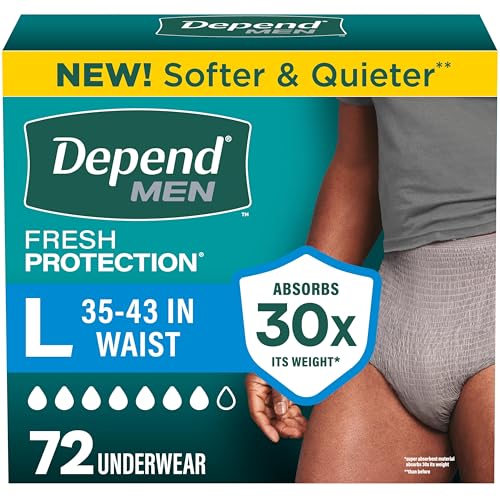
For men seeking a larger package of Fresh Protection, this option contains 72 maximum-absorbency underwear in Large. Depend says its Dryshield core absorbs 30 times its weight and turns liquid into gel; ODORBLOCK technology is intended to help neutralize and lock in odors. The size is for a 35–43-inch waist, so use that measurement rather than clothing size when checking fit. This is the strongest match when you want the Fresh Protection features and higher count. Its Large range may not suit a waist outside 35–43 inches.
Bottom line: Choose it for Fresh Protection features in a 72-count package and a 35–43-inch waist fit.
Depend Real Fit S/M, 56 Count

Unlike the Fresh Protection options, Real Fit emphasizes a body-conforming fabric and protection designed to stay less visible under clothing. The 56-count package is maximum absorbency in Small/Medium, sized for a 28–40-inch waist. Depend says the fabric conforms to the body and that the underwear offers up to zero leaks, odors and show; those are brand claims, not a guarantee for every wearer or fit. Consider this style when its broader S/M waist range and discreet-design emphasis matter more than Fresh Protection’s Dryshield and ODORBLOCK features. The size may not fit outside 28–40 inches.
Bottom line: Pick it if your waist fits 28–40 inches and you prefer a body-conforming design.
Depend Fresh Protection Large, 28 Count

This 28-count package offers the same Fresh Protection style and Large fit as Depend Fresh Protection Large, 72 Count, making package size its key distinction. Each pair is maximum absorbency for a 35–43-inch waist. Depend says the Dryshield core absorbs 30 times its weight and turns liquid into gel, while ODORBLOCK technology helps neutralize and lock in odors. Choose this package if the Fresh Protection design suits you but you prefer fewer pairs in the pack. It does not solve a fit mismatch: men outside the 35–43-inch waist range should compare a different size instead.
Bottom line: Choose it for Fresh Protection in Large when a 28-count package suits your needs.
How to choose Depend underwear for men
Start with waist measurement, then compare absorbency and design. Measure around the waist where underwear normally sits; use the brand’s range rather than assuming your pants size maps directly to a disposable garment size. A snug leg opening and close fit help contain leaks, while a garment that is too tight can feel restrictive. Absorbency labels such as “maximum” are useful within a product line, but they are not a universal volume scale for comparing every brand. If the waist is between sizes, try the size whose range includes the measurement and assess whether the waistband and leg openings sit securely without pinching.
Use the fit first
For the options here, choose Large only when the waist is 35–43 inches, and choose S/M only when it is 28–40 inches. The overlap at 35–40 inches means design and preferred fit can help decide between them.
Pull-on underwear versus tab-style briefs
Pull-on incontinence underwear is worn like regular underwear, while tab-style briefs open at the sides and can be fastened around the wearer. Pull-ons can suit someone able to step into and remove a garment; tab styles can be easier to change without removing shoes or trousers. Neither format is automatically more absorbent: check the product’s own absorbency category and intended use. A snug leg fit matters for both formats because gaps can allow leakage. Choose pull-on underwear when independent dressing and an underwear-like form are priorities; consider a tab style when easier changes while seated or lying down are the deciding need.
Format comparison
Use this quick guide to match the garment format to the changing routine.
| Format | Useful when | Fit check |
|---|---|---|
| Pull-on underwear | Independent dressing is practical | Waistband and leg openings sit close |
| Tab-style brief | Changing without stepping out is useful | Side tabs fasten securely without gaps |
When to change incontinence underwear
Change disposable underwear promptly after it becomes wet or soiled; there is no single time interval that suits every person or leakage amount. A damp garment left against skin can cause discomfort, so check it during routine bathroom visits and whenever it feels wet. For overnight use, choose a product whose absorbency category matches the expected need, and keep a spare garment accessible. A strong odor, repeated leakage, or skin irritation is a reason to reassess fit and changing frequency; persistent irritation warrants advice from a health professional. Do not treat a “maximum” label as permission to leave a wet garment on for a fixed number of hours.
Common fit and absorbency mistakes
Buying by clothing size alone is a common mistake; measure the waist and compare it with the garment’s size range. Another mistake is assuming “maximum absorbency” means the same capacity across all products, since the label does not provide a universal cross-brand volume measure. Leg openings that gape or a waistband that rolls can signal a poor fit even when the waist measurement falls within range. If leaks occur, check placement and fit before moving to another absorbency level. Dispose of used underwear in household waste unless local disposal rules say otherwise, and never flush it because absorbent materials can clog plumbing.
Frequently Asked Questions
How should men measure for incontinence underwear?
Measure around the waist where underwear normally sits, then match that number to the garment’s printed waist range. For the options here, Large fits 35–43 inches and S/M fits 28–40 inches.
Does maximum absorbency mean the same thing across brands?
No universal cross-brand volume scale is conveyed by the phrase “maximum absorbency.” Compare absorbency labels within the product line and consider when the garment will be worn.
How often should disposable underwear be changed?
Change it promptly after it becomes wet or soiled rather than relying on a fixed number of hours. Check during regular bathroom visits and sooner if it feels damp or uncomfortable.
Can incontinence underwear be flushed down the toilet?
No, disposable incontinence underwear belongs in household waste, not the toilet. Its absorbent materials can clog plumbing even if the garment is rolled or compacted.
What should I do if underwear leaks despite fitting the waist range?
Check that the garment is pulled fully into place and that the leg openings sit close without gaps. If the fit is secure and leaks continue, reassess the absorbency level for the time of day and amount of leakage.