
Best Diamond Nail File: 4 Options Compared by Fit

Clofiak 6.1-Inch Diamond Nail File is the best diamond nail file for most people because it pairs a 6.1-inch double-sided design with use on natural, acrylic and gel nails. Choose Caswell-Massey Diamond Dust Nail File for a longer 7-inch fine-dust file, or Mudder 3-Piece Diamond Nail File Set if having three file sizes matters more than a single-file format.
We earn a commission if you buy through links on this page. As an Amazon Associate I earn from qualifying purchases. Products are compared on manufacturer specifications, not hands-on testing.
- Best overall: Clofiak 6.1-Inch Diamond Nail File – Its 6.1-inch double-sided format is described for natural, acrylic and gel nails.
- Best for a fine surface: Caswell-Massey Diamond Dust Nail File – The 7-inch polished-steel file uses fine diamond dust grit.
- Best for multiple sizes: Mudder 3-Piece Diamond Nail File Set – The set includes three files in different sizes.
| Product | Best for | Length | Surface design | Set size | Shop |
|---|---|---|---|---|---|
| Clofiak 6.1-Inch Diamond Nail File | Multi-nail use | 6.1 in | Double-sided | 4 pieces | Check Price on Amazon |
| Caswell-Massey Diamond Dust Nail File | Fine-grit filing | 7 in | Fine diamond dust | 1 file | Check Price on Amazon |
| Sanguine 6-Inch Diamond Nail File | Washable filing | 6 in | Double-sided diamond dust | 1 file | Check Price on Amazon |
| Mudder 3-Piece Diamond Nail File Set | Mixed file sizes | Various sizes | Double-sided | 3 pieces | Check Price on Amazon |
Diamond Nail Files
Compare file length, abrasive surface and set format to find a match for your nail-care routine.
Clofiak 6.1-Inch Diamond Nail File
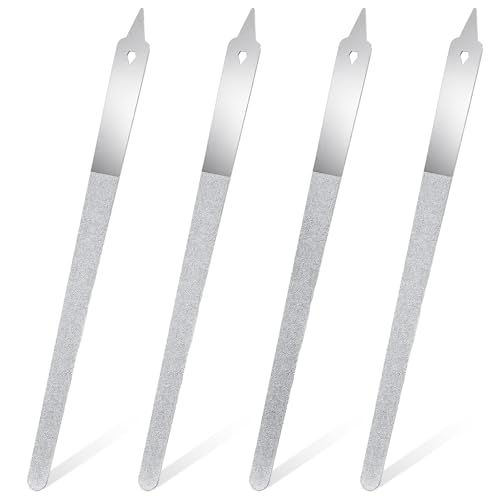
Clofiak 6.1-Inch Diamond Nail File is the most versatile pick in this group for nail types: its maker says the 6.1-inch stainless-steel file suits natural, acrylic and gel nails. The double-sided abrasive surface is described as coated with sapphire powder, and its pointed tip can reach beneath nails. The four-piece package suits someone who wants multiple files at home or on the go. Its limitation is that the pointed end is a specialized feature rather than an advantage for basic shaping; buyers who want a single fine-grit file may prefer a simpler design.
Bottom line: Choose it if you want one set for several nail types and under-nail cleanup.
Caswell-Massey Diamond Dust Nail File

Caswell-Massey Diamond Dust Nail File stands out for its fine diamond dust grit and 7-inch polished-steel body. The maker says the surface shapes and smooths nails, and the file is washable and reusable. Its extra length gives a longer working surface than the 6-inch options, which may suit someone who prefers a full-length hand file. This is a single-file option, not a multi-size kit, so it is less suitable if you want separate tools for different tasks. The fine abrasive is aimed at smoothing and pre-polish care rather than aggressive shortening.
Bottom line: Pick it if fine smoothing and a longer single file are your priorities.
Sanguine 6-Inch Diamond Nail File

Sanguine 6-Inch Diamond Nail File is a straightforward 6-inch steel file with diamond dust on both sides, a useful fit for someone who wants a simple, reusable tool rather than a kit. Its maker says it works on natural and artificial nails and can be rinsed in warm water for cleaning. At 6 inches, it is slightly shorter than the 7-inch file in this comparison. The specifications do not identify a fine or coarse side, so buyers who need a particular abrasive grade should confirm the surface before choosing it.
Bottom line: Choose it for a compact, rinse-cleanable single file for natural or artificial nails.
Mudder 3-Piece Diamond Nail File Set

Mudder 3-Piece Diamond Nail File Set is the set choice for someone who wants more than one file size: its package includes three stainless-steel files, including a compact file and a larger file with a cuticle pusher and cutter. The maker says the double-sided matte surfaces are washable and rust-resistant. A buyer needing a specific length should verify the sizes before choosing the set.
Bottom line: Pick it if a varied three-file assortment matters more than a known single length.
How to Choose a Diamond Nail File
Choose by abrasive feel, file length and the nail type you plan to shape. Natural nails are best filed with a fine abrasive; common salon files for natural nails are around 240 grit, while 180 grit is a coarser option often used on enhancements. A diamond-coated surface does not always give a familiar grit number, so avoid assuming two files feel alike based only on their labels. For ordinary home shaping, use light pressure and short strokes, then check the outline before removing more length. If you need to remove substantial length, use a clipper first and file the edge smooth rather than forcing a file across the nail.
Filing Natural Nails Without Splitting
File natural nails in one direction from the outer edge toward the center instead of sawing back and forth; repeated crosswise strokes can encourage peeling and splits. Keep the file nearly parallel to the nail edge, since steep filing can thin the sidewalls. A fine surface around 240 grit is a common choice for natural nails, while coarser 180-grit surfaces remove material faster and need a lighter touch. If nails are already thin or peeling, shape only the free edge and stop when the snag is gone. Diamond files can be used dry, and a washable steel file should be fully dried after rinsing to limit water remaining on the tool.
Diamond-Coated and Metal Files Compared
Diamond nail files use abrasive particles bonded to a base, while “metal file” describes the base material rather than the abrasive grade. A steel body can be durable and washable, but the surface texture—not the handle or base—determines how quickly it removes nail. Use the table to match a common need to a file style; the figures are typical guidance, not guaranteed grit ratings for every product.
| Need | Typical surface | Useful decision rule |
|---|---|---|
| Natural nail shaping | Fine, about 240 grit | Choose fine if you mainly smooth an edge |
| Faster shaping | Medium, about 180 grit | Use light pressure and stop to check length |
| Artificial nail work | Often coarser than natural-nail files | Use only a surface intended for enhancements |
Cleaning and Caring for a Reusable Nail File
Washable files can be rinsed to remove nail dust, but cleaning does not make a personal nail tool sterile. Brush debris from the abrasive surface, rinse if the maker allows it, and dry the entire file before storing it. Do not share nail files: small breaks in skin can transfer germs, and porous or worn abrasives are difficult to clean completely. Replace a file when its abrasive surface becomes smooth, clogged or uneven; continuing with a worn surface can lead to excess pressure and ragged edges. Keep pointed tips and any cuticle tool away from skin, since cuticle trimming can cause small wounds.
Frequently Asked Questions
What grit is best for filing natural nails?
About 240 grit is a common fine choice for shaping natural nails, while 180 grit removes material more quickly. Diamond files may not show a grit number, so use light pressure and check the nail edge often.
Should I file my nails wet or dry?
File natural nails when they are dry, because wet nails are softer and more prone to bending or tearing. Clean a washable file separately after filing and dry it before storage.
Can I use a diamond nail file on acrylic nails?
Some diamond nail files are intended for artificial nails, but abrasive coarseness matters: a fine natural-nail surface may take longer to shape an enhancement. Confirm the tool is suitable for the nail material and avoid filing the surrounding skin.
How often should I replace a nail file?
Replace a file when its abrasive face is clogged, smooth or uneven rather than relying on a fixed number of uses. A washable steel file can be rinsed, but cleaning does not restore worn abrasive particles.
Can two people share a metal nail file?
No; personal nail files should not be shared because tiny skin breaks can transfer germs. Rinsing a metal file removes debris but does not sterilize it.