
Best Ear Wax Removal Camera: 5 Models Compared

The JEGOAT 1296P Ear Cleaner suits most people seeking an ear wax removal camera because its 1296P camera offers the highest resolution among the models with figures. Choose Bebird D39R Flexible-Tube Camera or BEBIRD R1 Ultra 1296P instead if a flexible camera tube or insertion guard matters more than resolution.
These smartphone-connected otoscopes show the ear canal on a phone while the attached tip is positioned; they are not a substitute for clinical care. Avoid inserting tools deep into the canal, where delicate skin and the eardrum can be injured.
We earn a commission if you buy through links on this page. As an Amazon Associate I earn from qualifying purchases. Products are compared on manufacturer specifications, not hands-on testing.
- Best overall: JEGOAT 1296P Ear Cleaner – Its 1296P camera has the highest resolution among the models with figures.
- Best for curved canals: Bebird D39R Flexible-Tube Camera – Its flexible silicone camera tube is designed to fit curved ear canals.
- Best for insertion control: BEBIRD R1 Ultra 1296P – Its safety stopper and precise scale help limit how far the tool is inserted.
| Product | Best for | Camera resolution | Tip design | App or connection | Shop |
|---|---|---|---|---|---|
| JEGOAT 1296P Ear Cleaner | Higher resolution | 1296P | 12 silicone tips; 6 spoons | Wi-Fi; iOS and Android | Check Price on Amazon |
| Bebird D39R Flexible-Tube Camera | Curved canals | HD; resolution not given | Flexible tube; 12 tips | — | Check Price on Amazon |
| BEBIRD R1 Ultra 1296P | Insertion control | 1296P; 10 MP lens | 11 tips; stopper and scale | — | Check Price on Amazon |
| LEIPUT 1080P Ear Cleaner | Soft silicone tips | 1080P | 6 silicone covers; 3 scoop curves | Wi-Fi; iOS and Android | Check Price on Amazon |
| BEBIRD R1 1080P | App recording | 1080P; 3 MP lens | 10 replacement tips | Wi-Fi; iOS and Android | Check Price on Amazon |
Best ear wax removal cameras
Compare camera resolution, tip design and phone connectivity to find an otoscope that fits your needs.
JEGOAT 1296P Ear Cleaner

The 1296P camera gives this set the highest image resolution among the models with figures. JEGOAT pairs the camera with six LED lights, 12 silicone ear tips and six spoons, and its app connects to a smartphone over Wi-Fi. The product maker says the app can capture photos and videos for sharing with a healthcare provider. This set suits buyers who prioritize image detail and multiple accessories. Its longer set of tools may be more than needed for someone who wants a basic camera and a few tips.
Bottom line: Pick this if higher stated resolution and a broad selection of tips matter most.
Bebird D39R Flexible-Tube Camera

The flexible silicone camera tube distinguishes this model from rigid-probe designs, and the maker says it fits curved canals. The set includes 12 removal tips, an anti-insertion guard, a storage case and tweezers; the maker says the lens is IP67 waterproof. It suits buyers who want a flexible probe and several ways to handle different wax types. Move any ear tool gently and stop if it causes pain.
Bottom line: Choose this if a flexible camera tube matters more than a resolution.
BEBIRD R1 Ultra 1296P

The safety stopper and precise scale set this 1296P model apart for buyers focused on limiting insertion depth. It has a 10-megapixel lens, 3X magnification, 11 tips, a visual dropper tool and tweezers; the maker says its lens is IP67 waterproof. The combination suits someone who wants camera viewing plus a physical depth guide. A stopper cannot eliminate the risk of injury, and the product’s broad set of tools may be unnecessary for someone seeking only a basic otoscope. Use a camera tool at the canal entrance rather than pushing toward the eardrum.
Bottom line: Pick this if an insertion guard and depth scale are priorities.
LEIPUT 1080P Ear Cleaner

The three scoop curvatures and six silicone covers make this model distinctive for buyers who want to vary the scoop shape and soften contact. It has a 1080P camera, six LED lights, a rechargeable 240mAh battery and a Wi-Fi connection for iOS and Android. The maker says the lens is IP67 waterproof. It suits someone looking for a compact tip selection rather than a large family set. The 1080P resolution is lower than the 1296P options here, so buyers who prioritize image detail may prefer one of those models.
Bottom line: Choose this if interchangeable soft covers and scoop shapes suit your preference.
BEBIRD R1 1080P
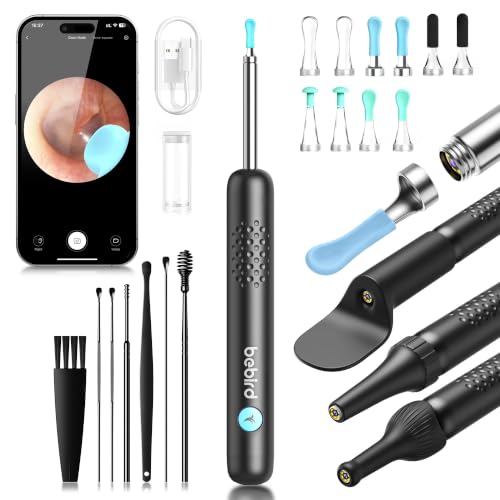
The Bebird app’s 20-frames-per-second video transfer is a distinguishing feature for buyers who want to record a live view. This 1080P camera has a 3-megapixel lens, six LED lights and 10 replacement tips, and connects directly to the Bebird app over Wi-Fi on phones and tablets running iOS or Android. It suits users who value app capture and a moderate tip assortment. The camera’s resolution is below the 1296P models, and the field of view may not suit buyers specifically seeking a flexible probe.
Bottom line: Pick this if app-based photo and video capture are central to your choice.
How to choose an ear wax removal camera
Choose by probe control and safe handling first, then compare resolution and accessories. A 1296P camera has more image pixels than a 1080P camera, but resolution alone does not establish how clear a live view will look on a particular phone. Silicone covers and a flexible-tube change how the tip contacts the canal; neither makes deep insertion safe. For routine earwax concerns, avoid probing if you have ear pain, drainage, a known eardrum perforation or prior ear surgery; ask a clinician instead. A useful decision rule is to favor a physical insertion guard if you are concerned about depth, while remembering that a guard cannot make forceful insertion safe. App compatibility and Wi-Fi setup also matter: check that the phone can run the required app before choosing a camera.
Camera resolution and live viewing
Compare resolution figures only where the maker provides them: the options here include 1080P and 1296P, while one model is labeled HD without a pixel figure. More pixels can preserve finer image detail, but a camera’s lens, lighting, focus and phone display also affect what you see. Six LED lights appear on several models, though brightness and adjustment range are not given for every option. A live ear image is a view for visual guidance, not a diagnosis. Ear canals curve, and the eardrum is delicate; do not advance a tool just because the screen seems to show open space. Use the camera to inspect only the portion you can reach comfortably, and stop if you meet resistance or discomfort.
Ear camera tips and insertion safety
Soft silicone tips can reduce hard-edge contact, but they do not remove the risk of scratching canal skin or pushing wax deeper. The ear canal is roughly 1 inch long in adults, and the eardrum closes its inner end, so a home tool should not be driven toward the full canal depth. Use a tip that is securely attached and appropriate to the tool; loose parts can detach in the ear. Keep the probe clean and dry between uses, even when a lens has an IP67 water-resistance rating, because a water-resistant camera is not the same as a sterile instrument. Children, people with ear tubes and anyone with prior ear surgery should get clinician guidance before using an ear-cleaning tool.
When to choose a different wax-removal method
A camera is not necessary for most routine earwax care, and cotton swabs can push wax farther into the canal. For a blocked ear without pain or drainage, OTC wax-softening drops may be an option if you have no eardrum injury, ear tubes or recent ear surgery; follow the product label. A clinician can remove impacted wax with instruments, suction or irrigation after considering the ear’s condition. Avoid home irrigation if you have a perforated eardrum, tubes, prior ear surgery or active ear infection. Seek medical help for sudden hearing loss, severe pain, bleeding, discharge or dizziness rather than trying to remove wax with a camera tool.
Frequently Asked Questions
Is a 1296P ear camera clearer than 1080P?
A 1296P camera has a higher stated resolution than a 1080P camera, so it can capture more pixels. Lens quality, lighting, focus and the phone display also affect perceived clarity.
How far should an ear camera go into the canal?
Do not push an ear camera toward the eardrum; an adult ear canal is roughly 1 inch long and curves inward. Stop at resistance or discomfort, and use a clinician for wax that is deep or painful.
Can I use an ear camera on a child?
Children’s ear canals are smaller and easier to injure, so ask a pediatric clinician before putting a camera or scoop in a child’s ear. Never insert a tool if the child moves or resists.
Does an IP67 ear camera need cleaning?
Yes, clean the probe and removable tips between uses according to their care directions. IP67 is a water-resistance rating, not proof that an instrument is sterile or safe to share without cleaning.
When should I avoid removing earwax at home?
Avoid home removal with ear pain, drainage, a known perforated eardrum, ear tubes or prior ear surgery. Sudden hearing loss, bleeding or dizziness calls for prompt medical care.