
Best Electronic Dog Training Collars Compared by Range

SLOPEHILL 4200FT Collar suits most buyers who want long-range, multi-dog control: the maker claims up to 1,400 yards and support for three dogs. Choose SportDOG FieldTrainer 425X instead if submersion depth and a compact field-training setup matter more; consider a tone- or vibration-only approach if you want to avoid static stimulation.
Electronic dog training collars use a handheld remote to send cues or stimulation to a receiver collar. Fit, measured range, and the training modes you plan to use are more useful decision points than the number of intensity levels alone.
We earn a commission if you buy through links on this page. As an Amazon Associate I earn from qualifying purchases. Products are compared on manufacturer specifications, not hands-on testing.
- Best overall: SLOPEHILL 4200FT Collar – The maker claims 1,400 yards of range and control of up to three dogs.
- Best for water use: SportDOG FieldTrainer 425X – The maker says the collar is submersible to 25 feet.
- Best for small dogs: Bousnic 3300Ft Collar – Its fit range starts at 5 pounds.
| Product | Best for | Range | Dog fit | Modes | Shop |
|---|---|---|---|---|---|
| SLOPEHILL 4200FT Collar | Long-range training | 1,400 yd | 8–140 lb | Beep, vibration, light, shock | Check Price on Amazon |
| Bousnic 3300Ft Collar | Small-dog fit | 1,100 yd | 5–120 lb | Beep, vibration, shock | Check Price on Amazon |
| SportDOG FieldTrainer 425X | Water exposure | 167 yd | 8 lb or larger; 5–22 in neck | Tone, vibration, static | Check Price on Amazon |
| Petrainer PET998DRB1 | Neck-size range | 110 yd | 14–25 in neck | Beep, vibration, static | Check Price on Amazon |
Electronic dog training collars
Compare each collar’s claimed range, fit guidance, and available cues before choosing a setup.
SLOPEHILL 4200FT Collar

SLOPEHILL 4200FT Collar has the longest claimed range among these options and can pair with up to three dogs on one remote. The maker describes seven modes, including beep, vibration, flash light, low and high shock, no-shock, and keypad lock; the collar is also described as IP68 waterproof. This combination suits outdoor sessions where range and multi-dog control are priorities. The limitation is that the dog-weight span begins at 8 pounds, so it is not the fit choice for a smaller dog. Check contact-point fit before use, especially on dogs with thick coats.
Bottom line: Choose this if claimed long range and three-dog support matter most.
Bousnic 3300Ft Collar
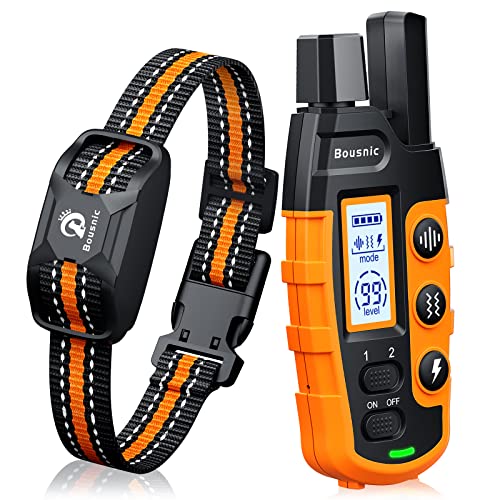
Bousnic 3300Ft Collar is the size-range pick here, with a fit for dogs from 5 to 120 pounds and dual-channel control for two dogs. Its maker describes adjustable beep, vibration, and shock levels, plus a range of up to 3,300 feet. The lower starting weight can make it a better candidate than the other options for a small dog, provided the receiver and contact points fit properly. Its main tradeoff is shorter claimed range and support for fewer dogs than SLOPEHILL 4200FT Collar. No waterproof rating is supplied in the product name or features, so do not assume it suits swimming.
Bottom line: Pick this when the dog weighs 5–7 pounds or two-dog control is enough.
SportDOG FieldTrainer 425X
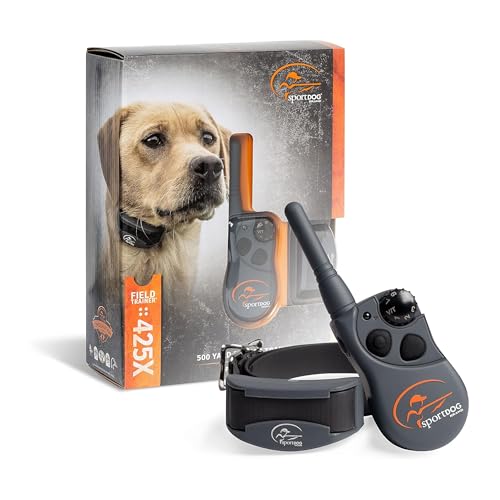
SportDOG FieldTrainer 425X stands apart for water exposure: the maker says its DryTek collar is submersible to 25 feet, and its batteries charge in two hours and run for 50–70 hours per charge. Its 500-yard range is shorter than SLOPEHILL 4200FT Collar and Bousnic 3300Ft Collar, but it supports up to three dogs with additional collars. It fits dogs weighing at least 8 pounds with necks from 5 to 22 inches. The 21 static levels offer more adjustment steps than the other collars, but level count does not tell you which setting is appropriate for an individual dog.
Bottom line: Choose this for a submersion rating and a three-dog system.
Petrainer PET998DRB1
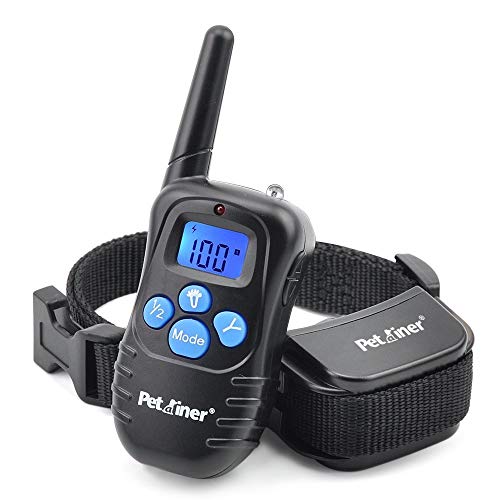
Petrainer PET998DRB1 gives a specific neck adjustment range of 14 to 25 inches and offers beep, vibration, and static modes. The maker describes vibration and stimulation intensity as adjustable from 0 to 100, with a 330-yard remote range. That smaller range makes it more suitable for close-range practice than for recall across large open spaces. The product is described as rainproof, not submersible, so keep that distinction in mind around water. Its fit is based on neck circumference rather than a dog-weight range; measure the dog’s neck before deciding whether the collar can be adjusted comfortably.
Bottom line: Choose this for close-range work when its 14–25-inch neck adjustment fits.
How to choose an electronic dog training collar
Start with fit and the least intrusive cue that can get your dog’s attention, not the largest intensity scale. Remote collars generally offer tone, vibration, and sometimes static stimulation; a higher number of settings gives more steps but does not establish that any setting is appropriate. Reward-based training is widely recommended for teaching behaviors, and aversive stimulation can cause fear or stress when used poorly. If you are considering static stimulation, get guidance from a qualified trainer or veterinary behavior professional and avoid using it to punish fear or aggression. Match the remote range to your training area: buildings, trees, terrain, and radio interference can reduce practical control distance, so rated range is not a guarantee in every setting.
How collar fit affects contact and comfort
Measure the neck with a flexible tape and compare that number with the collar’s adjustment range before ordering; a weight range alone cannot confirm neck fit. A receiver should sit in contact with the skin without being cinched tightly, and many fitting guides use room for about two fingers beneath the strap as a quick check. Recheck fit as the dog moves and inspect the skin after sessions; remove the collar if you see redness or irritation. Avoid leaving a training collar on continuously: prolonged pressure and friction can injure skin, especially under the contact points. For a thick-coated dog, verify that the contact points reach the skin without excessive tightening.
What range and water ratings mean
A remote’s rated distance is a best-case signal figure, not a promise of reliable control at that distance in a park, wooded trail, or neighborhood. Obstacles, terrain, and the handler’s position can all affect reception, so start close and test the controls before allowing more distance. Water terms also differ: rain resistance does not mean submersion protection, while a depth rating applies only to the specified product configuration. Do not infer swimming suitability from a generic waterproof description. Keep charging contacts dry and inspect the collar after water exposure. If your dog swims, choose a model with an explicit submersion rating rather than relying on a rainproof label.
Training mistakes to avoid
Use a consistent cue before any remote response, and reward the behavior you want so the dog can learn what earns reinforcement. Do not activate a collar when you cannot see what the dog is responding to; a startling cue delivered at the wrong moment can link discomfort with a person, animal, or place. Introduce any collar while it is turned off so wearing it does not immediately predict stimulation. Keep sessions short, end on a successful response, and stop if the dog shows distress such as cowering, freezing, or trying to escape. Avoid use around aggression or anxiety without professional help, because punishment can intensify fear-related behavior rather than teach an alternative.
Frequently Asked Questions
How tight should an electronic training collar be?
The receiver should contact the skin while still allowing about two fingers beneath the strap. Check for rubbing or redness after use and remove the collar if irritation appears.
Can a dog wear a training collar all day?
No; prolonged wear can cause pressure and friction injuries beneath the contact points. Limit wear to supervised training periods and inspect the skin regularly.
Does a longer remote range guarantee reliable recall?
No; trees, buildings, terrain, and interference can reduce practical range. Practice at short distances first and keep the dog within dependable voice or leash control.
Can a rainproof dog collar be used for swimming?
Not necessarily; rain resistance and submersion protection are different claims. Use a collar with an explicit submersion rating for swimming, and follow its water-use limits.
Are more stimulation levels safer for a dog?
More levels only provide more adjustment steps; they do not establish a safe setting for every dog. Start with non-aversive cues and seek qualified guidance before considering static stimulation.