
Best End of Life Planner: 4 Formats Compared

The Lamorial End of Life Planner suits most people who want prompted pages covering digital access, accounts and final wishes in one book. Choose a binder instead if you need document pockets, or a large-print format if readability is your priority.
We earn a commission if you buy through links on this page. As an Amazon Associate I earn from qualifying purchases. Products are compared on manufacturer specifications, not hands-on testing.
- Best overall: Lamorial End of Life Planner – Its 83 prompted pages across nine sections cover digital access, accounts and final wishes.
- Best for large print: End of Life Planner for Seniors, 7 x 10 – Bold, high-contrast type, 16 tabs and inner pockets support easier reading and organization.
- Best for document storage: End of Life Planner Document Binder – Eight envelope pockets fit A4 and letter-size papers without folding.
| Product | Best for | Format | Guided sections or tabs | Document storage | Shop |
|---|---|---|---|---|---|
| Lamorial End of Life Planner | Digital access notes | Bound book | 9 sections | — | Check Price on Amazon |
| End of Life Planner for Seniors, 7 x 10 | Large-print writing | Binder | 16 tabs | Inner pockets | Check Price on Amazon |
| End of Life Planner Document Binder | Paper document storage | Binder | 10 sections | 8 envelope pockets | Check Price on Amazon |
| Peace of Mind Planner | Hardcover durability | Hardcover book | — | — | Check Price on Amazon |
End of life planners
Compare guided books and binders by how they organize information and handle papers.
Lamorial End of Life Planner

For recording digital access alongside personal and financial matters, this bound book has 83 prompted pages across nine sections. The prompts cover phone passcodes, two-factor authentication backup codes, recovery emails, accounts, contacts and final wishes, so the writer has clear topics to work through rather than blank pages. Its A4 format offers a substantial writing area. The tradeoff is fixed binding: pages cannot be added or removed, so choose another format if you need to file loose documents or rearrange pages.
Bottom line: Choose it if you want guided prompts for digital access and final wishes in a bound book.
End of Life Planner for Seniors, 7 x 10
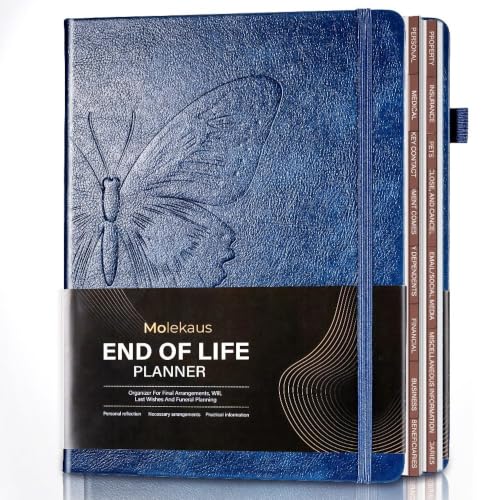
Readability is the distinguishing feature here: the binder uses bold fonts and high-contrast ink, with space for handwritten entries. It measures 7 by 10 inches and has 16 tabs plus inner pockets, making it a practical fit for someone who prefers a tabbed organizer to a permanently bound journal. Thick 120 GSM paper is part of its construction. The tradeoff is that its format prioritizes large-print writing and organization rather than specifying the same prompted digital-access coverage as the Lamorial book.
Bottom line: Pick it when large, high-contrast text and tabbed organization matter most.
End of Life Planner Document Binder

For keeping paperwork with planning notes, this oversized binder includes eight envelope pockets sized 12.2 by 8.66 inches to hold standard A4 and letter-size pages flat. Its 10 colored tabs divide topics including emergency steps, family, assets, pets, funeral arrangements and personal letters. At 11 by 12.6 inches, it takes more shelf space than a compact book, but suits households that want to gather documents alongside written plans. The maker describes the sections as guided; consider whether the larger binder format fits your storage space.
Bottom line: Choose it if storing loose papers flat alongside planning sections is essential.
Peace of Mind Planner

A hardcover and concealed wire-o binding set this planner apart from tabbed binders and a standard bound journal. Its archival, acid-free paper is intended to help preserve written information, which may appeal to someone focused on keeping records together over time. The title frames its subject around belongings, business affairs and wishes. Unlike the binder options, it does not give a pocket or tab count, so this format is a better match for someone seeking a hardcover planner than for anyone who needs visible dividers or document pockets.
Bottom line: Pick it if a hardcover format and archival paper are your priorities.
How to choose an end of life planner
Start with what you need to record and how you want to find it later. A prompted book provides a sequence for writing; a tabbed binder separates topics, and pockets can keep supporting papers nearby. For digital access, make sure your plan addresses the full recovery chain: device passcodes, two-factor authentication recovery methods, and the email account used to reset passwords. Keep a separate secure copy of sensitive credentials rather than treating an ordinary notebook as a protected password manager.
Use this decision guide to match format to task.
| Need | Format to prioritize |
|---|---|
| Step-by-step writing prompts | Guided book |
| Easy-to-scan topics | Tabbed binder |
| Loose papers kept with plans | Binder with document pockets |
| High-contrast text | Large-print organizer |
With more than a handful of supporting papers, favor a pocketed binder; for a short written record, a book is easier to store.
What to record for digital access and final wishes
A useful plan covers access routes as well as account names. Record where recovery codes are stored, which email controls account resets, and how a trusted person can reach the relevant device. Avoid writing sensitive details where visitors or casual readers can see them; store the planner in a controlled location and tell the right person how to find it. For financial, medical and legal decisions, a planner is an index and communication aid, not a substitute for formal documents such as a will or health care directive. Keep those documents current and identify their storage location.
Separate personal preferences from instructions that require legal authority. A note about funeral wishes can communicate preferences, while legal authority over property or health decisions depends on the appropriate documents and local rules.
How to organize documents and keep plans current
Keep originals of wills, deeds, insurance papers and identity documents secure; use planner pockets for copies or a note pointing to the originals. Letter-size paper is 8.5 by 11 inches, while A4 is 8.27 by 11.69 inches, so check pocket dimensions before expecting both formats to lie flat. Put a review date on the first page and revisit the plan after major changes, such as a move, new account, marriage or changed emergency contact. A yearly review is a practical baseline because account access and contacts can change between major life events.
For passwords and codes, do not assume a paper planner is theft-proof. Limit access, avoid leaving it in an obvious shared area, and update entries when credentials change.
Frequently Asked Questions
How often should I update an end of life planner?
Review it at least once a year and after a major change such as moving, opening key accounts or changing emergency contacts. Replace outdated access routes promptly so recovery instructions still work.
Should I write passwords in an end of life planner?
Only record credentials if you can store the planner securely and control who can access it. A password manager with an emergency-access plan can reduce exposure of a written master list.
Can an end of life planner replace a will?
No, a planner organizes information and preferences but does not replace a legally executed will. Keep formal documents current and note where the originals are stored.
What papers should go in a planning binder?
Useful copies can include insurance summaries, property records and contact lists, while originals should remain in a secure location. Letter paper measures 8.5 by 11 inches, so check pocket dimensions before filing it flat.
Where should I keep an end of life planner?
Keep it in a secure, consistent place and tell a trusted person how to access it when needed. Avoid storing exposed passcodes in a location that household visitors can reach.