
Best Exhaust Seal Joint and Crack Sealers Compared

LOCBONDSO Muffler Repair Kit, 2.6 oz suits most exhaust repairs because its 2.6-fluid-ounce paste is made for both leaks and exhaust-system joints and claims heat resistance up to 2,012°F. Choose another option if you need a larger container or a compound specifically described for forcing into small openings and cracks.
Exhaust sealer is a heat-curing paste used to seal joints or small leaks; it is not a substitute for replacing badly damaged or structurally weakened exhaust parts.
We earn a commission if you buy through links on this page. As an Amazon Associate I earn from qualifying purchases. Products are compared on manufacturer specifications, not hands-on testing.
- Best overall: LOCBONDSO Muffler Repair Kit, 2.6 oz – Its non-slumping paste is intended for exhaust joints and leaks and claims resistance up to 2,012°F.
- Best for small cracks: Permatex 10160 Exhaust Joint Crack Sealer – The product is described as forceable into small openings and cracks.
- Best for larger repairs: MPD Muffler Cement Putty, 16 oz – Its 16-ounce container is the largest size provided.
| Product | Best for | Package size (oz) | Application | Shop |
|---|---|---|---|---|
| LOCBONDSO Muffler Repair Kit, 2.6 oz | Joints and leaks | 2.6 oz | Joints and leaks | Check Price on Amazon |
| Permatex 10160 Exhaust Joint Crack Sealer | Small cracks | — | Small openings and cracks | Check Price on Amazon |
| Visbella Exhaust System Sealant, 75 g | Heated curing | 2.65 oz | Joints and cracks | Check Price on Amazon |
| NASCA High Temp Exhaust Sealant, 5.3 oz | Larger paste tube | 5.3 oz | Cracks, holes, and leaks | Check Price on Amazon |
| MPD Muffler Cement Putty, 16 oz | Largest container | 16 oz | Cracks, leaks, seams | Check Price on Amazon |
Exhaust Seal Joint and Crack Sealers
Compare the package sizes, heat claims, and intended applications before choosing a compound for the repair.
LOCBONDSO Muffler Repair Kit, 2.6 oz

LOCBONDSO Muffler Repair Kit, 2.6 oz is the most versatile option here for sealing exhaust joints as well as holes and leaks. Its 2.6-ounce gray cement uses a non-slumping formula, and the maker says it withstands temperatures up to 2,012°F. That combination suits a small repair where paste needs to stay in place during application. The package is smaller than the 5.3-ounce and 16-ounce options, so it may be less convenient when covering a larger repair area or keeping extra compound on hand.
Bottom line: Choose this for a small joint or leak repair where a non-slumping paste matters.
Permatex 10160 Exhaust Joint Crack Sealer
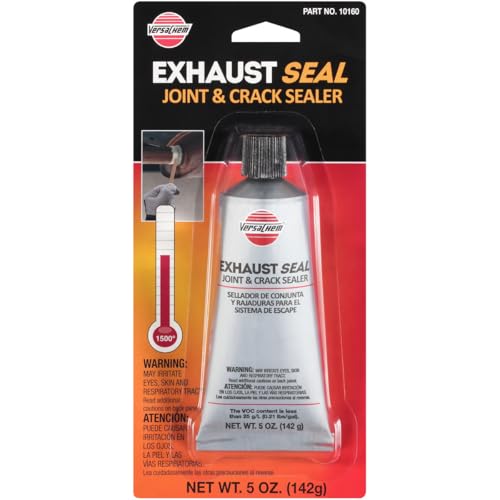
Permatex 10160 Exhaust Joint Crack Sealer stands out for its specific application to small openings and cracks: its compound can be forced into them, according to the product features. It is also described as a high-temperature joint sealer resistant to corrosive exhaust heat and gases. That focus makes it a practical match for a narrow crack or joint rather than a buyer choosing by container size or a temperature figure. Its package dimensions do not establish the amount of compound, so buyers who need a particular quantity should confirm the fill size before ordering.
Bottom line: Pick this when the repair involves a small crack or opening that needs compound worked into it.
Visbella Exhaust System Sealant, 75 g

Visbella Exhaust System Sealant, 75 g is a 75-gram gray exhaust cement that the maker says sets hard with heat and can withstand up to 2,012°F. Its uses include assembling exhaust-system joints and repairing cracks, making it a close alternative to other heat-curing pastes in this group. The maker also says the material cures by water evaporation and continues curing with added heat. The 75-gram package is smaller than the 5.3-ounce and 16-ounce choices, which matters if the repair covers a broad area.
Bottom line: Choose this for a smaller repair when heat-curing cement in a 75-gram tube fits the job.
NASCA High Temp Exhaust Sealant, 5.3 oz

NASCA High Temp Exhaust Sealant, 5.3 oz provides more paste than the 2.6-ounce and 2.65-ounce options, in a 5.3-ounce package. The maker says its non-slumping formula is rated up to 2,012°F and is intended to seal cracks, holes, and leaks in exhaust components. That makes it a fit for buyers who want a larger tube for a repair involving more surface area. The product features also call the bond permanent, but the heat rating and formula alone do not establish whether a damaged component can be safely repaired rather than replaced.
Bottom line: Pick this when you want a 5.3-ounce tube for sealing cracks, holes, or leaks.
MPD Muffler Cement Putty, 16 oz
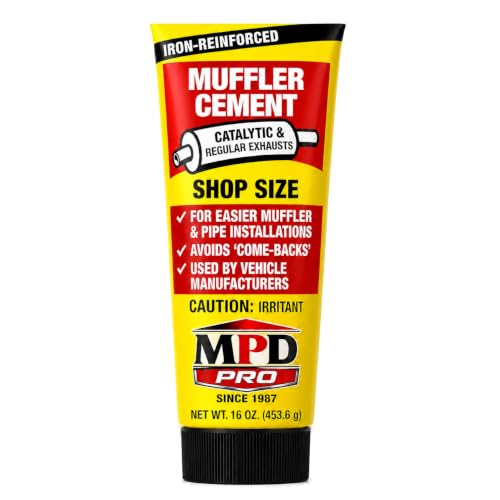
MPD Muffler Cement Putty, 16 oz is the largest container here at 16 ounces, making it the option for buyers who need more compound than a small tube provides. The product features describe a heat-resistant putty for exhaust cracks, leaks, and seams, with a hard finish after drying. It is also described for use on mufflers, tailpipes, and catalytic converters. No numerical temperature rating is provided, so this choice is less suitable when a specific maximum heat figure is a deciding requirement.
Bottom line: Choose this for a larger quantity of putty when a numerical heat rating is not essential.
Choosing an exhaust sealer for the repair
Match the compound to the repair: joint assembly paste is intended for mating exhaust sections, while a crack or hole calls for material specified for patching that damage. A sealer cannot restore metal that is split, missing, or badly corroded; replace a structurally compromised section rather than treating paste as a repair. Check the product’s temperature limit against the location of the repair, since exhaust temperatures vary by component and operating conditions. A claim such as 2,012°F is a product rating, not a guarantee that every repair will hold under every vehicle’s heat and vibration. For a small opening, a paste that can be pressed into the gap may be more useful than a larger-volume option.
Exhaust joint paste versus crack repair
Exhaust cement is commonly applied to slip-fit joints and small gaps, while patch products are used to cover holes or cracks when the material and repair method permit it. A joint compound helps seal the connection, but a loose clamp, misaligned pipe, or damaged flange can leave the underlying cause unresolved. The size and location of the gap matter: a pinhole is different from a long split or a failed welded seam. Use the comparison below to match the intended repair with the type of product claim; it is a starting point, not a substitute for checking whether the exhaust part is sound enough to keep.
| Repair need | Look for |
|---|---|
| Slip-fit joint | Compound specifically intended for exhaust joints |
| Small opening or crack | Paste described as workable into small gaps |
| Broad repair area | Larger package and an explicit crack or hole application |
Safe application and curing basics
Work on a cool exhaust system in a well-ventilated outdoor area, and never run an engine in an enclosed garage: exhaust can contain carbon monoxide, an odorless, potentially fatal gas. Wear gloves and eye protection when handling cement, and keep uncured material off skin and away from children. Exhaust compounds often need heat to cure, but the required cure process varies by formulation; a heat rating is not the same as a cure schedule. Avoid driving until the repair material has had the cure time its manufacturer requires. If exhaust fumes enter the cabin, stop driving and address the leak promptly rather than relying on a surface patch.
Frequently Asked Questions
Can exhaust sealer fix a cracked muffler?
Exhaust sealer may suit a small crack if the product is intended for crack repair and the surrounding metal remains sound. A large split, missing metal, or heavy corrosion calls for replacing the damaged section instead of relying on paste.
How hot does exhaust sealant need to get to cure?
Curing requirements depend on the specific compound, and a maximum heat rating does not tell you the cure schedule. Some exhaust cements cure further when heated, so use the manufacturer’s cure process and keep the vehicle out of service until it is complete.
Is exhaust sealant safe to use indoors?
Apply it outdoors or with strong ventilation, and never run the engine in an enclosed garage. Exhaust can contain carbon monoxide, which is odorless and can be fatal.
Can exhaust paste seal a loose pipe joint?
Joint paste can help seal mating exhaust sections, but it will not correct a loose clamp, poor alignment, or a damaged flange. Fix the mechanical cause first, then use compound only if the joint and product are suitable.
When should a damaged exhaust pipe be replaced?
Replace the section when it has a long split, missing metal, severe corrosion, or a joint that cannot be secured. Paste is intended for limited sealing jobs and cannot restore the strength of deteriorated metal.