
Best Fans for Chicken Coop: 5 Models Compared by Fit

For most coops with a safe outlet and a wall location, Ehiair 8-Inch Thermostat Exhaust Fan is the best choice because its thermostat automates ventilation and it moves up to 760 CFM. Choose a solar model instead if wiring an outlet is impractical, but match its operating limits to your daylight and weather.
Coop fans are mechanical ventilation devices that move stale, warm air out; they do not replace appropriately sized passive openings for incoming air.
We earn a commission if you buy through links on this page. As an Amazon Associate I earn from qualifying purchases. Products are compared on manufacturer specifications, not hands-on testing.
- Best overall: Ehiair 8-Inch Thermostat Exhaust Fan – Thermostat control and airflow up to 760 CFM suit an outlet-equipped coop needing automatic ventilation.
- Best for nighttime solar use: TARKARI Solar Coop Fan with Battery – A built-in 2500mAh battery supports a maker-claimed 5–8 hours of night use.
- Best for listed electrical safety: Windigaga 8-Inch Shutter Exhaust Fan – ETL listing and grounding protection are specified alongside 760 CFM airflow.
- Best for small solar setups: NHZOTUD 22W Solar Dual-Fan Kit – The maker recommends its dual-fan kit for spaces up to 200 cubic feet.
| Product | Best for | Power | Airflow | Control | Shop |
|---|---|---|---|---|---|
| Ehiair 8-Inch Thermostat Exhaust Fan | Automatic ventilation | Plug-in electric | Up to 760 CFM | Thermostat and remote | Check Price on Amazon |
| TARKARI Solar Coop Fan with Battery | Nighttime solar use | Solar with battery | — | Sensor, 3 modes | Check Price on Amazon |
| Windigaga 8-Inch Shutter Exhaust Fan | Grounded plug-in use | Plug-in electric | Up to 760 CFM | Plug and play | Check Price on Amazon |
| NHZOTUD 22W Solar Dual-Fan Kit | Small solar coops | Solar | Up to 200 CFM | Intake or exhaust | Check Price on Amazon |
| MARBERO Solar Dual-Fan Kit | Daylight-only ventilation | Solar | — | Intake and exhaust | Check Price on Amazon |
Best fans for chicken coop ventilation
Compare the power source, airflow and operating controls against your coop’s layout and daily ventilation needs.
Ehiair 8-Inch Thermostat Exhaust Fan

Automatic temperature control distinguishes this 8-inch wall exhaust fan from the solar kits. It moves up to 760 CFM and has high- and low-temperature modes, plus a remote control; the maker says the fan switches on or off based on the set temperature. That suits a coop with a usable outlet and a wall position where exhaust can leave without blowing directly across roosting birds. The limitation is dependence on electric power and a suitable wall opening, so it is a poor fit for an off-grid site or a coop without safe wiring.
Bottom line: Choose this when you have a safe outlet and want temperature-based operation.
TARKARI Solar Coop Fan with Battery
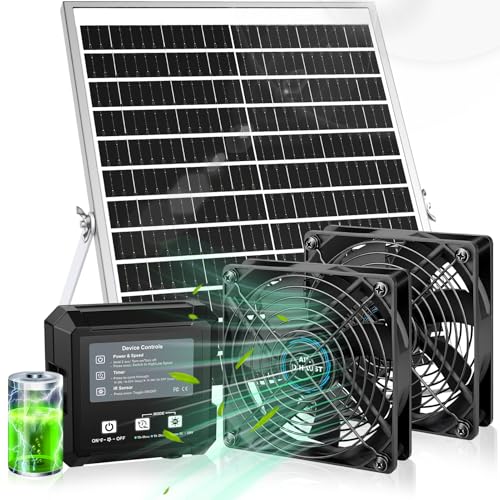
A built-in battery sets this solar-powered exhaust fan apart from the other solar kits here. Its 25W panel charges a 2500mAh battery, and the maker claims 5–8 hours of nighttime use; sensor mode runs for 10 minutes after detecting an animal. The two 4.7-inch fans and three modes suit a coop where a grid connection is inconvenient and short periods of after-dark operation matter. Battery performance can suffer in extremely low temperatures, so the maker recommends placing the controller inside shelter in that condition. Airflow capacity is not provided in the specifications, making it harder to size by CFM.
Bottom line: Choose this for a solar setup where battery-backed night use matters.
Windigaga 8-Inch Shutter Exhaust Fan

Electrical safety credentials are the differentiator for this 8-inch shutter exhaust fan: the maker says it is ETL-listed and has grounding protection. The fan moves up to 760 CFM, uses a 26W motor and is rated below 40 dB by the maker. Its plug-and-play format suits a coop with an appropriate, protected outlet and a wall opening. Unlike the thermostat model, no automatic temperature control is included in the specifications, so someone must manage operation separately. Keep electrical connections protected from coop moisture and dust.
Bottom line: Choose this for a plug-in installation where the specified grounding protection is important.
NHZOTUD 22W Solar Dual-Fan Kit

The airflow and space recommendation make this solar kit easier to size than the other solar options: its two fans provide up to 200 CFM, and the maker recommends it for spaces up to 200 cubic feet. The 22W panel powers fans that can be configured for intake or exhaust, which suits a small coop where a wall opening and sunny panel position are available. The maker describes the motors as weatherproof and the panel as IPX7-rated. This kit has no battery specified in the specifications, so do not count on it to ventilate after sunset.
Bottom line: Choose this for a small coop within the maker’s 200-cubic-foot recommendation.
MARBERO Solar Dual-Fan Kit

Separate intake and exhaust functions distinguish this solar kit, which includes a 13-foot cable for positioning its panel relative to the fans. The maker says it is intended to refresh air and remove heat, dust and odors in small coops and similar spaces. It suits a sunny site where daytime ventilation is the priority and the panel can face the sun at the recommended 45-degree angle. The limitation is substantial: there is no built-in battery, and the maker says the fan will not operate at night or in rainy weather; shade and clouds can also reduce performance.
Bottom line: Choose this where daytime sun is reliable and night ventilation is unnecessary.
How to size a chicken coop fan
Size a coop fan by its airflow in cubic feet per minute (CFM) and the coop’s interior volume, not by fan diameter alone. A useful calculation is air changes per hour: multiply CFM by 60, then divide by the coop’s cubic feet. For example, a 200 CFM fan serving a 200-cubic-foot coop would produce 60 calculated air changes per hour before accounting for resistance from openings, screens or ducting. That is a theoretical rate, not a guarantee of actual airflow. Place the exhaust high enough to remove rising heat and moisture, and provide a separate path for fresh air to enter. Avoid aiming a strong stream directly onto roosting birds.
Solar or plug-in fan for a chicken coop
Solar fans avoid a grid connection, while plug-in exhaust fans can provide airflow when sunlight is absent if their electrical supply remains available. Battery backup matters: a solar panel alone does not mean a fan will run at night or in poor sun. For a plug-in unit in a coop, route and protect wiring from pecking, dust and damp conditions, and use an appropriately protected outdoor circuit. Electrical work near water or damp bedding can create shock and fire hazards; have a qualified electrician handle new circuits. The table compares the trade-offs that most affect daily operation.
| Setup | Useful when | Check before choosing |
|---|---|---|
| Solar, no battery | Ventilation is needed mainly in sunny daytime hours | Shade, clouds, rain and night operation |
| Solar with battery | Limited after-dark run time is useful | Battery runtime, recharge and cold-weather limits |
| Plug-in exhaust | Grid power and protected wiring are available | Outlet safety, opening size and airflow rating |
Where to place a coop exhaust fan
Place the exhaust high and arrange an inlet on another wall so replacement air crosses the coop rather than short-circuiting directly into the fan. Warm, moisture-laden air rises, so high exhaust openings help remove heat and damp air; incoming air should not create a cold draft across roosts. Screens and shutters can reduce free airflow, so the fan’s rated CFM is not the same as measured airflow after installation. Check for stale or ammonia-smelling air at bird height, condensation, and damp litter; those signs indicate the ventilation arrangement needs attention. Keep the fan guard in place and prevent birds from reaching moving blades.
Chicken coop fan maintenance and safety
Inspect a coop fan and its openings at least monthly during regular use, and clean dust and feathers from guards and blades whenever buildup appears. Dirty blades and blocked screens restrict airflow, while a loose guard can expose birds to moving parts. Solar panels also need a clear, secure position; shade can cut output, and cables should be protected from pecking and abrasion. Keep electrical connections away from wet litter and wash-down spray. Before installation, measure the wall opening and confirm the fan’s mounting dimensions, since nominal fan diameter does not necessarily equal the required cutout. Do not rely on an exhaust fan as the only source of fresh air; maintain a clear inlet path.
Frequently Asked Questions
How many CFM does a chicken coop fan need?
Calculate coop volume in cubic feet and compare it with fan airflow in CFM; CFM × 60 ÷ volume gives theoretical air changes per hour. Screens, shutters and restricted inlets reduce real airflow, so provide a clear air path and watch for damp litter or stale air.
Should a chicken coop fan run overnight?
A fan should run overnight when the coop needs ventilation after dark, but solar-only models without battery backup cannot provide that. Battery runtime is finite, so compare the claimed run time with the hours of ventilation your setup requires.
Can a chicken coop fan blow directly on roosting hens?
Avoid directing a strong fan stream onto roosting birds; use high exhaust and a separate inlet to move air through the space. Check bird-level conditions after installation, especially in cold weather.
How often should I clean a coop exhaust fan?
Inspect the fan and guards at least monthly during regular use, and clean them sooner if feathers or dust accumulate. Blocked blades and screens reduce airflow, so check the inlet path at the same time.
Do solar chicken coop fans work on cloudy days?
Solar output falls with cloud cover and shade, and some solar kits stop in rain or at night. A battery-backed model can bridge some downtime, but its run time depends on stored charge and operating conditions.