
Gbnryg Gold Detectors: Models Compared by Features

For most buyers, Gbnryg M55J is the more practical Gbnryg gold detector because its 12-inch IP68 coil and five search modes come with a weight of 2.8 pounds. Choose Gbnryg M55Z if its larger stated weight is not a concern; consider the alternatives if you want an adjustable or foldable design.
Metal detectors use a search coil to sense metal targets and signal the control unit, while modes can help distinguish or focus on selected targets.
We earn a commission if you buy through links on this page. As an Amazon Associate I earn from qualifying purchases. Products are compared on manufacturer specifications, not hands-on testing.
- Best overall: Gbnryg M55J – Its 12-inch IP68 coil, five modes and listed 2.8-pound weight make a practical combination.
- Best for broad scanning: Gbnryg M55Z – The 12-inch coil and five modes suit buyers who prioritize search coverage.
- Best for portability: SAKOBS Foldable 11-Inch Detector – Its foldable design weighs 2.7 pounds and adjusts from 26 to 47 inches.
| Product | Best for | Search coil | Listed weight | Shop |
|---|---|---|---|---|
| Gbnryg M55J | Lightweight searching | 12 in | 2.8 lb | Check Price on Amazon |
| Gbnryg M55Z | Beach scanning | 12 in | 5.8 lb | Check Price on Amazon |
| BOXTREN 10-Inch Detector | Adjustable fit | 10 in | — | Check Price on Amazon |
| SAKOBS Foldable 11-Inch Detector | Compact transport | 11 in | 2.7 lb | Check Price on Amazon |
Gbnryg Gold Detectors and Alternatives
Compare coil size, weight and design to find a detector that fits your search area and carrying needs.
Gbnryg M55J
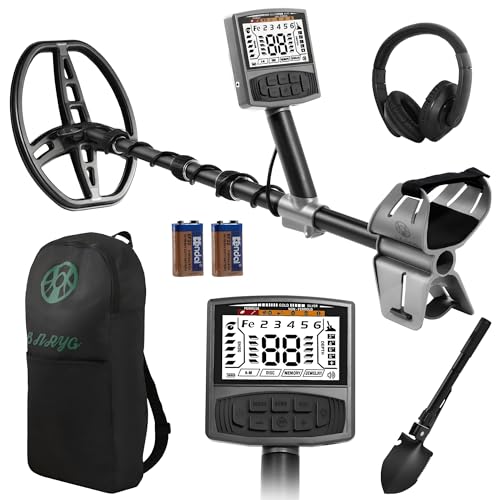
Among the Gbnryg models here, this one pairs a 12-inch coil with the lower stated weight, making it a reasonable pick when carrying comfort matters. Its five modes include all-metal scanning, junk rejection, memory, jewelry and pinpoint positioning. The maker says its system can detect targets as deep as 12 inches, but actual depth depends on the target’s size, metal, orientation and soil conditions. Its jewelry mode is noted as working best with high-purity metals, so buyers searching for mixed or low-purity alloys may prefer to use another mode and interpret weaker signals cautiously.
Bottom line: Choose this if a lighter stated weight and five target modes are priorities.
Gbnryg M55Z

This Gbnryg model has the same 12-inch coil size and five-mode setup as Gbnryg M55J, but its weight is higher. The maker describes the coil as IP68 waterproof and says the detector can locate quarter-sized items as deep as 12 inches; detection depth varies with target and ground conditions, so treat that figure as a capability rather than a guarantee for every find. The features also identify a backlit LCD and DSP chip. Its weight may matter more on long hunts, particularly for buyers who prioritize carrying comfort over the detection features.
Bottom line: Pick this if you want the 12-inch waterproof coil and do not mind its higher stated weight.
BOXTREN 10-Inch Detector

Unlike the Gbnryg choices, this BOXTREN detector has a 10-inch coil and an adjustable telescoping stem, so its standout fit feature is the 23-to-35-inch shaft range. The maker also describes an adjustable armrest from 5.9 to 11.8 inches and quick assembly. Its 10-inch IP68 coil is smaller than the 12-inch coils on the Gbnryg options, which can mean less ground covered per sweep; a smaller coil can also be easier to maneuver in tight areas.
Bottom line: Choose this if adjustability and a 10-inch coil fit your search area.
SAKOBS Foldable 11-Inch Detector

This alternative emphasizes portability: its foldable design weighs 2.7 pounds and adjusts from 26 to 47 inches. Its 11-inch IP68 waterproof DD coil is smaller than the Gbnryg 12-inch coils, while its coil style and foldability make it a different option for beach or outdoor trips. The maker describes it for wet sand and shallow-water searching, but the waterproof claim applies to the coil in the product name; do not assume the control unit is safe to submerge. Buyers wanting the largest coil among these models should look at the Gbnryg options instead.
Bottom line: Pick this if foldability and a low stated weight matter more than a 12-inch coil.
How to choose a gold detector
Choose by search area, target type and the amount of equipment you want to carry. A larger coil generally covers more ground per sweep, while a smaller coil can be easier to control around rocks, roots and crowded areas. Detection depth is not a fixed property of a coil: target size, metal composition, orientation, mineralized soil and sweep technique all affect the signal. A detector’s modes can help reject unwanted metals or isolate a target category, but discrimination can also make some desired targets harder to hear. For these models, compare the coil diameter and weight first, then decide whether five modes or adjustable/foldable construction matters most.
A waterproof-coil rating does not by itself establish that the display or control housing can be submerged. Check the device’s immersion limits before taking any detector into water.
What coil size and weight mean
Coil diameter is a useful coverage comparison, not a promise of greater depth on every target. The 10-inch coil is the smallest here, the 11-inch coil is intermediate, and the 12-inch coils offer the largest sweep footprint. Mineralized ground and small targets can reduce practical detection depth, so a maker’s depth figure should not be treated as a guaranteed find depth. Weight also affects how long a user can comfortably swing a detector; where weights are supplied, SAKOBS Foldable 11-Inch Detector and Gbnryg M55J are listed below 3 pounds, while Gbnryg M55Z is listed at 5.8 pounds.
Use this comparison to match the hardware to your priority rather than assuming the widest coil is always best.
| Priority | Model fit |
|---|---|
| Largest coil size | 12-inch coil |
| Smaller coil for tighter areas | 10-inch coil |
| Foldable transport | Foldable design |
| Adjustable shaft range | 23 to 35 inches or 26 to 47 inches |
Waterproof coils and beach use
An IP68 coil rating describes the coil’s water protection, not necessarily the detector’s entire assembly. Beach use can involve dry sand, wet sand and shallow water, which create different conditions; salt and mineral content can complicate signals and increase false responses. Before entering water, establish the control unit’s depth limits and keep non-waterproof components dry. Rinse salt and sand from the coil after beach use and dry the detector before storage. Avoid assuming that a beach-oriented coil rating makes a detector suitable for underwater searching, especially when the maker identifies only the coil as waterproof.
For shoreline work, a stable sweep and overlapping passes help reduce missed strips of ground. Slow down if the detector gives inconsistent signals over wet or mineralized sand.
Frequently Asked Questions
How deep can a metal detector find gold?
Depth depends on target size, metal, orientation and ground mineralization, so no single depth applies to every gold item. The Gbnryg models’ maker claims reach up to 12 inches for specified targets, but small gold in mineralized soil may be detected at less depth.
Does an IP68 coil make the whole detector waterproof?
No, a waterproof coil rating does not establish that the control housing or display can be submerged. Confirm the control unit’s water limits before using any detector in shallow water.
Is a larger search coil always better?
No, a larger coil can cover more ground per sweep, but a smaller coil is often easier to maneuver around obstacles. In tight spaces or highly cluttered ground, choosing a 10-inch coil over a 12-inch coil may be more manageable.
What does a metal detector pinpoint mode do?
Pinpoint mode helps narrow the location of a detected target before digging. Center the coil over the strongest response and use short, controlled sweeps to reduce the area to investigate.
How should I search wet beach sand?
Sweep steadily and overlap each pass, since wet and mineralized sand can produce unstable signals. Use a detector whose coil is rated for the intended water exposure, and keep the control unit within its own water limits.