
Best Flash Cards for Toddlers: 4 Sets Compared

LearnWorx 101 First Words Cards suits most toddlers because its 101 first-word cards include a game on the reverse of each card. Choose a different set if you want rings for keeping cards together or a larger collection organized by preschool subjects.
Toddler flash cards are picture-and-word prompts for practicing recognition and early vocabulary; short, interactive sessions work better than drilling a young child.
We earn a commission if you buy through links on this page. As an Amazon Associate I earn from qualifying purchases. Products are compared on manufacturer specifications, not hands-on testing.
- Best overall: LearnWorx 101 First Words Cards – Combines 101 first-word cards across everyday topics with a game on every reverse side.
- Best for broad early skills: Torlam 60 Double-Sided Cards – Covers letters, counting, shapes, colors, animals, body parts, foods, and first words in 60 double-sided cards.
- Best for travel: 60 Toddler Cards with Rings – Uses three rings to keep its 60 cards organized on the go.
| Product | Best for | Card count | Card size | Topics | Shop |
|---|---|---|---|---|---|
| LearnWorx 101 First Words Cards | First words and games | 101 cards | 5 × 3.7 in | Everyday objects, animals, food, places | Check Price on Amazon |
| Torlam 60 Double-Sided Cards | Broad skill coverage | 60 cards | 4.9 × 3.9 in | Alphabet, counting, shapes, colors, words | Check Price on Amazon |
| 60 Toddler Cards with Rings | Travel organization | 60 cards | — | Letters, numbers, colors, shapes | Check Price on Amazon |
| ZazzyKid 54 Double-Sided Cards | Alphabet basics | 54 cards | 3.5 × 2.5 in | Alphabet, numbers, colors, shapes | Check Price on Amazon |
Toddler Flash Cards Compared
Compare each set’s card format, size, and learning topics to match a toddler’s current interests.
LearnWorx 101 First Words Cards

LearnWorx 101 First Words Cards stands out for pairing a broad first-word collection with a prompt or game on the back of every card. The 101 cards cover animals, food, household and outdoor objects, and places; reverse-side activities include color questions and spot-the-difference prompts. At 5 × 3.7 inches, the cards are large enough for shared picture talk. This set fits families who want vocabulary practice woven into simple games, rather than a narrow alphabet or number deck. Its focus is first words and recognition, so choose another set if alphabet, shapes, and counting are the main goal.
Bottom line: Choose this set for first-word practice with a game on every card.
Torlam 60 Double-Sided Cards
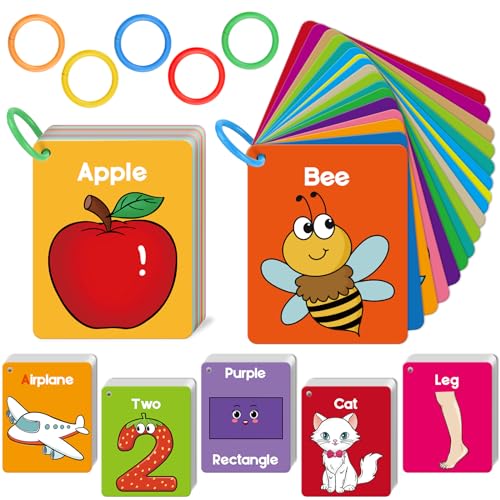
Torlam 60 Double-Sided Cards is the broad-skills option, covering alphabet, counting from 1 to 10, shapes, colors, animals, body parts, foods, fruits, and first words across 60 double-sided cards. Five colored rings are included, giving caregivers a way to group or organize cards for short activities. Each card measures 4.9 × 3.9 inches. This mix suits a household that wants several early-learning topics in one set instead of a deck centered on vocabulary games. The tradeoff is a smaller card count than the first-word set, so it offers less breadth within any single topic.
Bottom line: Pick this for variety across early-learning subjects in one compact set.
60 Toddler Cards with Rings

60 Toddler Cards with Rings is the ring-bound choice: three durable rings keep its 60 cards together for travel or everyday use. The set combines letters, numbers, shapes, and colors, and its maker describes real-photo imagery. That format suits caregivers who want a small selection to carry and revisit without managing a loose stack. Choose a loose-card set instead if sorting or removing cards individually matters most.
Bottom line: Choose this when keeping cards together for travel matters.
ZazzyKid 54 Double-Sided Cards

ZazzyKid 54 Double-Sided Cards focuses on foundational symbols and categories in 54 double-sided cards: uppercase and lowercase letters, numbers, colors, and shapes. Its alphabet section includes both letter cases, and each card has a laminated layer. At 3.5 × 2.5 inches, this is a more compact format than the larger picture-card options. It suits caregivers introducing letters and basic categories in a tidy set. The age range is around 2 to 5, so it is less aligned with very young toddlers than sets explicitly aimed at ages 1 to 3.
Bottom line: Pick this for a compact alphabet-and-shapes set for children around age 2 and up.
How to Choose Toddler Flash Cards
Choose by the skill you want to practice, then narrow by format and how long a child can stay engaged. First-word decks support naming and conversation; alphabet, number, shape, and color decks introduce categories and symbols. For a toddler, start with 5 to 10 cards per sitting and stop when attention fades rather than pushing through a full deck. A simple decision rule: if everyday vocabulary is the goal, favor cards with familiar objects and picture prompts; if the child already names common objects, add letters, counting, or shapes. Double-sided cards can create prompts beyond naming, while rings help keep a portable group together.
Card Size and Handling
Card dimensions affect how easily a young child can hold, see, and sort a deck. The compared cards span from 2.5 inches wide to about 5 inches wide, so the smaller format packs more easily while wider cards can make shared picture viewing easier. For a child still mouthing objects, supervise closely and put cards away if corners become damaged; paper cards are not teething toys. Keep the working pile small and rotate a few cards at a time. Rings can reduce loose-card scattering, but they also mean the cards stay attached unless removed from the rings.
Flash Card Formats Compared
Choose a format based on whether the priority is variety, portability, or deeper practice in one subject. This table separates common set formats by their practical tradeoff.
| Format | Useful for | Tradeoff |
|---|---|---|
| First-word cards with games | Picture naming and conversation | Less emphasis on letters or formal counting |
| Rings and mixed topics | Portable, organized practice | Fewer cards per topic |
| Multi-deck preschool set | Broader skills like rhyming | May be advanced for younger toddlers |
| Alphabet-focused compact deck | Letter cases and basic categories | Smaller cards are easier to misplace |
Using Flash Cards Without Drilling
Use cards as conversation starters, not as a test with a required number of correct answers. Naming a picture, finding the same object nearby, or asking what color it is adds context that a memorized label alone lacks. For counting cards, touch or move one object for each number spoken; this one-to-one matching is more meaningful than reciting a number sequence. Keep sessions brief, praise attempts, and revisit missed words later rather than correcting repeatedly. Toddlers develop at different rates, so use the child’s interest and attention as the stopping point, not the goal of finishing every card.
Frequently Asked Questions
How many flash cards should a toddler use at once?
Start with 5 to 10 cards in one short session, then add more only if the child remains interested. A small group makes it easier to repeat and talk about each picture without turning the activity into a long drill.
What age can children start using flash cards?
Picture cards can be introduced with an adult from around 12 months, using simple naming and pointing rather than expecting the child to read. Keep cards out of reach when unsupervised, especially if a child still mouths objects.
How can I make toddler flash cards interactive?
Pair each card with an action, such as finding the pictured object in the room or naming its color. For counting, point to one item at a time so each number maps to one object.
Are double-sided flash cards useful for toddlers?
Double-sided cards can provide a second prompt, such as a question or game after the picture side. Use only the prompt that suits the child’s attention and language level, and pause if the child loses interest.
When should I stop using a flash card session?
Stop when a toddler turns away, loses focus, or becomes frustrated; sessions of a few minutes are often enough. Resume later with a small selection rather than trying to complete the deck.