
Best FM Antenna for Vintage Receiver: 5 Compared

For most vintage receivers with 300-ohm screw or clip terminals, Ancable 300-Ohm T Dipole is the straightforward choice because it uses spade terminals and a 300-ohm dipole. Choose Kaunosta Magnetic-Base Adapter Antenna instead if your receiver has a different input connector or you need its included adapters; check the receiver’s FM input before choosing because antenna connectors and impedance differ.
We earn a commission if you buy through links on this page. As an Amazon Associate I earn from qualifying purchases. Products are compared on manufacturer specifications, not hands-on testing.
- Best overall: Ancable 300-Ohm T Dipole – Its 300-ohm dipole and spade terminals match vintage tuners with 300-ohm clip or terminal inputs.
- Best for connector flexibility: Kaunosta Magnetic-Base Adapter Antenna – Includes 75-to-300-ohm adapters plus PAL, BNC, and 3.5mm adapters.
- Best for a spare antenna: ALMOCN Two-Pack 300-Ohm Dipoles – The package includes two 300-ohm T-shaped dipoles with bare-wire connectors.
| Product | Best for | Impedance | Cable length | Connector | Shop |
|---|---|---|---|---|---|
| Ancable 300-Ohm T Dipole | 300-ohm terminals | 300 ohms | 5.9 ft | Spade terminals | Check Price on Amazon |
| Kaunosta Magnetic-Base Adapter Antenna | Multiple connectors | 75 to 300 ohms | 10 ft | F-type; multiple adapters | Check Price on Amazon |
| ALMOCN Two-Pack 300-Ohm Dipoles | Two antenna setup | 300 ohms | 5.9 ft | Bare-wire connectors | Check Price on Amazon |
| Bingfu 75-Ohm Adhesive Dipole | Wall-mounted setup | 75 ohms | 10 ft | F-type; 3 adapters | Check Price on Amazon |
| Magnetic-Base 75-Ohm Antenna | Metal-surface placement | 75 ohms | 16.4 ft | Coaxial cable | Check Price on Amazon |
FM Antennas for Vintage Receivers
Match the antenna’s impedance and connector to the receiver’s FM input before choosing a mounting style.
Ancable 300-Ohm T Dipole
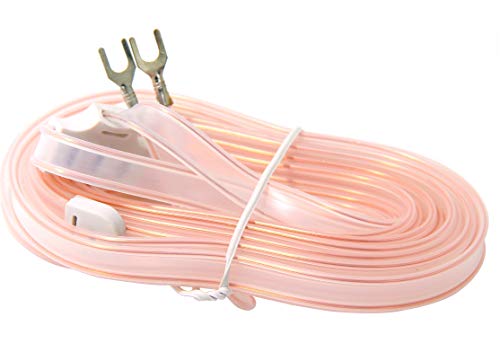
For a vintage receiver with 300-ohm clip or terminal inputs, this T-shaped dipole is the most direct match among these choices. The antenna has spade terminals and a 5.9-foot cable, and the maker says it fits receivers with a clip or terminal FM socket. The flat dipole can be stretched away from the receiver, which gives you room to adjust placement. This is a single antenna, so it is less useful if you want a spare. Confirm your receiver has matching 300-ohm terminals before choosing it.
Bottom line: Choose this if your receiver has 300-ohm clip or terminal inputs.
Kaunosta Magnetic-Base Adapter Antenna
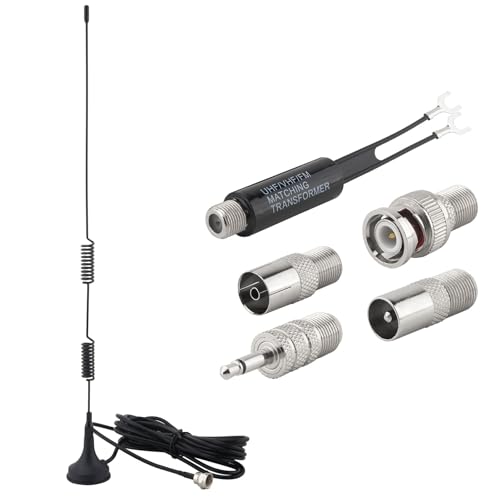
For a vintage receiver whose antenna connection is uncertain, this model stands out for its range of included adapters. It has a 10-foot coaxial extension and a magnetic-base, with PAL, BNC, 3.5mm, and 75-to-300-ohm adapters among the accessories. That can help when the receiver’s input does not match a basic spade-terminal dipole. The magnetic-base is useful where a metal mounting surface is available. Adapter variety does not guarantee a fit for every vintage tuner, so identify the receiver’s input and check the adapter connection before ordering.
Bottom line: Choose this if you need several connector options and an impedance adapter.
ALMOCN Two-Pack 300-Ohm Dipoles

Unlike the single-antenna choices, this package includes two T-shaped, 300-ohm dipoles with bare-wire connectors. That makes it a practical choice when you want a spare or need antennas for two compatible receivers. Each antenna has a 5.9-foot cable, and the maker recommends stretching the ends away from the receiver for reception. The bare-wire connection differs from the spade terminals on Ancable 300-Ohm T Dipole, so check how your receiver accepts 300-ohm leads. This is not the most flexible option for a receiver with a coaxial 75-ohm input.
Bottom line: Choose this if you want two 300-ohm antennas and your receiver accepts bare-wire leads.
Bingfu 75-Ohm Adhesive Dipole

For a receiver with a 75-ohm coaxial FM input, this dipole offers an adhesive wall-mounting option rather than 300-ohm spade terminals. Its 10-foot coaxial cable ends in an F-type plug, and the package includes TV female, 3.5mm audio, and TV male adapters. The adhesive backing can keep the antenna positioned on a suitable wall, while the cable allows some separation from the receiver. The adapters do not include a 75-to-300-ohm adapter, so this is a less direct fit for a receiver with only 300-ohm terminals.
Bottom line: Choose this for a 75-ohm input and an adhesive wall-mounting location.
Magnetic-Base 75-Ohm Antenna

This antenna has the longest specified cable here at 16.4 feet, giving more room to position it away from a vintage receiver. The maker describes a retractable antenna and a magnetic-base intended to sit on a metal surface; the connection is 75 ohms. That combination may suit a tuner with a 75-ohm coaxial input and a nearby metal mounting point. Unlike Kaunosta Magnetic-Base Adapter Antenna, it does not include a range of adapters in the features. Check the receiver’s input before choosing it, especially if the tuner has 300-ohm terminals.
Bottom line: Choose this if your receiver has a 75-ohm input and you need a longer cable.
How to Match an FM Antenna to a Vintage Receiver
Start with the receiver’s FM terminals: a 300-ohm input uses two terminals, while a 75-ohm input uses coaxial cable. A twin-lead dipole with spade or bare-wire ends is intended for 300-ohm terminals; a coaxial antenna connects to a 75-ohm input through its matching connector. An impedance adapter can bridge 75 and 300 ohms, but it does not make an incompatible physical plug fit without the right connector. If the receiver has both inputs, use the one that matches the antenna directly. With only 300-ohm terminals, choose a 300-ohm dipole or an antenna with a 75-to-300-ohm adapter, rather than assuming any FM antenna will connect.
Where to Place an Indoor FM Dipole
Place a dipole as high and unobstructed as practical, then spread its two arms into a T shape for a starting position. FM broadcasts occupy 88 to 108 MHz, where a half-wave dipole is roughly 4.5 to 5.5 feet long overall; compact indoor antennas may not span that full length, so orientation and location still matter. Keep the antenna away from large metal objects and electronics that can obstruct or interfere with reception. If reception is weak, move the antenna to a different wall or window area and rotate it before changing equipment. A magnetic-base needs a metal surface to attach securely, while adhesive mounting requires a clean, suitable wall surface.
75-Ohm Coax and 300-Ohm Twin-Lead Compared
Choose between coax and twin-lead by the receiver input and the installation environment. Coax uses a shielded cable and typically ends in a plug such as F-type; twin-lead is a two-conductor line for 300-ohm terminals. The following table maps the common input to the matching antenna connection. An adapter can change impedance or connector format, but it cannot compensate for a poor antenna position. Keep twin-lead away from metal surfaces where possible, and avoid sharp bends or pinching any antenna cable, which can affect its geometry or connection.
| Receiver FM input | Matching antenna connection | Useful check |
|---|---|---|
| 300-ohm twin terminals | Two-wire dipole leads | Match bare wire or spade ends |
| 75-ohm coax input | 75-ohm coaxial cable | Match the plug or use a connector adapter |
| One input type, other antenna type | Impedance adapter plus matching plug | Verify both impedance and connector |
Frequently Asked Questions
How should I orient a T-shaped FM antenna?
Start with the antenna arms spread horizontally, then rotate the T and test reception. FM reception can change with the direction of the broadcast signal, so small placement changes near a window or exterior wall may help.
Can I connect a 300-ohm antenna to a 75-ohm receiver?
Yes, use a 75-to-300-ohm matching transformer along with any connector adapter the receiver needs. The matching transformer addresses impedance; it does not automatically change an incompatible plug into the right physical connector.
How long should an FM dipole antenna be?
A half-wave dipole for the 88–108 MHz FM band is roughly 4.5 to 5.5 feet long overall. Indoor antennas may use shorter conductors, so placement and orientation can affect reception.
Will an indoor FM antenna work in a basement?
An indoor antenna can receive FM in a basement, but concrete, earth, and metal reinforcement can weaken signals. If reception is poor, try a higher position near a window or exterior wall, and reposition the antenna before settling on a location.